Tansel Aylin, Katz Lior H, El-Serag Hashem B, Thrift Aaron P, Parepally Mayur, Shakhatreh Mohammad H, Kanwal Fasiha
Section of Gastroenterology and Hepatology, Department of Medicine, Baylor College of Medicine, Houston, Texas.
The Department of Gastroenterology, Sheba Medical Center and Sackler Faculty of Medicine, Tel-Aviv University, Tel-Hashomer, Israel.
Clin Gastroenterol Hepatol. 2017 Aug;15(8):1207-1217.e4. doi: 10.1016/j.cgh.2017.02.006. Epub 2017 Feb 12.
BACKGROUND & AIMS: The risk of hepatocellular carcinoma (HCC) in patients with autoimmune hepatitis (AIH) is unclear. We conducted a systematic review and meta-analysis of the incidence of HCC and associated risk factors among patients with AIH.
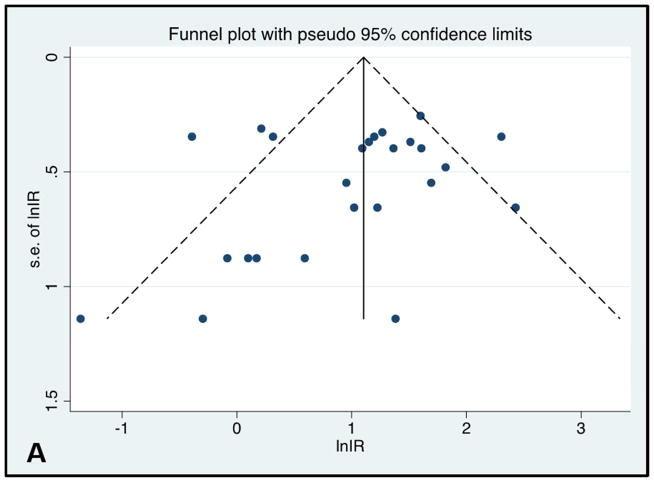
We searched PubMed, Embase, and reference lists from relevant articles through June 2016 to identify cohort studies that examined the incidence of HCC in patients with AIH. We used random effects models to estimate pooled incidence rates overall and in subgroup of patients with cirrhosis. The between-study heterogeneity was assessed using I statistic.
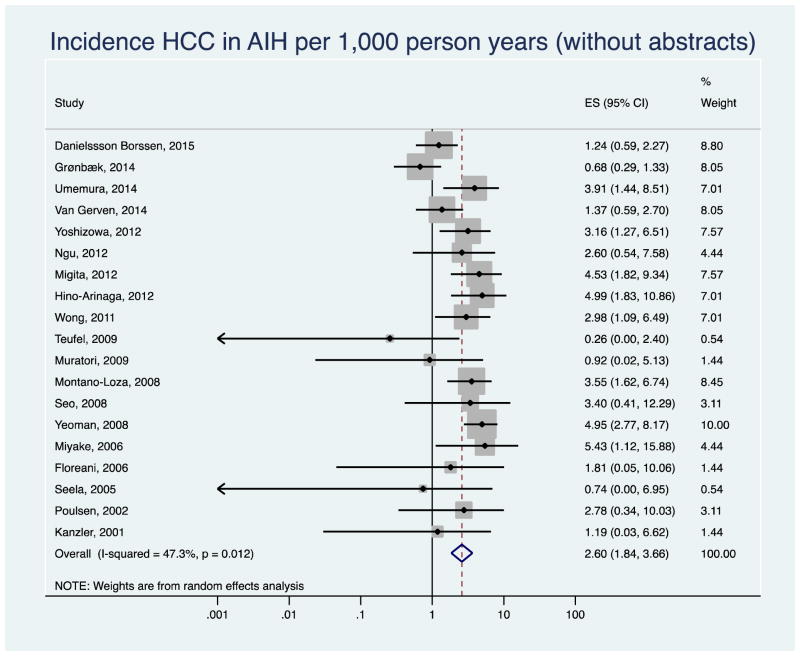
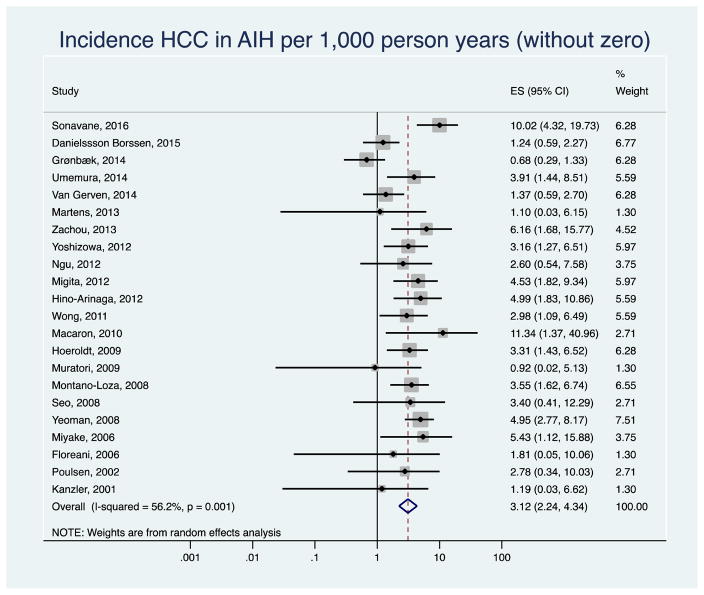
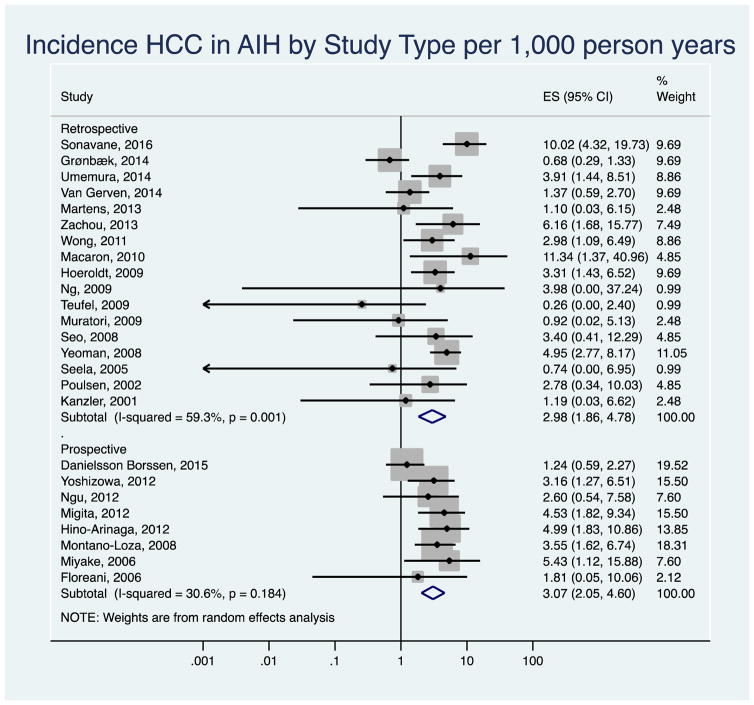
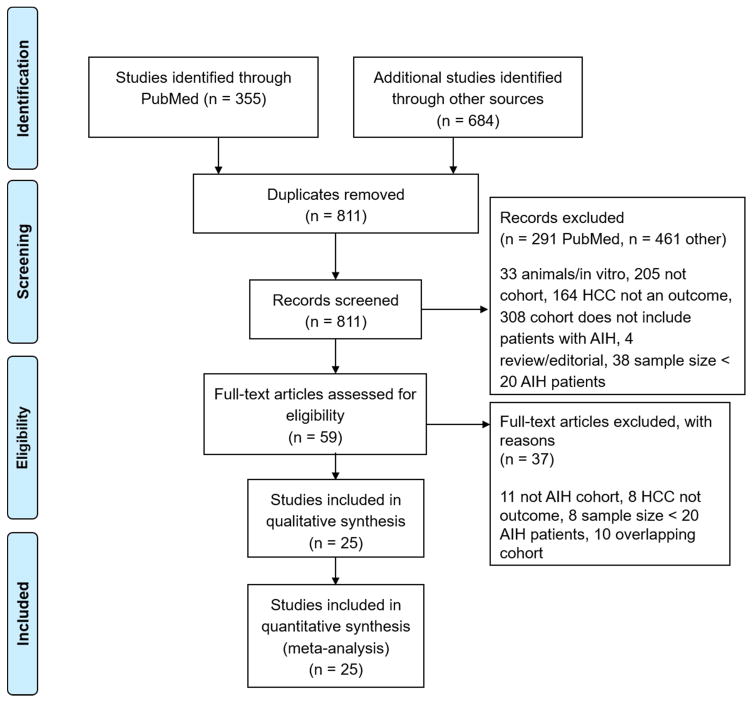
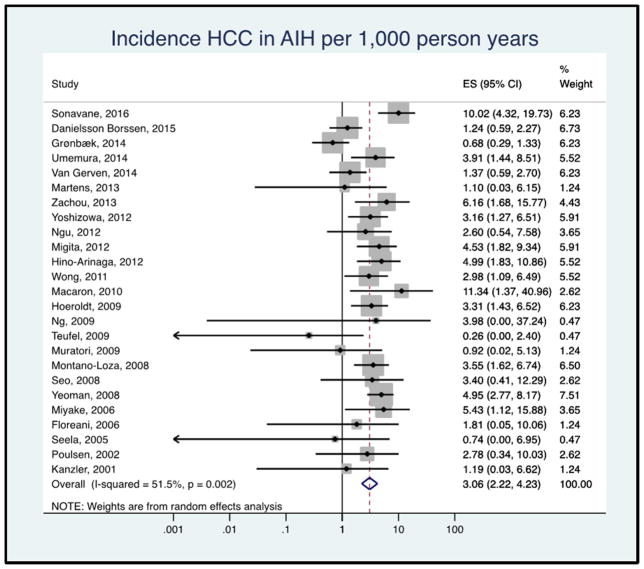
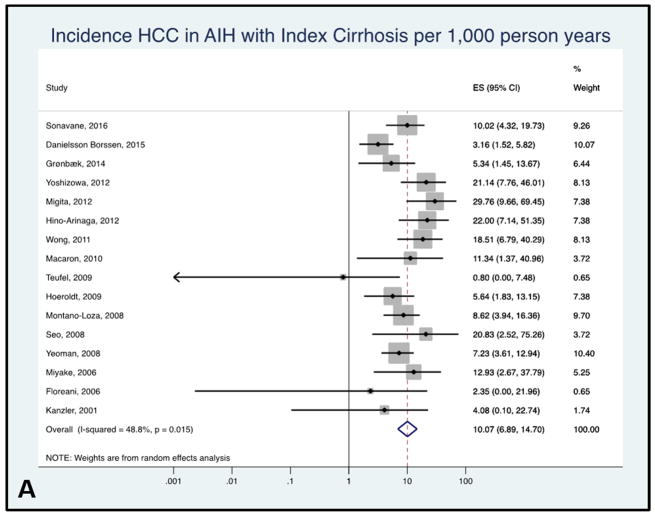
A total of 25 studies (20 papers and 5 abstracts), including 6528 patients, met the eligibility criteria. The median cohort size was 170 patients with AIH (range, 25-1721 patients), followed for a median of 8.0 years (range, 3.3-16.0 years). The pooled incidence rate for HCC in patients with AIH was 3.06 per 1000 patient-years (95% confidence interval, 2.22-4.23; I = 51.5%; P = .002). The pooled incidence of HCC in patients with cirrhosis at AIH diagnosis was 10.07 per 1000 patient-years (95% confidence interval, 6.89-14.70; I = 48.8%; P = .015). In addition, 92 of 93 patients who had HCC had evidence of cirrhosis before or at the time of their HCC diagnosis. The risk of HCC seems to be lower in patients with AIH and cirrhosis than that reported for patients with cirrhosis from hepatitis B, hepatitis C, or primary biliary cholangitis.
Based on the increased risked of HCC shown in this meta-analysis, there may be a role for HCC surveillance in patients with AIH and cirrhosis.
自身免疫性肝炎(AIH)患者发生肝细胞癌(HCC)的风险尚不清楚。我们对AIH患者中HCC的发病率及相关危险因素进行了一项系统评价和荟萃分析。
我们检索了截至2016年6月的PubMed、Embase以及相关文章的参考文献列表,以确定研究AIH患者中HCC发病率的队列研究。我们使用随机效应模型来估计总体及肝硬化患者亚组的合并发病率。采用I²统计量评估研究间的异质性。
共有25项研究(20篇论文和5篇摘要),包括6528例患者,符合纳入标准。队列规模中位数为170例AIH患者(范围为25 - 1721例患者),随访时间中位数为8.0年(范围为3.3 - 16.0年)。AIH患者中HCC的合并发病率为每1000患者年3.06例(95%置信区间为2.22 - 4.23;I² = 51.5%;P = 0.002)。AIH诊断时伴有肝硬化的患者中HCC的合并发病率为每1000患者年10.07例(95%置信区间为6.89 - 14.70;I² = 48.8%;P = 0.015)。此外,93例发生HCC的患者中有92例在HCC诊断之前或之时有肝硬化证据。AIH合并肝硬化患者发生HCC的风险似乎低于乙型肝炎、丙型肝炎或原发性胆汁性胆管炎所致肝硬化患者报告的风险。
基于该荟萃分析显示的HCC风险增加,对AIH合并肝硬化患者进行HCC监测可能有必要。