Johnson Carl Hirschie, Zhao Chi, Xu Yao, Mori Tetsuya
Department of Biological Sciences, Vanderbilt University, 465 21st Avenue South, Nashville, Tennessee 37235, USA.
Nat Rev Microbiol. 2017 Apr;15(4):232-242. doi: 10.1038/nrmicro.2016.196. Epub 2017 Feb 20.
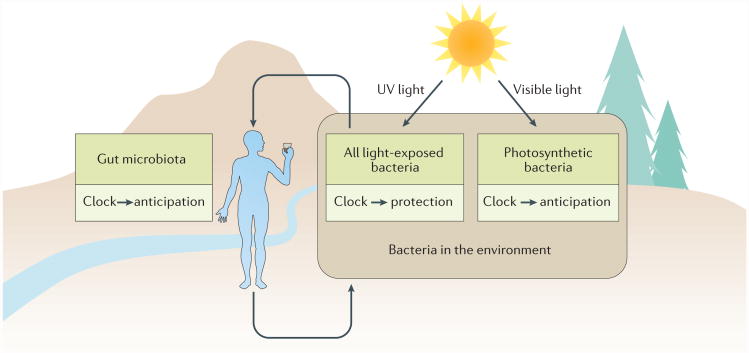
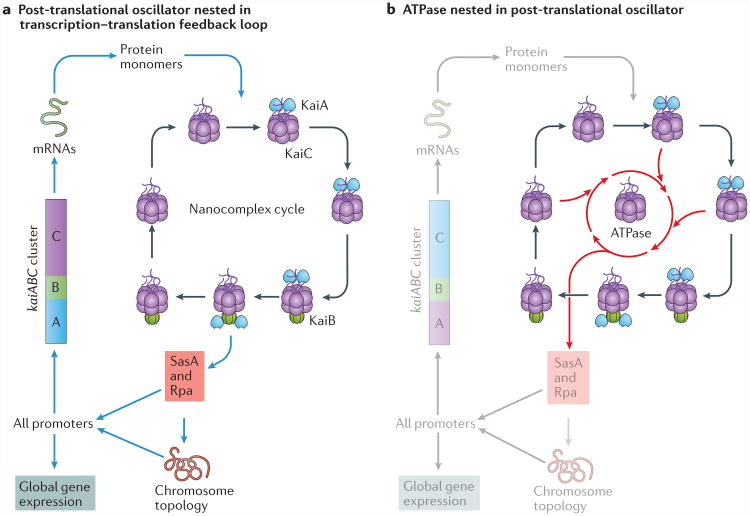
Chronobiological studies of prokaryotic organisms have generally lagged far behind the study of endogenous circadian clocks in eukaryotes, in which such systems are essentially ubiquitous. However, despite only being studied during the past 25 years, cyanobacteria have become important model organisms for the study of circadian rhythms and, presently, their timekeeping mechanism is the best understood of any system in terms of biochemistry, structural biology, biophysics and adaptive importance. Nevertheless, intrinsic daily rhythmicity among bacteria other than cyanobacteria is essentially unknown; some tantalizing information suggests widespread daily timekeeping among Eubacteria and Archaea through mechanisms that share common elements with the cyanobacterial clock but are distinct. Moreover, the recent surge of information about microbiome-host interactions has largely neglected the temporal dimension and yet daily cycles control important aspects of their relationship.
对原核生物的生物钟学研究总体上远远落后于对真核生物内源性生物钟的研究,在真核生物中,此类系统基本无处不在。然而,尽管蓝细菌仅在过去25年中得到研究,但它们已成为研究昼夜节律的重要模式生物,目前,就生物化学、结构生物学、生物物理学和适应性重要性而言,其计时机制是所有系统中最清楚的。尽管如此,除蓝细菌外的其他细菌的内在每日节律基本上是未知的;一些诱人的信息表明,通过与蓝细菌生物钟有共同元素但又不同的机制,真细菌和古细菌中广泛存在每日计时现象。此外,最近关于微生物组与宿主相互作用的大量信息在很大程度上忽略了时间维度,然而,每日周期控制着它们关系的重要方面。