Jaan Sumiya, Sehgal Ashish, Wani Rauf Ahmad, Wani Muneer Ahmad, Wani Khursheed Alam, Laway Bashir Ahmad
Department of General and Minimal Access Surgery, Sher-I-Kashmir Institute of Medical Sciences, Srinagar, Jammu and Kashmir, India.
Department of Endocrinology, Sher-I-Kashmir Institute of Medical Sciences, Srinagar, Jammu and Kashmir, India.
Indian J Endocrinol Metab. 2017 Jan-Feb;21(1):51-55. doi: 10.4103/2230-8210.195997.
Total thyroidectomy (TT) is a commonly performed surgery and postoperative hypocalcemia is a major detriment to early discharge. The aim of this randomized controlled trial was to ascertain the usefulness of routine pre- and post-operative calcium and Vitamin D supplementation in prevention of hypocalcemia after TT.
Sixty consecutive patients who underwent total or near TT from February 2013 to August 2014 were included in the study. They were randomly divided into two groups - Group 1 received oral calcium (500 mg every 6 h) and Vitamin D (calcitriol 0.25 mcg every 6 h) 7 days before and 7 days after the surgery; and Group 2 did not receive supplementation. Symptoms and signs of hypocalcemia were monitored. Calcium profile was measured pre- and post-operatively at 6, 12, 24, 48, 72 h, and on 30 day. Hypocalcemia after surgery was either symptomatic or laboratory documented. Serum calcium level ≤ 8.5 mg/dl was considered as laboratory hypocalcemia.
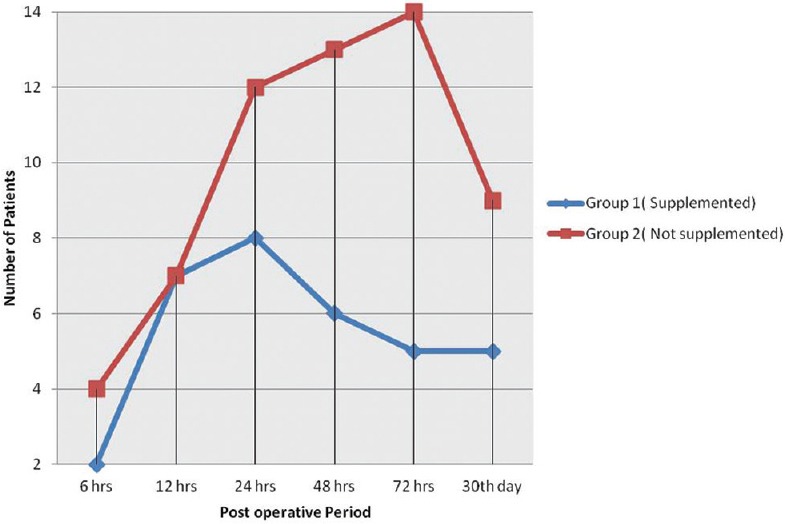
Twelve patients from Group 2, and 3 patients from Group 1 developed symptomatic hypocalcemia ( < 0.01). Laboratory hypocalcemia within postoperative 24 h was comparable between two groups, but more patients of Group 2 compared to Group 1 developed hypocalcemia at 48 h (6 and 13, respectively; = 0.04) and at 72 h after surgery (5 and 14, respectively; = 0.01). Twenty-four hours postoperative serum calcium level was significantly associated with grade of goiter, preoperative calcium, and nature of thyroid disease (benign or malignant). On multiple linear regression analysis, preoperative serum calcium was only independent variable significantly associated with development of 24 h post-TT hypocalcemia.
Routine pre- and post-TT calcium and Vitamin D supplementation can significantly reduce postoperative hypocalcemia.
全甲状腺切除术(TT)是一种常见的手术,术后低钙血症是早期出院的主要不利因素。本随机对照试验的目的是确定术前和术后常规补充钙和维生素D在预防TT术后低钙血症中的作用。
纳入2013年2月至2014年8月连续接受全甲状腺或近全甲状腺切除术的60例患者。他们被随机分为两组——第1组在手术前7天和手术后7天接受口服钙(每6小时500毫克)和维生素D(骨化三醇每6小时0.25微克);第2组不接受补充剂。监测低钙血症的症状和体征。在术前以及术后6、12、24、48、72小时和30天时测量血钙情况。术后低钙血症通过症状或实验室记录确诊。血清钙水平≤8.5毫克/分升被视为实验室低钙血症。
第2组有12例患者,第1组有3例患者出现症状性低钙血症(P<0.01)。术后24小时内两组实验室低钙血症情况相当,但第2组在术后48小时(分别为6例和13例;P = 0.04)和术后72小时(分别为5例和14例;P = 0.01)发生低钙血症的患者比第1组多。术后24小时血清钙水平与甲状腺肿等级、术前血钙以及甲状腺疾病性质(良性或恶性)显著相关。多元线性回归分析显示,术前血清钙是与TT术后24小时低钙血症发生显著相关的唯一独立变量。
TT术前和术后常规补充钙和维生素D可显著降低术后低钙血症的发生。