Ravikumar Krishnan, Sadacharan Dhalapathy, Muthukumar Sankaran, Sundarram Thalavai, Periyasamy Selladurai, Suresh R V
Department of Endocrine Surgery, Christian Medical College, Vellore, Chennai, Tamil Nadu, India.
Department of Endocrine Surgery, Madras Medical College, Chennai, Tamil Nadu, India.
Indian J Endocrinol Metab. 2017 Jul-Aug;21(4):498-503. doi: 10.4103/ijem.IJEM_402_16.
Postoperative transient hypocalcemia is sequelae of total thyroidectomy (TT), which is observed in up to 50% of patients. Routine oral calcium and Vitamin D supplementation have been proposed to prevent symptomatic hypocalcemia preventing morbidity and facilitating early discharge.
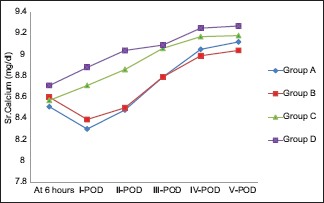
A total of 208 patients with nontoxic benign thyroid disorders, undergoing TT, were serially randomized into four groups: Group A (no supplements were given), Group B (oral calcium - 2 g/day given), Group C (calcium and calcitriol - 1 mcg/day are given), and Group D (calcium, calcitriol, and cholecalciferol - 60,000 IU/day are given). Patients were monitored for clinical and biochemical hypocalcemia (serum calcium, [Sr. Ca] <8 mg/dl), along with serum intact parathormone (Sr. PTH) and magnesium 6 h after surgery and Sr. Ca every 24 h. Intravenous (IV) calcium infusion was started, if any of the above four groups exhibit frank hypocalcemia. Patients are followed up with Sr. Ca and Sr. PTH at 3 and 6 months.
All groups were age and sex matched. Hypocalcemia was observed in 72/208 (34.61%) cases. Incidence of hypocalcemia was higher in Group A (57.69%) and Group B (50%) compared to Group C (15.38%) and Group D (15.38%). Hypocalcemia necessitating IV calcium occurred in 31/208 (14.90%) patients. IV calcium requirement exceeded in Group A (26.92%) and Group B (23.07%) compared to Group C (5.76%) and Group D (3.84%). There was no statistical difference in basal levels of serum Vitamin D, calcium, magnesium, intact PTH, and 6 h after surgery. Permanent hypoparathyroidism developed in five patients on follow-up.
Routine postoperative supplementation of oral calcium and Vitamin D will help in the prevention of postthyroidectomy transient hypocalcemia significantly. Preoperative Vitamin D levels do not predict postoperative hypocalcemia.
术后短暂性低钙血症是全甲状腺切除术(TT)的后遗症,高达50%的患者会出现这种情况。有人提出常规口服钙和维生素D补充剂可预防有症状的低钙血症,从而预防发病并促进早期出院。
总共208例患有非毒性良性甲状腺疾病并接受TT的患者被连续随机分为四组:A组(未给予补充剂)、B组(给予口服钙——每天2克)、C组(给予钙和骨化三醇——每天1微克)和D组(给予钙、骨化三醇和胆钙化醇——每天60,000国际单位)。术后6小时监测患者的临床和生化低钙血症(血清钙,[Sr.Ca]<8mg/dl),以及血清完整甲状旁腺激素(Sr.PTH)和镁,并每24小时监测一次Sr.Ca。如果上述四组中的任何一组出现明显的低钙血症,则开始静脉输注钙。在3个月和6个月时对患者进行Sr.Ca和Sr.PTH的随访。
所有组在年龄和性别上匹配。208例中有72例(34.61%)出现低钙血症。与C组(15.38%)和D组(15.38%)相比,A组(57.69%)和B组(50%)的低钙血症发生率更高。208例中有31例(14.90%)患者需要静脉补钙。与C组(5.76%)和D组(3.84%)相比,A组(26.92%)和B组(23.07%)对静脉补钙量的需求更高。血清维生素D、钙、镁、完整PTH的基础水平以及术后6小时的水平无统计学差异。随访中有5例患者发生永久性甲状旁腺功能减退。
术后常规补充口服钙和维生素D将有助于显著预防甲状腺切除术后短暂性低钙血症。术前维生素D水平不能预测术后低钙血症。