Packianathan Raj, Hodge Andrew, Bruellke Natalie, Davis Kylie, Maeder Steven
Zoetis Australia Research and Manufacturing Pty Ltd, Veterinary Medicine Research and Development, Level 6, 5 Rider Boulevard, Rhodes, NSW, 2138, Australia.
Zoetis, Veterinary Medicine Research and Development, 333 Portage St, Kalamazoo, MI, 49007, USA.
Parasit Vectors. 2017 Feb 21;10(1):98. doi: 10.1186/s13071-017-2024-9.
The Australian paralysis tick, Ixodes holocyclus, causes paralysis predominantly in dogs and cats in the Eastern coastal regions of Australia. Rapid onset of effect of a parasiticide is critical to minimize the deleterious effects of these tick infestations, especially tick paralysis caused by the salivary neurotoxin. The speed of kill of a novel orally administered isoxazoline parasiticide, sarolaner chewable tablets (Simparica), against I. holocyclus on dogs was evaluated and compared with afoxolaner (NexGard) for 5 weeks after a single oral dose.
Twenty-four (24) dogs were randomly allocated to treatment with either placebo, sarolaner (label dose of 2 to 4 mg/kg as per dosing table), or afoxolaner (label dose of 2.7 to 6.9 mg/kg) based on pre-treatment body weights. Following artificial infestation on Day -1, dogs were examined and live ticks counted at 8, 12, 24 and 48 h after treatment on Day 0, and at 12, 24 and 48 h after subsequent re-infestations on Days 7, 14, 21, 28 and 35. Efficacy was determined at each time point relative to counts for placebo dogs based on geometric means.
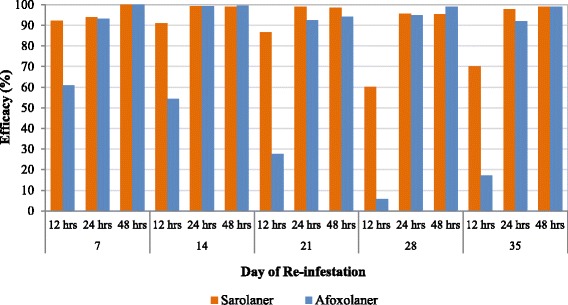
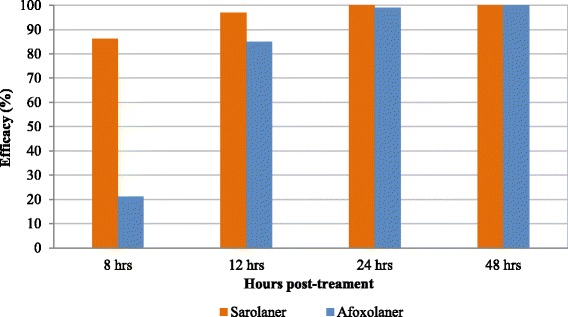
At 8 and 12 h time points on Day 0, sarolaner-treated dogs had significantly lower geometric mean tick counts compared to the dogs treated with afoxolaner (P ≤ 0.0303). Efficacy of sarolaner against an existing infestation was 86.2 and 96.9% compared with that of afoxolaner which had efficacy of 21.3 and 85.0% at 8 and 12 h time points, respectively. Against subsequent weekly re-infestations at 12 h time points, treatment with sarolaner resulted in significantly lower geometric mean tick counts than afoxolaner-treated dogs on all days (P ≤ 0.0077) with the efficacy ranging from 60.2 to 92.2%, compared to 5.8 to 61.0% in the afoxolaner-treated dogs. Against subsequent weekly re-infestations at the 24 h time points on Days 22 and 36, efficacy of sarolaner was significantly higher at 99.2 and 97.9%, respectively, compared with afoxolaner which had efficacy of 92.4 and 91.9% (P ≤ 0.0356). At the 48 h time points following each of the five weekly re-infestations, the mean efficacy results of sarolaner and afoxolaner treated dogs were similar on most occasions. There were no adverse reactions to treatments.
In this controlled laboratory evaluation, a single dose of sarolaner had a significantly faster speed of kill against an existing infestation of I. holocyclus, than afoxolaner at 8 and 12 h post-treatment. The rapid and consistent kill of ticks provided by sarolaner within 24 h after a single oral dose and following weekly re-infestations over 35 days suggests this treatment will provide highly effective, rapid and reliable control of ticks over the entire treatment interval, thereby minimizing the risk of tick paralysis in dogs.
澳大利亚麻痹蜱(全环硬蜱)主要在澳大利亚东部沿海地区的犬猫中引起麻痹。杀虫剂起效迅速对于将这些蜱虫侵扰的有害影响降至最低至关重要,尤其是由唾液神经毒素引起的蜱麻痹。评估了一种新型口服异恶唑啉类杀虫剂沙罗拉纳咀嚼片(Simparica)对犬身上的全环硬蜱的杀蜱速度,并与阿福拉纳(NexGard)在单次口服给药后5周内进行了比较。
根据治疗前体重将24只犬随机分配接受安慰剂、沙罗拉纳(根据给药表标记剂量为2至4mg/kg)或阿福拉纳(标记剂量为2.7至6.9mg/kg)治疗。在第-1天人工感染后,于第0天治疗后8、12、24和48小时,以及在第7、14、21、28和35天随后再次感染后12、24和48小时对犬进行检查并计数存活蜱虫。根据几何平均数,相对于安慰剂组犬的计数,在每个时间点确定疗效。
在第0天的8和12小时时间点,沙罗拉纳治疗的犬的几何平均蜱计数显著低于阿福拉纳治疗的犬(P≤0.0303)。沙罗拉纳对现有感染的疗效分别为86.2%和96.9%,而阿福拉纳在8和12小时时间点的疗效分别为21.3%和85.0%。在随后每周12小时时间点的再次感染中,沙罗拉纳治疗导致所有天数的几何平均蜱计数显著低于阿福拉纳治疗的犬(P≤0.0077),疗效范围为60.2%至92.2%,而阿福拉纳治疗的犬为5.8%至61.0%。在第22天和36天24小时时间点随后每周的再次感染中,沙罗拉纳的疗效分别显著高于阿福拉纳,为99.2%和97.9%,而阿福拉纳的疗效为92.4%和91.9%(P≤0.0356)。在每周5次再次感染后的48小时时间点,大多数情况下沙罗拉纳和阿福拉纳治疗的犬的平均疗效结果相似。治疗未出现不良反应。
在这项对照实验室评估中,单剂量沙罗拉纳在治疗后8和12小时对现有全环硬蜱感染的杀蜱速度明显快于阿福拉纳。沙罗拉纳在单次口服给药后24小时内以及在35天内每周再次感染后对蜱虫的快速且持续杀灭表明,这种治疗将在整个治疗期间提供高效、快速且可靠的蜱虫控制,从而将犬蜱麻痹的风险降至最低。