Burton Derek F, Zhang Chengjin, Boa-Amponsem Oswald, Mackinnon Shanta, Cole Gregory J
Julius L. Chambers Biomedical/Biotechnology Research Institute, United States; Department of Biological and Biomedical Sciences, United States.
Julius L. Chambers Biomedical/Biotechnology Research Institute, United States.
Neurotoxicol Teratol. 2017 May;61:66-73. doi: 10.1016/j.ntt.2017.01.006. Epub 2017 Feb 20.
Developmental exposure to ethanol is recognized to produce long-term neurobehavioral impairment in multiple animal models. However, the molecular mechanisms underlying these deficits remain poorly understood. The present study was undertaken to ascertain whether two well-characterized targets of prenatal alcohol exposure, sonic hedgehog (Shh) and retinoic acid (RA), that induce the hallmark morphological phenotypes of fetal alcohol spectrum disorders (FASD), are involved in the generation of behavioral alterations as a result of alcohol exposure.
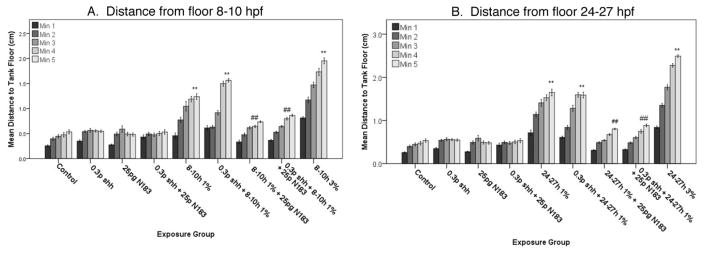
Zebrafish embryos were exposed to ethanol (0%, 1%, 3%) at either 8-10 or 24-27h post-fertilization (hpf) and then evaluated during adolescence in the novel tank dive test to assess anxiety and risk-taking behavior. Overt signs of dysmorphogenesis were also scored and behavioral and morphological changes were compared for embryos treated with alcohol alone or in combination with subthreshold doses of shh or alhh1a3 morpholinos (MOs).
Ethanol treated fish displayed altered tank diving behavior that was not exacerbated by combined MO treatment. While treatment of embryos with either shha mRNA or RA prior to ethanol exposure only ameliorated the altered tank diving response in the case of shha mRNA overexpression, dysmorphogenesis was rescued by both treatments.
These results suggest that the effects of ethanol exposure on changes in anxiety and risk-taking behavior in adolescent zebrafish is manifested by a blunting of Shh, but not RA, signaling during early development.
在多种动物模型中,发育期接触乙醇会导致长期神经行为损伤。然而,这些缺陷背后的分子机制仍知之甚少。本研究旨在确定产前酒精暴露的两个特征明确的靶点,即诱导胎儿酒精谱系障碍(FASD)标志性形态学表型的音猬因子(Shh)和视黄酸(RA),是否参与了酒精暴露导致的行为改变的产生。
在受精后8 - 10小时或24 - 27小时,将斑马鱼胚胎暴露于乙醇(0%、1%、3%)中,然后在青春期通过新水箱潜水试验评估焦虑和冒险行为。对形态发生异常的明显迹象进行评分,并比较单独用酒精处理或与亚阈值剂量的shh或alhh1a3吗啉代寡核苷酸(MOs)联合处理的胚胎的行为和形态变化。
乙醇处理的鱼表现出改变的水箱潜水行为,联合MO处理并未使其加剧。虽然在乙醇暴露前用shha mRNA或RA处理胚胎,仅在shha mRNA过表达的情况下改善了改变的水箱潜水反应,但两种处理都挽救了形态发生异常。
这些结果表明,乙醇暴露对青少年斑马鱼焦虑和冒险行为变化的影响,在早期发育过程中表现为Shh信号的减弱,而非RA信号的减弱。