Bain Earle E, Shafner Laura, Walling David P, Othman Ahmed A, Chuang-Stein Christy, Hinkle John, Hanina Adam
AbbVie Inc., North Chicago, IL, United States.
AiCure, LLC, New York, NY, United States.
JMIR Mhealth Uhealth. 2017 Feb 21;5(2):e18. doi: 10.2196/mhealth.7030.
Accurately monitoring and collecting drug adherence data can allow for better understanding and interpretation of the outcomes of clinical trials. Most clinical trials use a combination of pill counts and self-reported data to measure drug adherence, despite the drawbacks of relying on these types of indirect measures. It is assumed that doses are taken, but the exact timing of these events is often incomplete and imprecise.
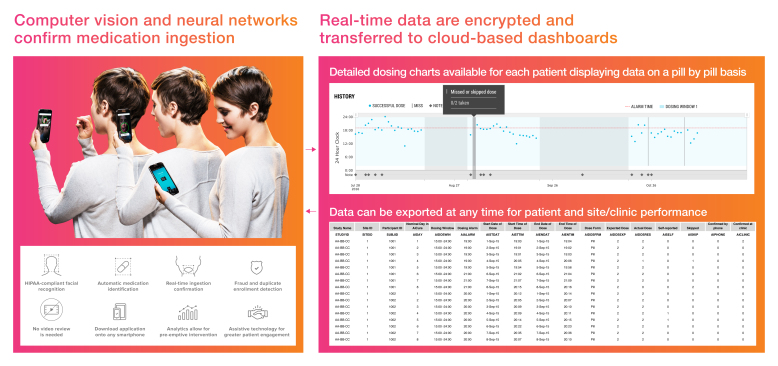
The objective of this pilot study was to evaluate the use of a novel artificial intelligence (AI) platform (AiCure) on mobile devices for measuring medication adherence, compared with modified directly observed therapy (mDOT) in a substudy of a Phase 2 trial of the α7 nicotinic receptor agonist (ABT-126) in subjects with schizophrenia.
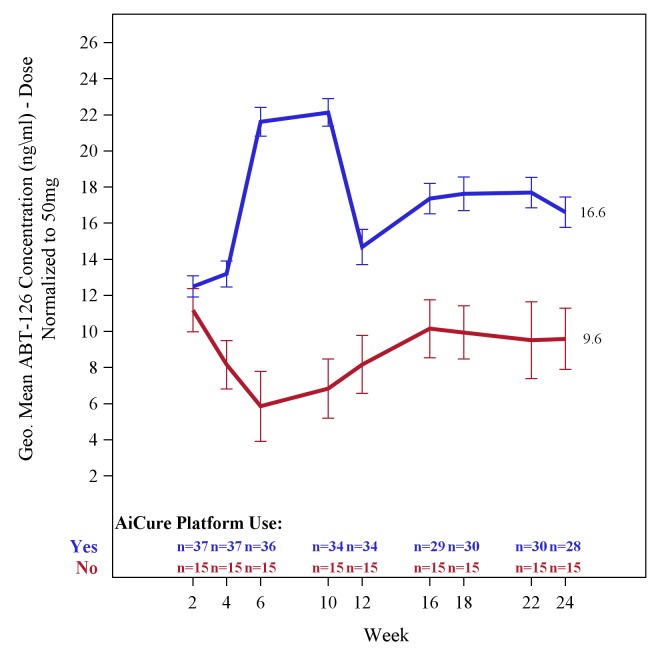
AI platform generated adherence measures were compared with adherence inferred from drug concentration measurements.
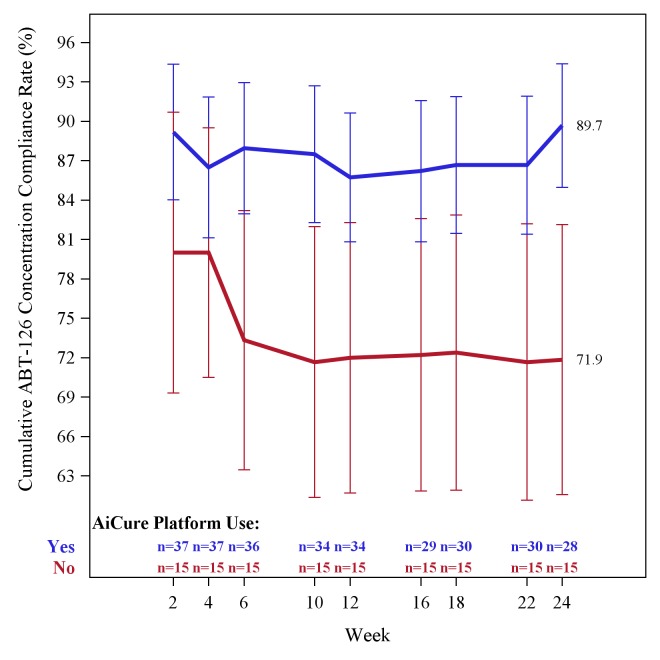
The mean cumulative pharmacokinetic adherence over 24 weeks was 89.7% (standard deviation [SD] 24.92) for subjects receiving ABT-126 who were monitored using the AI platform, compared with 71.9% (SD 39.81) for subjects receiving ABT-126 who were monitored by mDOT. The difference was 17.9% (95% CI -2 to 37.7; P=.08).
Using drug levels, this substudy demonstrates the potential of AI platforms to increase adherence, rapidly detect nonadherence, and predict future nonadherence. Subjects monitored using the AI platform demonstrated a percentage change in adherence of 25% over the mDOT group. Subjects were able to use the technology successfully for up to 6 months in an ambulatory setting with early termination rates that are comparable to subjects outside of the substudy.
ClinicalTrials.gov NCT01655680 https://clinicaltrials.gov/ct2/show/NCT01655680?term=NCT01655680.
准确监测和收集药物依从性数据有助于更好地理解和解释临床试验结果。尽管依赖这些间接测量方法存在缺点,但大多数临床试验仍使用药丸计数和自我报告数据相结合的方式来衡量药物依从性。人们假定药物剂量已服用,但这些事件的确切时间往往不完整且不准确。
本试点研究的目的是在一项针对精神分裂症患者的α7烟碱受体激动剂(ABT - 126)的2期试验的子研究中,评估一种新型移动设备人工智能(AI)平台(AiCure)在测量药物依从性方面的应用,并与改良直接观察疗法(mDOT)进行比较。
将AI平台生成的依从性测量结果与从药物浓度测量推断出的依从性进行比较。
使用AI平台监测的接受ABT - 126治疗的受试者在24周内的平均累积药代动力学依从性为89.7%(标准差[SD]24.92),而通过mDOT监测的接受ABT - 126治疗的受试者为71.9%(SD 39.81)。差异为17.9%(95%CI -2至37.7;P = 0.08)。
通过药物水平,本项子研究证明了AI平台在提高依从性、快速检测不依从性以及预测未来不依从性方面的潜力。使用AI平台监测的受试者与mDOT组相比,依从性百分比变化为25%。受试者能够在门诊环境中成功使用该技术长达6个月,早期终止率与子研究之外的受试者相当。
ClinicalTrials.gov NCT01655680 https://clinicaltrials.gov/ct2/show/NCT01655680?term=NCT01655680