Tarantino Luciano, Busto Giuseppina, Nasto Aurelio, Fristachi Raffaele, Cacace Luigi, Talamo Maria, Accardo Catello, Bortone Sara, Gallo Paolo, Tarantino Paolo, Nasto Riccardo Aurelio, Di Minno Matteo Nicola Dario, Ambrosino Pasquale
Luciano Tarantino, Paolo Gallo, Paolo Tarantino, Department of Surgery, Interventional Hepatology Unit, Andrea Tortora Hospital, 84016 Pagani, Italy.
World J Gastroenterol. 2017 Feb 7;23(5):906-918. doi: 10.3748/wjg.v23.i5.906.
To treated with electrochemotherapy (ECT) a prospective case series of patients with liver cirrhosis and Vp3-Vp4- portal vein tumor thrombus (PVTT) from hepatocellular carcinoma (HCC), in order to evaluate the feasibility, safety and efficacy of this new non thermal ablative technique in those patients.
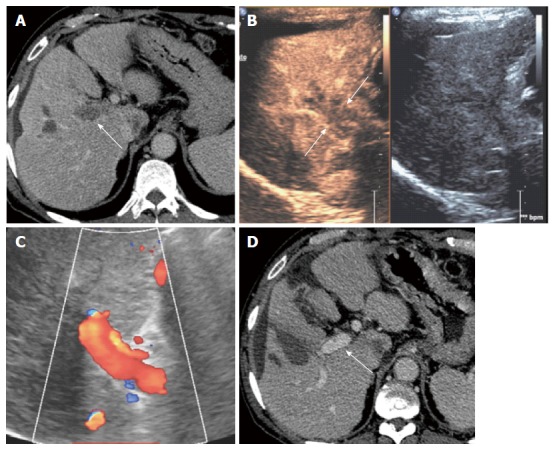
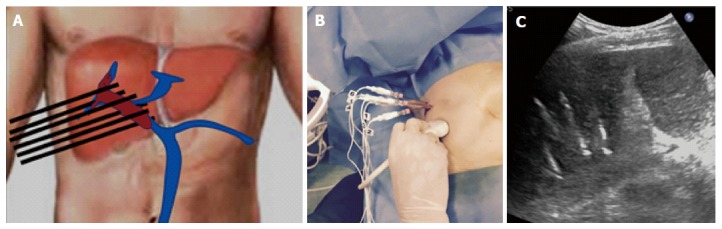
Six patients (5 males and 1 female), aged 61-85 years (mean age, 70 years), four in Child-Pugh A and two in Child-Pugh B class, entered our study series. All patients were studied with three-phase computed tomography (CT), contrast enhanced ultrasound (CEUS) and ultrasound-guided percutaneous biopsy of the thrombus before ECT. All patients underwent ECT treatment (Cliniporator Vitae, IGEA SpA, Carpi, Modena, Italy) of Vp3-Vp4 PVTT in a single session. At the end of the procedure a post-treatment biopsy of the thrombus was performed. Scheduled follow-up in all patients entailed: CEUS within 24 h after treatment; triphasic contrast-enhanced CT and CEUS at 3 mo after treatment and every six months thereafter.
Post-treatment CEUS showed complete absence of enhancement of the treated thrombus in all cases. Post-treatment biopsy showed apoptosis and necrosis of tumor cells in all cases. The follow-up ranged from 9 to 20 mo (median, 14 mo). In 2 patients, the follow-up CT and CEUS demonstrated complete patency of the treated portal vein. Other 3 patients showed a persistent avascular non-tumoral shrinked thrombus at CEUS and CT during follow-up. No local recurrence was observed at follow-up CT and CEUS in 5/6 patients. One patient was lost to follow-up because of death from gastrointestinal hemorrage 5 wk after ECT.
In patients with cirrhosis, ECT seems effective and safe for curative treatment of Vp3-Vp4 PVTT from HCC.
对一系列肝细胞癌(HCC)合并肝硬化及Vp3 - Vp4门静脉肿瘤血栓(PVTT)患者进行电化学疗法(ECT)治疗,以评估这种新型非热消融技术在这些患者中的可行性、安全性和有效性。
6例患者(5例男性,1例女性),年龄61 - 85岁(平均年龄70岁),Child - Pugh A级4例,Child - Pugh B级2例,进入我们的研究系列。所有患者在ECT治疗前均接受了三期计算机断层扫描(CT)、对比增强超声(CEUS)及超声引导下经皮血栓活检。所有患者均接受了一次ECT治疗(使用意大利摩德纳卡尔皮IGEA SpA公司的Cliniporator Vitae)治疗Vp3 - Vp4 PVTT。治疗结束后对血栓进行了治疗后活检。所有患者的定期随访包括:治疗后24小时内进行CEUS;治疗后3个月及此后每6个月进行三期对比增强CT和CEUS检查。
治疗后CEUS显示所有病例中治疗后的血栓均完全无强化。治疗后活检显示所有病例中肿瘤细胞均有凋亡和坏死。随访时间为9至20个月(中位数为14个月)。2例患者的随访CT和CEUS显示治疗后的门静脉完全通畅。另外3例患者在随访期间的CEUS和CT检查显示血栓持续无血管、非肿瘤性缩小。5/6例患者在随访CT和CEUS中未观察到局部复发。1例患者在ECT治疗后5周因胃肠道出血死亡而失访。
对于肝硬化患者,ECT似乎对HCC的Vp3 - Vp4 PVTT的根治性治疗有效且安全。