Pietrabissa Giada, Manzoni Gian Mauro, Rossi Alessandro, Castelnuovo Gianluca
Psychology Research Laboratory, Ospedale San Giuseppe, IRCSS Istituto Auxologico Italiano IRCCSVerbania, Italy; Department of Psychology, Catholic University of MilanMilan, Italy.
Psychology Research Laboratory, Ospedale San Giuseppe, IRCSS Istituto Auxologico Italiano IRCCSVerbania, Italy; Faculty of Psychology, eCampus UniversityNovedrate, Italy.
Front Psychol. 2017 Feb 7;8:83. doi: 10.3389/fpsyg.2017.00083. eCollection 2017.
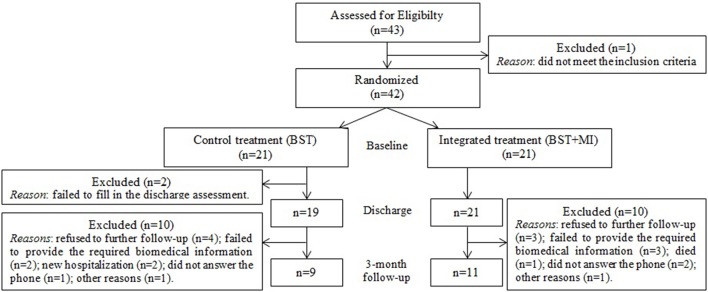
Psychological distress, biomedical parameters, and unhealthy lifestyles contribute to a poorer prognosis for cardiac disease. Public health's challenge is to motivate patients to utilize self-care. This prospective, randomized, single-blind pilot study aimed at testing the incremental efficacy of Brief Strategic Therapy (BST) combined with Motivational Interviewing (MI) in improving selected biomedical and psychological outcomes over and beyond those of the stand-alone BST in a residential Cardiac Rehabilitation (CR) program. Fourty-two inpatients (17 females), enrolled in a 1-month CR program, were randomly allocated into two conditions: (a) Three sessions of BST and (b) Three sessions of BST plus MI. Data were collected at baseline, discharge, and after 3 months through phone interviews. At discharge, no significant between-group difference was found in any outcome variable. Changes from pre- to post-treatment within each condition showed significant improvements only in the BST group, where the level of external regulation diminished, and both the participants' self-regulation (Relative Autonomous Motivation Index, RAI) and willingness to change improved. At the 3-month follow-up, within-group analyses on responders (BST = 9; BST + MI = 11) showed a statistically significant improvement in the level of systolic blood pressure in both groups. Findings showed no evidence of the incremental efficacy of combining BST and MI over and beyond BST alone on either selected biomedical or psychological outcomes among CR patients. Ends and limitations from the present pilot study should be considered and addressed in future investigations.
心理困扰、生物医学参数和不健康的生活方式会导致心脏病的预后较差。公共卫生面临的挑战是激励患者进行自我护理。这项前瞻性、随机、单盲的试点研究旨在测试在住院心脏康复(CR)项目中,简短策略疗法(BST)与动机性访谈(MI)相结合在改善特定生物医学和心理结果方面相对于单独使用BST的增效作用。42名参加为期1个月CR项目的住院患者(17名女性)被随机分为两组:(a)接受三次BST治疗;(b)接受三次BST加MI治疗。通过电话访谈在基线、出院时和3个月后收集数据。出院时,在任何结果变量上均未发现组间有显著差异。每个组内从治疗前到治疗后的变化仅在BST组中显示出显著改善,即外部调节水平降低,参与者的自我调节(相对自主动机指数,RAI)和改变意愿均有所提高。在3个月的随访中,对有反应者(BST组 = 9人;BST + MI组 = 11人)进行的组内分析显示,两组的收缩压水平均有统计学上的显著改善。研究结果表明,在CR患者中,将BST和MI相结合相对于单独使用BST在所选生物医学或心理结果方面没有增效作用的证据。本试点研究的结果和局限性应在未来的调查中予以考虑和解决。