Kruuk Loeske E B
Research School of Biology, The Australian National University, Canberra, Australia.
PLoS Biol. 2017 Feb 22;15(2):e2001832. doi: 10.1371/journal.pbio.2001832. eCollection 2017 Feb.
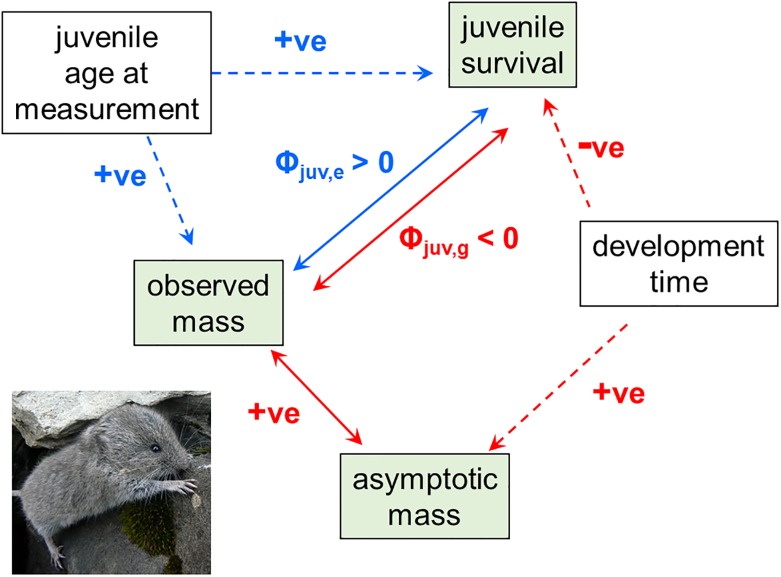
Bigger is apparently frequently fitter, and body size is typically heritable, so why don't animals in wild populations evolve towards larger sizes? Different explanations have been proposed for this apparent "paradox of stasis." A new study of snow voles in the Swiss Alps finds higher survival in animals with larger body mass and heritability of body mass, but, surprisingly, a genetic decline in body mass is also indicated. The authors suggest a novel explanation for this observation: the appearance of positive phenotypic selection is driven by a confounding variable of the age at which a juvenile is measured, whereas the evolutionarily relevant selection actually acts negatively on mass via its association with development time. Thus, genes for larger mass are not actually "fitter" because they are associated with longer development times, and juvenile snow voles with longer development times run the risk of not completing development before the first winter snow. However, the genetic decline in body size is not apparent at the phenotypic level, presumably because of countervailing trends in environmental effects on the phenotype.
显然,体型较大通常更具适应性,而且体型大小通常具有遗传性,那么为什么野生种群中的动物没有朝着更大的体型进化呢?针对这一明显的“停滞悖论”,人们提出了不同的解释。一项对瑞士阿尔卑斯山雪田鼠的新研究发现,体型较大的动物存活率更高,且体型具有遗传性,但令人惊讶的是,研究还表明体型存在基因衰退现象。作者对这一观察结果提出了一种新颖的解释:正向表型选择的出现是由测量幼体时的年龄这一混杂变量驱动的,而与进化相关的选择实际上通过其与发育时间的关联对体型产生负面影响。因此,体型较大的基因实际上并非“更具适应性”,因为它们与更长的发育时间相关联,而发育时间较长的幼年雪田鼠有在第一场冬雪来临之前无法完成发育的风险。然而,体型的基因衰退在表型水平上并不明显,大概是由于环境对表型的影响存在抵消趋势。