Endres Dominique, Perlov Evgeniy, Feige Bernd, Altenmüller Dirk-Matthias, Venhoff Nils, Tebartz van Elst Ludger
Section for Experimental Neuropsychiatry, Department of Psychiatry, Faculty of Medicine, University of Freiburg , Freiburg , Germany.
Freiburg Epilepsy Center, Department of Neurosurgery, Faculty of Medicine, University of Freiburg , Freiburg , Germany.
Front Psychiatry. 2017 Feb 8;8:12. doi: 10.3389/fpsyt.2017.00012. eCollection 2017.
Schizophrenia-like disorders can be divided into endogenic or primary, idiopathic, polygenetic forms, and different secondary, organic subgroups [e.g., (para)epileptic, immunological, degenerative]. Epileptic and paraepileptic explanatory approaches have a long tradition due to the high rate of electroencephalography (EEG) alterations in patients with schizophrenia.
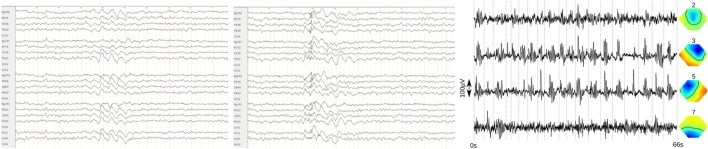
We present the case of a 23-year-old female patient suffering, since the age of 14 years, from a fluctuating paranoid-hallucinatory syndrome with formal thought disorder, fear, delusions of persecution, auditory, visual, and tactile hallucinations, as well as negative and cognitive symptoms. Laboratory measurements showed increased titers of antinuclear antibodies (ANAs) in the context of ulcerative colitis. While there was no clear history or evidence of epileptic seizures, the EEG showed generalized 3 Hz polyspike wave complexes. Under treatment with levetiracetam, the symptoms disappeared and the patient was able to complete vocational training.
The schizophrenia-like symptoms associated with epileptiform discharges but not overt seizures and the good response to antiepileptic treatment could be interpreted in the context of a (para)epileptic pathomechanism. The EEG alterations might be due to a polygenetic effect due to different genes. Mild immunological mechanisms in the framework of ulcerative colitis and increased ANA titers might have supported the network instability. This case report illustrates (1) the importance of EEG screenings in schizophrenia, (2) a potential pathogenetic role of epileptiform discharges in a subgroup of patients with schizophrenia-like symptoms, and (3) that antiepileptic medication with levetiracetam could be a successful treatment alternative in schizophrenia-like disorders with EEG alterations.
精神分裂症样障碍可分为内源性或原发性、特发性、多基因形式,以及不同的继发性、器质性亚组[例如,(类)癫痫性、免疫性、退行性]。由于精神分裂症患者脑电图(EEG)改变的发生率较高,癫痫性和类癫痫性的解释方法有着悠久的传统。
我们报告一例23岁女性患者的病例,该患者自14岁起就患有波动性偏执-幻觉综合征,伴有形式思维障碍、恐惧、被害妄想、听觉、视觉和触觉幻觉,以及阴性和认知症状。实验室检查显示,在溃疡性结肠炎的背景下,抗核抗体(ANA)滴度升高。虽然没有明确的癫痫发作病史或证据,但脑电图显示为全身性3Hz多棘波复合波。在左乙拉西坦治疗下,症状消失,患者能够完成职业培训。
与癫痫样放电相关但无明显发作的精神分裂症样症状以及对抗癫痫治疗的良好反应,可以在(类)癫痫发病机制的背景下进行解释。脑电图改变可能是由于不同基因的多基因效应所致。溃疡性结肠炎框架内的轻度免疫机制和ANA滴度升高可能支持了网络不稳定。本病例报告说明了(1)脑电图筛查在精神分裂症中的重要性,(2)癫痫样放电在一组有精神分裂症样症状的患者中的潜在致病作用,以及(3)左乙拉西坦抗癫痫药物可能是治疗有脑电图改变的精神分裂症样障碍的一种成功替代疗法。