Amaro Adriana, Gangemi Rosaria, Piaggio Francesca, Angelini Giovanna, Barisione Gaia, Ferrini Silvano, Pfeffer Ulrich
Laboratory of Molecular Pathology, Department of Integrated Oncology Therapies, IRCCS AOU San Martino - IST Istituto Nazionale per la Ricerca sul Cancro, L.go Rosanna Benzi 10, 16132, Genoa, Italy.
Laboratory of Biotherapies, Department of Integrated Oncology Therapies, IRCCS AOU San Martino - IST Istituto Nazionale per la Ricerca sul Cancro, Genoa, Italy.
Cancer Metastasis Rev. 2017 Mar;36(1):109-140. doi: 10.1007/s10555-017-9663-3.
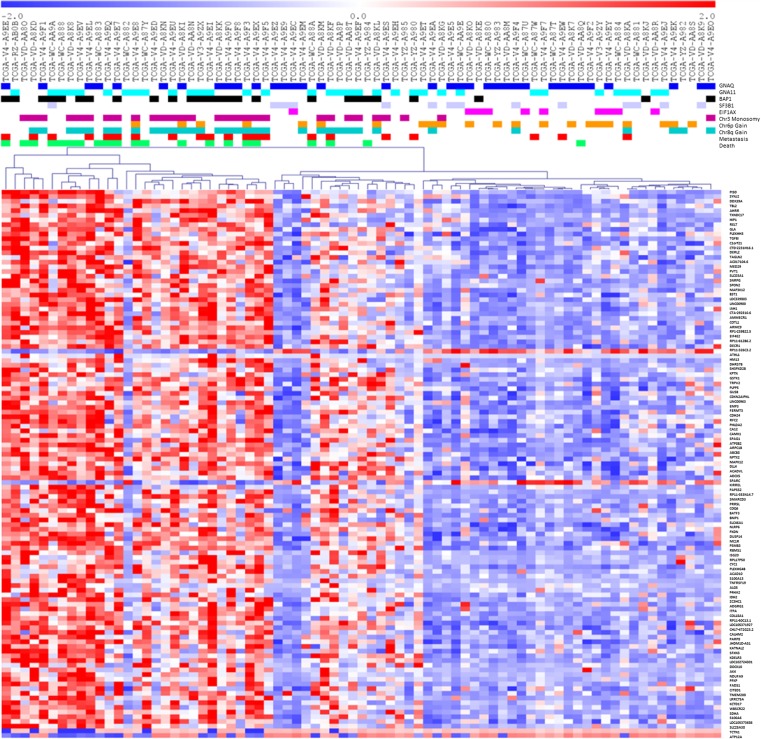
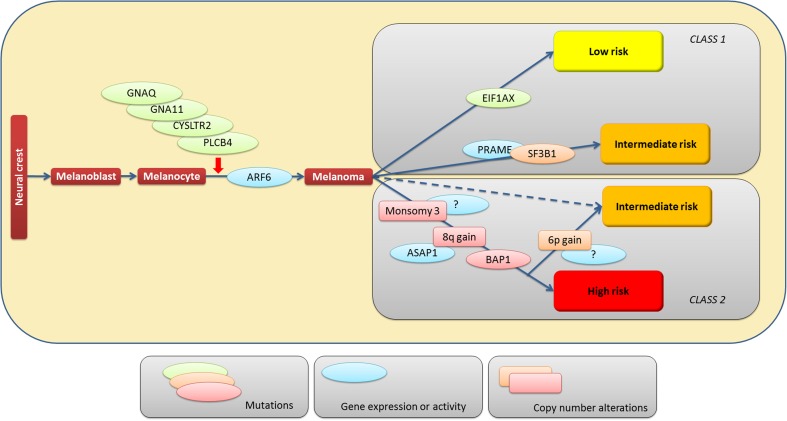
Uveal melanoma (UM), a rare cancer of the eye, is distinct from cutaneous melanoma by its etiology, the mutation frequency and profile, and its clinical behavior including resistance to targeted therapy and immune checkpoint blockers. Primary disease is efficiently controlled by surgery or radiation therapy, but about half of UMs develop distant metastasis mostly to the liver. Survival of patients with metastasis is below 1 year and has not improved in decades. Recent years have brought a deep understanding of UM biology characterized by initiating mutations in the G proteins GNAQ and GNA11. Cytogenetic alterations, in particular monosomy of chromosome 3 and amplification of the long arm of chromosome 8, and mutation of the BRCA1-associated protein 1, BAP1, a tumor suppressor gene, or the splicing factor SF3B1 determine UM metastasis. Cytogenetic and molecular profiling allow for a very precise prognostication that is still not matched by efficacious adjuvant therapies. G protein signaling has been shown to activate the YAP/TAZ pathway independent of HIPPO, and conventional signaling via the mitogen-activated kinase pathway probably also contributes to UM development and progression. Several lines of evidence indicate that inflammation and macrophages play a pro-tumor role in UM and in its hepatic metastases. UM cells benefit from the immune privilege in the eye and may adopt several mechanisms involved in this privilege for tumor escape that act even after leaving the niche. Here, we review the current knowledge of the biology of UM and discuss recent approaches to UM treatment.
葡萄膜黑色素瘤(UM)是一种罕见的眼部癌症,在病因、突变频率和特征以及临床行为(包括对靶向治疗和免疫检查点阻断剂的耐药性)方面与皮肤黑色素瘤不同。原发性疾病可通过手术或放射治疗有效控制,但约一半的UM会发生远处转移,主要转移至肝脏。发生转移的患者生存率低于1年,且数十年来一直没有改善。近年来,人们对UM生物学有了深入了解,其特征是G蛋白GNAQ和GNA11发生起始突变。细胞遗传学改变,特别是3号染色体单体和8号染色体长臂扩增,以及肿瘤抑制基因BRCA1相关蛋白1(BAP1)或剪接因子SF3B1的突变决定了UM的转移。细胞遗传学和分子谱分析能够进行非常精确的预后评估,但目前仍没有有效的辅助治疗与之匹配。已证明G蛋白信号传导可独立于HIPPO激活YAP/TAZ途径,通过丝裂原活化激酶途径的传统信号传导可能也有助于UM的发生和进展。多项证据表明,炎症和巨噬细胞在UM及其肝转移中发挥促肿瘤作用。UM细胞受益于眼部免疫赦免,可能采用多种参与这种赦免的机制来实现肿瘤逃逸,即使离开该微环境后这些机制仍起作用。在此,我们综述了当前关于UM生物学的知识,并讨论了UM治疗的最新方法。