Östman Malin, Ung Eva Jakobsson, Falk Kristin
a Institute of Health and Care Sciences Sahlgrenska Academy, University of Gothenburg , Gothenburg , Sweden.
b Närhälsan Källstorp Health Centre , Trollhättan , Sweden.
Int J Qual Stud Health Well-being. 2015 Jan;10(1):27775. doi: 10.3402/qhw.v10.27775.
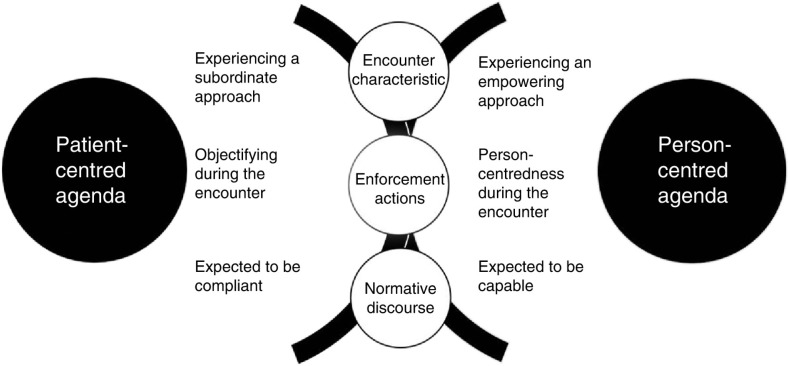
Living with chronic heart failure (CHF) often involves lifelong contact with health care, more or less frequently, depending on fluctuating health-generating disruptions in everyday life. To reduce the influence on continuity in life, health-care professionals should preferably focus on supporting patients in managing their daily lives, based on their perspective. The aim of this study was to describe how the interaction in health-care encounters contributes to either continuity or discontinuity in the daily life for persons with CHF. Interviews with 18 participants were carried out, using the grounded theory method, through data collection and analysis. Two core concepts were constructed from data which reveal a model that illuminates the characteristics of the encounters, the actions of health-care professionals and the normative discourse. Patient-centred agenda consists of the categories: "Experiencing a subordinate approach," "Objectifying during the encounter" and "Expected to be compliant." This describes how health-care professionals enhance discontinuity in daily life by using a paternalistic approach in the encounter. Person-centred agenda consists of the categories: "Experiencing an empowering approach," "Person-centredness during the encounter" and "Expected to be capable." It describes how participants perceive that health-care professionals enable them to deal with everyday life which enhances continuity. The findings highlight the importance of health-care professionals' attitudes and communication in encounters with patients. Health care must be designed to support and promote patients' own strategic thinking by strengthening their self-image to enhance continuity in everyday life. The experience of discontinuity is based on the prevailing health-care culture which focuses on disease and medical treatment and regards it as superior to the illness experience in an everyday life context. We therefore strongly suggest a paradigm shift in the health-care organisation and culture in order to support the patients in their efforts to live a meaningful, rich life, in spite of the chronic illness CHF.
患有慢性心力衰竭(CHF)通常意味着要与医疗保健进行或多或少频繁的终身接触,这取决于日常生活中健康状况的波动。为了减少对生活连续性的影响,医疗保健专业人员最好从患者的角度出发,专注于支持患者管理日常生活。本研究的目的是描述医疗保健接触中的互动如何影响CHF患者日常生活的连续性或不连续性。通过数据收集和分析,采用扎根理论方法对18名参与者进行了访谈。从数据中构建了两个核心概念,揭示了一个阐明接触特征、医疗保健专业人员的行为和规范性话语的模型。以患者为中心的议程包括以下类别:“体验从属方法”、“接触过程中客观化”和“期望顺从”。这描述了医疗保健专业人员如何在接触中采用家长式方法加剧日常生活中的不连续性。以人为本的议程包括以下类别:“体验赋权方法”、“接触过程中以人为本”和“期望有能力”。它描述了参与者如何认为医疗保健专业人员使他们能够应对日常生活,从而增强连续性。研究结果强调了医疗保健专业人员在与患者接触时的态度和沟通的重要性。医疗保健必须设计成通过强化患者的自我形象来支持和促进患者自身的战略思维,以增强日常生活的连续性。不连续性的体验基于当前以疾病和医疗治疗为重点、并在日常生活背景下将其视为优于疾病体验的医疗保健文化。因此,我们强烈建议在医疗保健组织和文化方面进行范式转变,以支持患者努力过上有意义、丰富的生活,尽管患有慢性心力衰竭CHF。