Department of Health and Nursing Sciences, Inland Norway University of Applied Sciences, 2400, Elverum, Norway.
Department of Health Sciences, Karlstad University SE, Karlstad, Sweden.
BMC Palliat Care. 2022 Apr 11;21(1):49. doi: 10.1186/s12904-022-00939-y.
The wish to be cared for and to die at home is common among people with end-stage cancer in the western world. However, home deaths are declining in many countries. The aim of this study was to explore the preferences for home care over time to enable home death among adult patients with cancer in the late palliative phase.
A qualitative method was applied according to grounded theory (Corbin & Strauss, 2008). Data was collected using individual interviews (n = 15) with nine adult patients. One to two follow up interviews were conducted with four patients. Sampling, data collection and constant comparative analysis were undertaken simultaneously.
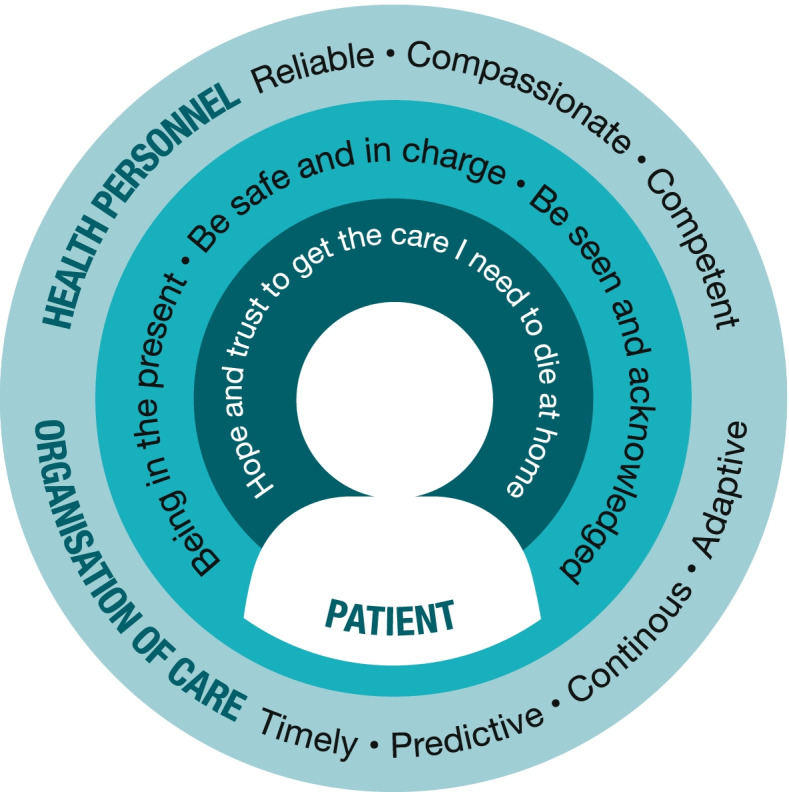
The findings are presented as a conceptual model of patients' preferences for care to enable home death. The core category "Hope and trust to get the care I need to die at home" showed that the preference to die at home seemed stable over time and did not change with deterioration in health status and progression in illness. Five categories were related to the core category. The categories "being in the present", "be safe and in charge" and "be seen and acknowledged" describe the patients' preferences to live a meaningful life until death and be the same person as always. These preferences depended on the categories describing characteristics of healthcare personnel and the organisation of care: "reliable, compassionate and competent healthcare personnel" and "timely, predictive, continuous and adaptive organisation".
An important preference over time was to be here and now and to live as meaningful a life as possible until death. Moreover, the patients preferred to retain control over their lives, to be autonomous and to be seen as the person they had always been. To achieve this, person-centred care provided by healthcare personnel with competence, skills and enough/ample time were required. In addition, home care needed to be organised in a way that ensured continuity and predictability. Systematic implementation of a person-centred care model and the use of advanced home care plans with continued re-evaluation for patients' preferences of home care were proposed measures to enable home death.
在西方世界,终末期癌症患者普遍希望在家中得到关怀并在家中离世。然而,在许多国家,在家中离世的人数正在下降。本研究旨在探讨在晚期姑息治疗阶段的成年癌症患者中,随着时间的推移,人们对在家中接受护理并在家中离世的偏好。
本研究采用扎根理论(Corbin & Strauss,2008)的定性方法。通过对 9 名成年患者进行个人访谈(n=15)收集数据,并对 4 名患者进行了一到两次随访访谈。同时进行了抽样、数据收集和持续比较分析。
研究结果呈现为一个患者偏好在家中接受护理以实现在家中离世的概念模型。核心类别“希望并信任能够在家中获得临终关怀”表明,随着时间的推移,在家中离世的偏好似乎是稳定的,并且不会随着健康状况的恶化和疾病的进展而改变。五个类别与核心类别相关。“活在当下”、“安全并负责”和“被看见和认可”这三个类别的描述了患者在生命结束前过有意义的生活并保持始终如一的自我的偏好。这些偏好取决于描述医疗保健人员和护理组织特征的类别:“可靠、富有同情心和有能力的医疗保健人员”和“及时、可预测、持续和适应性的组织”。
随着时间的推移,一个重要的偏好是活在当下,尽可能有意义地生活,直到死亡。此外,患者希望保持对生活的控制,保持自主,并被视为他们一直以来的那个人。要实现这一目标,需要医疗保健人员提供以患者为中心的关怀,具备能力、技能和足够/充裕的时间。此外,需要以确保连续性和可预测性的方式组织家庭护理。提出的措施包括系统实施以患者为中心的关怀模式和使用带有持续重新评估的先进家庭护理计划,以实现患者对家庭护理的偏好。