Institute of Biomedical Sciences, National Chung Hsing University, Taichung, Taiwan.
Division of Gastroenterology, Taichung Veterans General Hospital, Taichung, Taiwan.
Cell Death Dis. 2017 Feb 23;8(2):e2626. doi: 10.1038/cddis.2016.472.
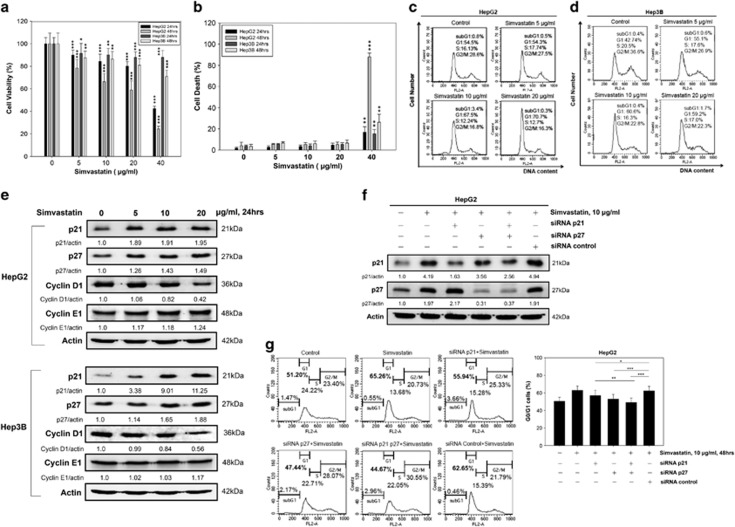
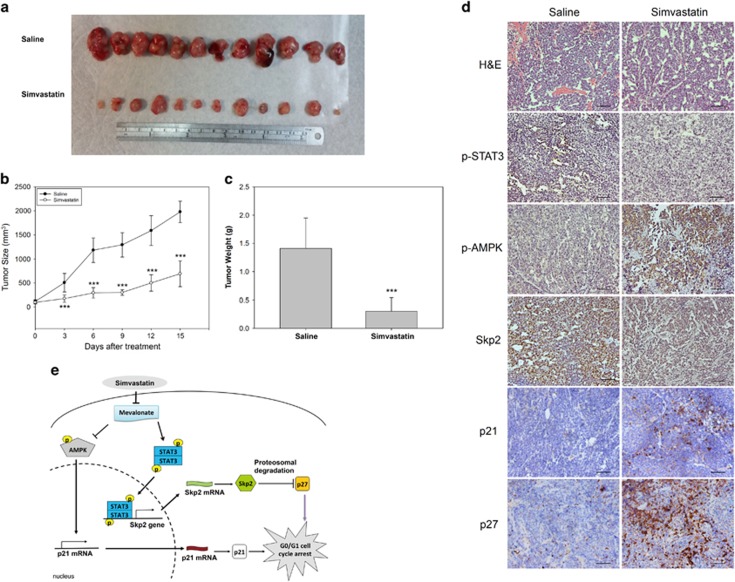
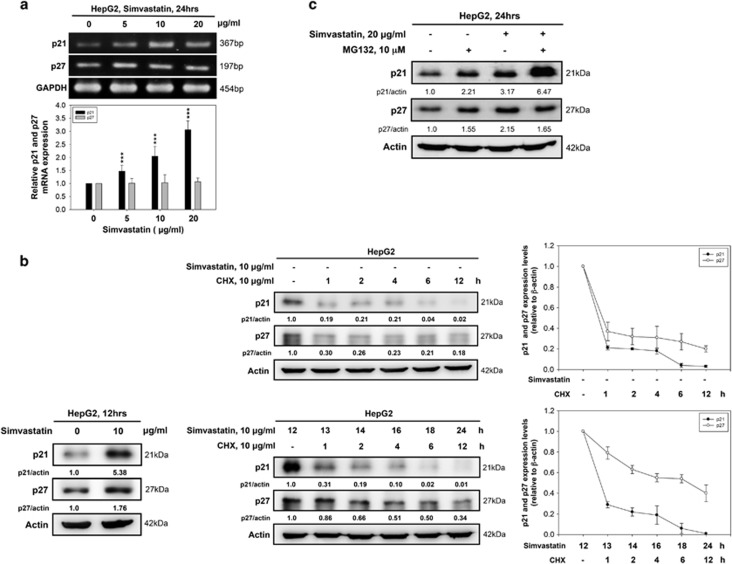
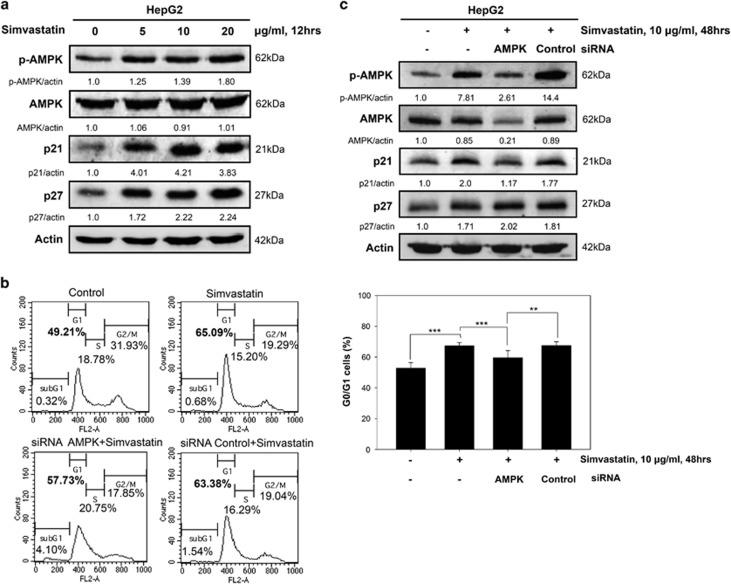
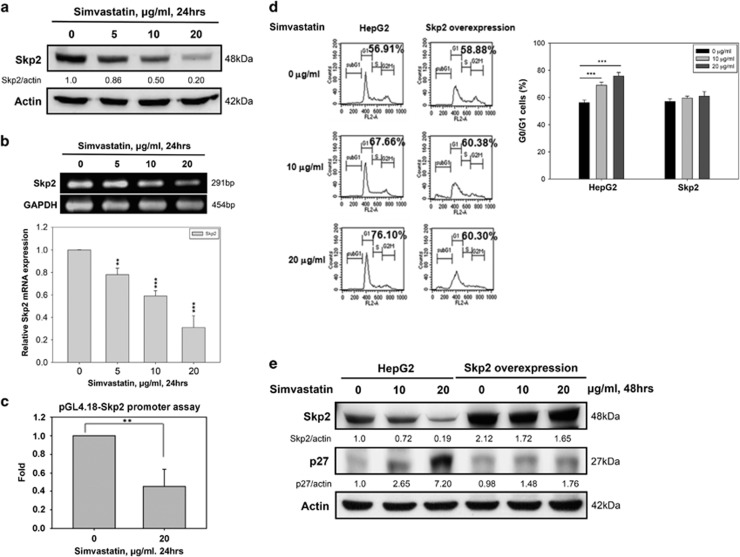
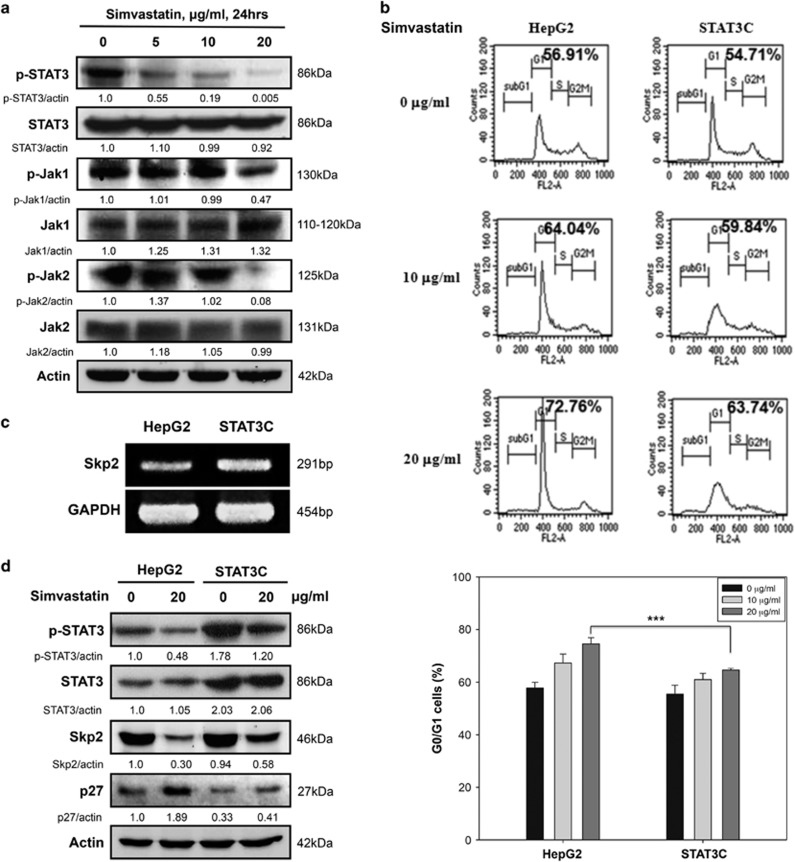
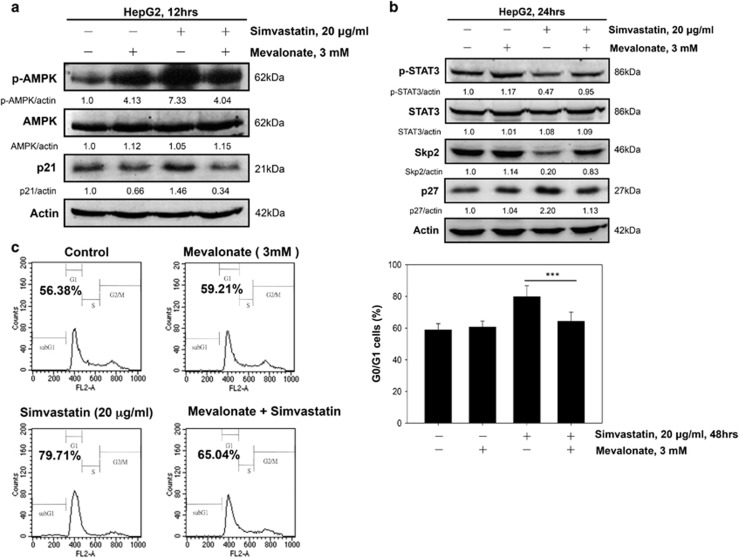
Hepatocellular carcinoma (HCC) is characterized by a poor prognosis and is one of the leading causes of cancer-related death worldwide. Simvastatin, an HMG-CoA reductase inhibitor, which decreases cholesterol synthesis by inhibiting mevalonate pathways and is widely used to treat cardiovascular diseases. Simvastatin exhibits anticancer effects against several malignancies. However, the molecular mechanisms underlying the anticancer effects of simvastatin on HCC are still not well understood. In this study, we demonstrated simvastatin-induced G0/G1 arrest by inducing p21 and p27 accumulation in HepG2 and Hep3B cells. Simvastatin also promoted AMP-activated protein kinase (AMPK) activation, which induced p21 upregulation by increasing its transcription. Consistent with this finding, we found genetic silencing of AMPK reduced p21 expression; however, AMPK silencing had no effect on p27 expression in HCC cells. Simvastatin decreased Skp2 expression at the transcriptional level, which resulted in p27 accumulation by preventing proteasomal degradation, an effect mediated by signal transducer and activator of transcription 3 (STAT3) inhibition. Constitutive STAT3 activation maintained high-level Skp2 expression and lower level p27 expression and significantly prevented G0/G1 arrest in simvastatin-treated HCC cells. Mevalonate decreased simvastatin-induced AMPK activation and rescued phospho-STAT3 and Skp2 expression in HCC cells, which resulted in the prevention of G0/G1 arrest through inhibition of p21 and p27 accumulation. Moreover, simvastatin significantly decreased tumor growth in HepG2 xenograft mice. Consistently, we found that simvastatin also increased p21 and p27 expression in tumor sections by reducing Skp2 expression and inducing AMPK activation and STAT3 suppression in the same tumor tissues. Taken together, these findings are demonstrative of the existence of a novel pathway in which simvastatin induces G0/G1 arrest by upregulating p21 and p27 by activating AMPK and inhibiting the STAT3-Skp2 axis, respectively. The results identify novel targets that explain the beneficial anticancer effects of simvastatin treatment on HCC in vitro and in vivo.
肝细胞癌(HCC)的预后较差,是全球癌症相关死亡的主要原因之一。辛伐他汀是一种 HMG-CoA 还原酶抑制剂,通过抑制甲羟戊酸途径减少胆固醇合成,广泛用于治疗心血管疾病。辛伐他汀对多种恶性肿瘤具有抗癌作用。然而,辛伐他汀对 HCC 的抗癌作用的分子机制尚不清楚。在这项研究中,我们证明辛伐他汀通过诱导 HepG2 和 Hep3B 细胞中 p21 和 p27 的积累来诱导 G0/G1 期阻滞。辛伐他汀还促进 AMP 激活的蛋白激酶(AMPK)的激活,通过增加其转录来诱导 p21 的上调。与这一发现一致,我们发现 AMPK 的基因沉默降低了 p21 的表达;然而,在 HCC 细胞中,AMPK 沉默对 p27 的表达没有影响。辛伐他汀在转录水平上降低了 Skp2 的表达,通过阻止蛋白酶体降解导致 p27 积累,这一作用是通过信号转导和转录激活因子 3(STAT3)抑制介导的。组成型 STAT3 激活维持高水平的 Skp2 表达和低水平的 p27 表达,并显著阻止辛伐他汀处理的 HCC 细胞中的 G0/G1 期阻滞。甲羟戊酸降低了辛伐他汀诱导的 AMPK 激活,并挽救了 HCC 细胞中磷酸化 STAT3 和 Skp2 的表达,从而通过抑制 p21 和 p27 的积累来防止 G0/G1 期阻滞。此外,辛伐他汀显著减少了 HepG2 异种移植小鼠的肿瘤生长。同样,我们发现辛伐他汀通过降低 Skp2 表达并分别激活 AMPK 和抑制 STAT3 抑制在相同的肿瘤组织中诱导 AMPK 激活和 STAT3 抑制,从而增加肿瘤组织中 p21 和 p27 的表达。综上所述,这些发现表明,辛伐他汀通过激活 AMPK 并抑制 STAT3-Skp2 轴分别上调 p21 和 p27,诱导 G0/G1 期阻滞,存在一种新的途径。研究结果确定了新的靶点,解释了辛伐他汀在体外和体内治疗 HCC 的有益抗癌作用。