Simard Trevor, Jung Richard G, Motazedian Pouya, Di Santo Pietro, Ramirez F Daniel, Russo Juan J, Labinaz Alisha, Yousef Altayyeb, Anantharam Brijesh, Pourdjabbar Ali, Hibbert Benjamin
CAPITAL Research Group, Division of Cardiology, University of Ottawa Heart Institute, Ottawa, ON, Canada; Department of Cellular and Molecular Medicine, University of Ottawa, Ottawa, ON, Canada.
CAPITAL Research Group, Division of Cardiology, University of Ottawa Heart Institute, Ottawa, ON, Canada.
Stem Cells Int. 2017;2017:8270498. doi: 10.1155/2017/8270498. Epub 2017 Jan 23.
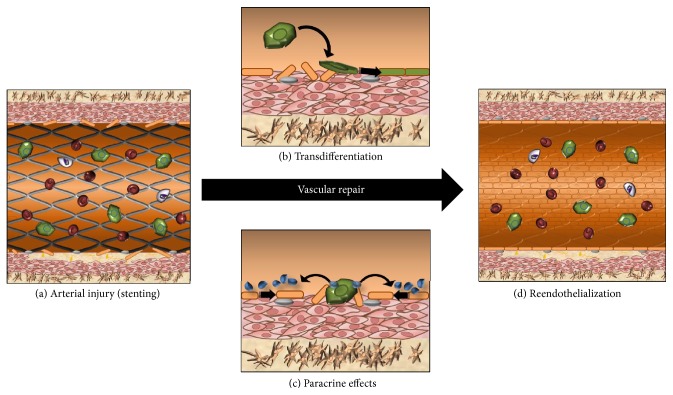
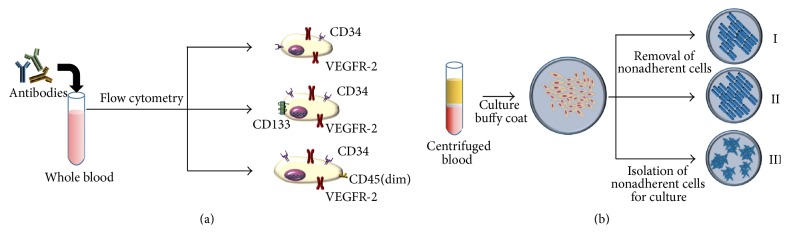
Coronary revascularization remains the standard treatment for obstructive coronary artery disease and can be accomplished by either percutaneous coronary intervention (PCI) or coronary artery bypass graft surgery. Considerable advances have rendered PCI the most common form of revascularization and improved clinical outcomes. However, numerous challenges to modern PCI remain, namely, in-stent restenosis and stent thrombosis, underscoring the importance of understanding the vessel wall response to injury to identify targets for intervention. Among recent promising discoveries, endothelial progenitor cells (EPCs) have garnered considerable interest given an increasing appreciation of their role in vascular homeostasis and their ability to promote vascular repair after stent placement. Circulating EPC numbers have been inversely correlated with cardiovascular risk, while administration of EPCs in humans has demonstrated improved clinical outcomes. Despite these encouraging results, however, advancing EPCs as a therapeutic modality has been hampered by a fundamental roadblock: what constitutes an EPC? We review current definitions and sources of EPCs as well as the proposed mechanisms of EPC-mediated vascular repair. Additionally, we discuss the current state of EPCs as therapeutic agents, focusing on endogenous augmentation and transplantation.
冠状动脉血运重建仍然是阻塞性冠状动脉疾病的标准治疗方法,可通过经皮冠状动脉介入治疗(PCI)或冠状动脉旁路移植手术来实现。重大进展使PCI成为最常见的血运重建形式,并改善了临床结果。然而,现代PCI仍面临诸多挑战,即支架内再狭窄和支架血栓形成,这凸显了了解血管壁对损伤的反应以确定干预靶点的重要性。在最近有前景的发现中,鉴于内皮祖细胞(EPCs)在血管稳态中的作用及其促进支架置入后血管修复的能力越来越受到重视,它们引起了相当大的关注。循环EPC数量与心血管风险呈负相关,而在人体中施用EPC已证明可改善临床结果。然而,尽管有这些令人鼓舞的结果,但将EPCs作为一种治疗方式的进展却受到一个基本障碍的阻碍:什么构成EPC?我们回顾了EPCs的当前定义和来源以及EPC介导的血管修复的 proposed 机制。此外,我们讨论了EPCs作为治疗剂的当前状态,重点是内源性增强和移植。 (注:“proposed”原文有误,可能是“proposed”,暂按此翻译)