Department of Interventional Therapy, Shanghai Ninth People's Hospital, Shanghai Jiao Tong University of Medicine, No. 639 Zhi Zao Ju Road, Shanghai, 200233, People's Republic of China.
Department of Radiology, The Sixth People's Hospital, Affiliated to Shanghai Jiao Tong University, 600 Yi-Shan Road, Shanghai, 200233, People's Republic of China.
Stem Cell Res Ther. 2021 May 3;12(1):264. doi: 10.1186/s13287-021-02324-7.
Endothelial progenitor cell (EPC) dysfunction contributes to vascular disease in diabetes mellitus. However, the molecular mechanism underlying EPC dysfunction and its contribution to delayed reendothelialization in diabetes mellitus remain unclear. Our study aimed to illustrate the potential molecular mechanism underlying diabetic EPC dysfunction in vivo and in vitro. Furthermore, we assessed the effect of EPC transplantation on endothelial regeneration in diabetic rats.
Late outgrowth EPCs were isolated from the bone marrow of rats for in vivo and in vitro studies. In vitro functional assays and Western blotting were conducted to reveal the association between C-X-C chemokine receptor type 7 (CXCR7) expression and diabetic EPC dysfunction. To confirm the association between cellular CXCR7 levels and EPC function, CXCR7 expression in EPCs was upregulated and downregulated via lentiviral transduction and RNA interference, respectively. Western blotting was used to reveal the potential molecular mechanism by which the Stromal-Derived Factor-1 (SDF-1)/CXCR7 axis regulates EPC function. To elucidate the role of the SDF-1/CXCR7 axis in EPC-mediated endothelial regeneration, a carotid artery injury model was established in diabetic rats. After the model was established, saline-treated, diabetic, normal, or CXCR7-primed EPCs were injected via the tail vein.
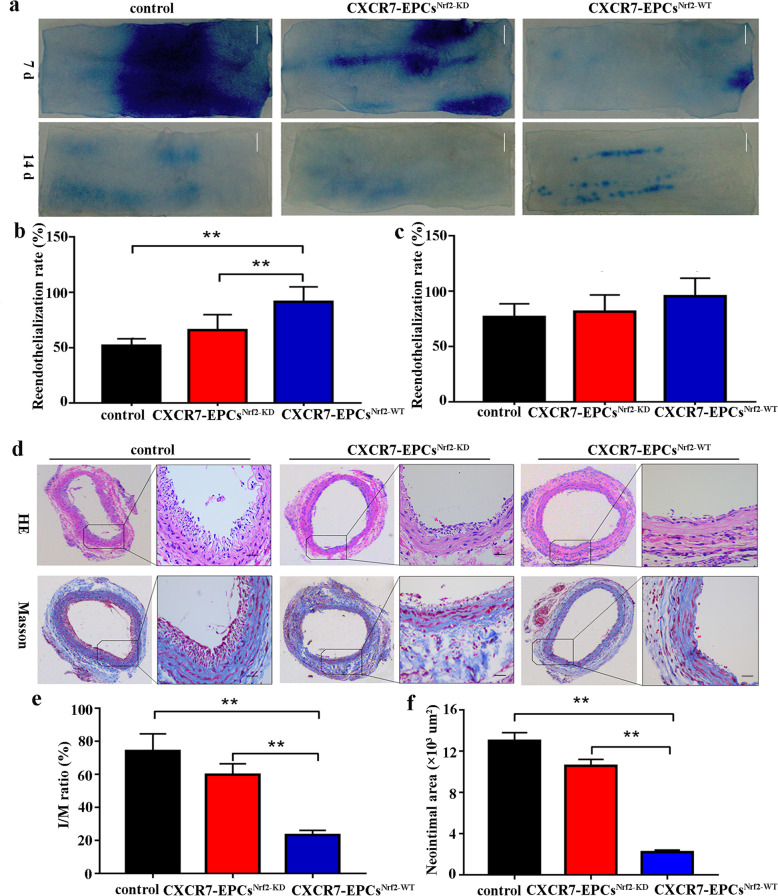
Diabetic EPC dysfunction was associated with decreased CXCR7 expression. Furthermore, EPC dysfunction was mimicked by knockdown of CXCR7 in normal EPCs. However, upregulating CXCR7 expression reversed the dysfunction of diabetic EPCs. The SDF-1/CXCR7 axis positively regulated EPC function by activating the AKT-associated Kelch-like ECH-associated protein 1 (keap-1)/nuclear factor erythroid 2-related factor 2 (Nrf2) axis, which was reversed by blockade of AKT and Nrf2. Transplantation of CXCR7-EPCs accelerated endothelial repair and attenuated neointimal hyperplasia in diabetes mellitus more significantly than transplantation of diabetic or normal EPCs. However, the therapeutic effect of CXCR7-EPC transplantation on endothelial regeneration was reversed by knockdown of Nrf2 expression.
Dysfunction of diabetic EPCs is associated with decreased CXCR7 expression. Furthermore, the SDF-1/CXCR7 axis positively regulates EPC function by activating the AKT/keap-1/Nrf2 axis. CXCR7-primed EPCs might be useful for endothelial regeneration in diabetes-associated vascular disease.
内皮祖细胞(EPC)功能障碍导致糖尿病血管疾病。然而,EPC 功能障碍的分子机制及其对糖尿病延迟再内皮化的贡献仍不清楚。本研究旨在阐明糖尿病体内和体外 EPC 功能障碍的潜在分子机制。此外,我们评估了 EPC 移植对糖尿病大鼠内皮再生的影响。
从大鼠骨髓中分离晚期生长 EPC 进行体内和体外研究。进行体外功能测定和 Western blot 分析,以揭示 C-X-C 趋化因子受体 7(CXCR7)表达与糖尿病 EPC 功能障碍之间的关系。为了确认细胞 CXCR7 水平与 EPC 功能之间的关系,通过慢病毒转导和 RNA 干扰分别上调和下调 EPC 中的 CXCR7 表达。Western blot 分析揭示了基质衍生因子-1(SDF-1)/CXCR7 轴调节 EPC 功能的潜在分子机制。为了阐明 SDF-1/CXCR7 轴在 EPC 介导的内皮再生中的作用,在糖尿病大鼠中建立颈动脉损伤模型。模型建立后,通过尾静脉注射生理盐水、糖尿病、正常或 CXCR7 预刺激的 EPC。
糖尿病 EPC 功能障碍与 CXCR7 表达降低有关。此外,在正常 EPC 中敲低 CXCR7 可模拟 EPC 功能障碍。然而,上调 CXCR7 表达可逆转糖尿病 EPC 的功能障碍。SDF-1/CXCR7 轴通过激活 AKT 相关 Kelch-like ECH 相关蛋白 1(keap-1)/核因子红细胞 2 相关因子 2(Nrf2)轴正向调节 EPC 功能,该轴可通过阻断 AKT 和 Nrf2 逆转。与移植糖尿病或正常 EPC 相比,移植 CXCR7-EPC 可更显著地加速糖尿病内皮修复并减轻新生内膜增生。然而,敲低 Nrf2 表达可逆转 CXCR7-EPC 移植对内皮再生的治疗作用。
糖尿病 EPC 功能障碍与 CXCR7 表达降低有关。此外,SDF-1/CXCR7 轴通过激活 AKT/keap-1/Nrf2 轴正向调节 EPC 功能。CXCR7 预刺激的 EPC 可能有助于糖尿病相关血管疾病的内皮再生。