Hauser Donna D W, Laidre Kristin L, Stern Harry L, Moore Sue E, Suydam Robert S, Richard Pierre R
School of Aquatic & Fishery Sciences, University of Washington, Seattle, WA, United States of America.
Polar Science Center, Applied Physics Laboratory, University of Washington, Seattle, WA, United States of America.
PLoS One. 2017 Feb 24;12(2):e0172755. doi: 10.1371/journal.pone.0172755. eCollection 2017.
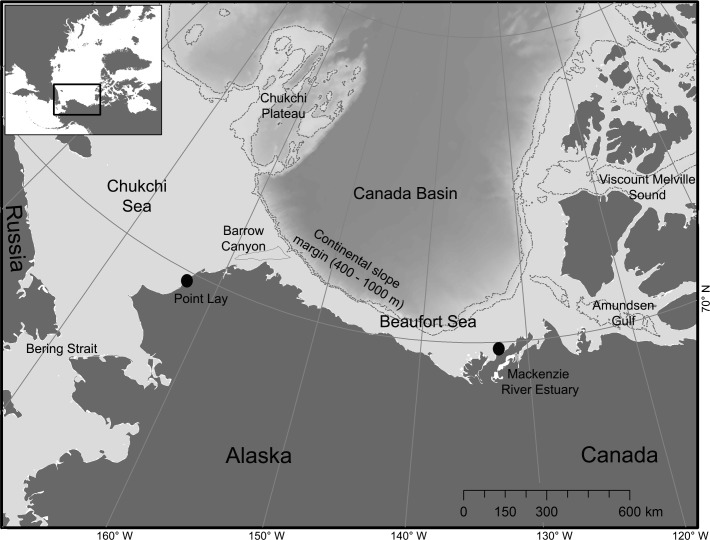
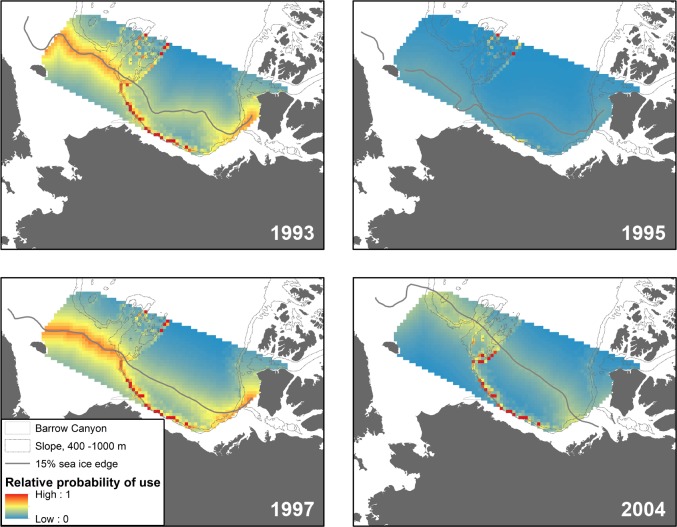
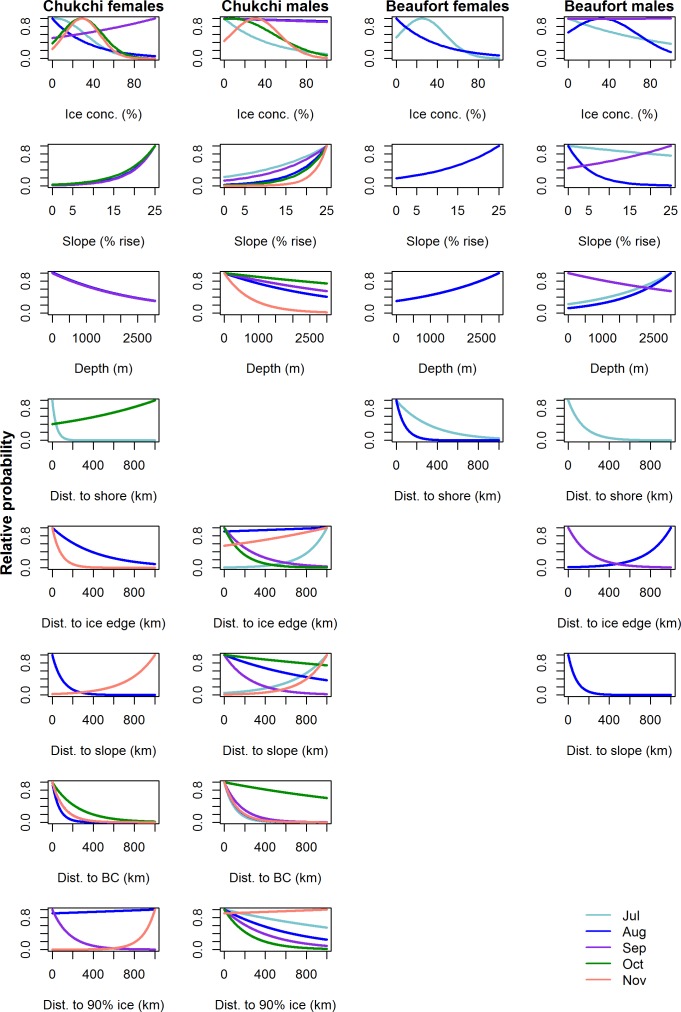
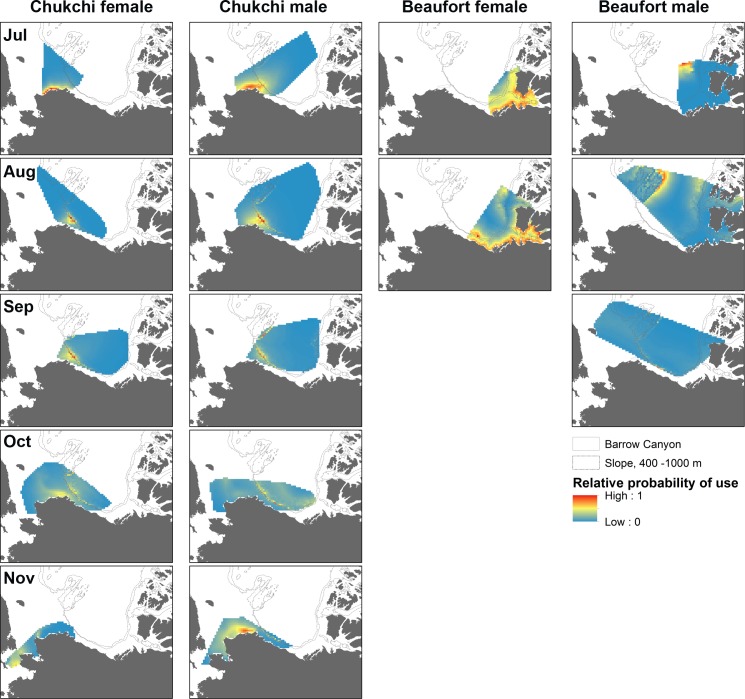
There has been extensive sea ice loss in the Chukchi and Beaufort seas where two beluga whale (Delphinapterus leucas) populations occur between July-November. Our goal was to develop population-specific beluga habitat selection models that quantify relative use of sea ice and bathymetric features related to oceanographic processes, which can provide context to the importance of changing sea ice conditions. We established habitat selection models that incorporated daily sea ice measures (sea ice concentration, proximity to ice edge and dense ice) and bathymetric features (slope, depth, proximity to the continental slope, Barrow Canyon, and shore) to establish quantitative estimates of habitat use for the Eastern Chukchi Sea ('Chukchi') and Eastern Beaufort Sea ('Beaufort') populations. We applied 'used v. available' resource selection functions to locations of 65 whales tagged from 1993-2012, revealing large variations in seasonal habitat selection that were distinct between sex and population groups. Chukchi whales of both sexes were predicted to use areas in close proximity to Barrow Canyon (typically <200 km) as well as the continental slope in summer, although deeper water and denser ice were stronger predictors for males than females. Habitat selection differed more between sexes for Beaufort belugas. Beaufort males selected higher ice concentrations (≥40%) than females (0-40%) in July-August. Proximity to shore (<200 km) strongly predicted summer habitat of Beaufort females, while distance to the ice edge was important for male habitat selection, especially during westward migration in September. Overall, our results indicate that sea ice variables were rarely the primary drivers of beluga summer-fall habitat selection. While diminished sea ice may indirectly affect belugas through changes in the ecosystem, associations with bathymetric features that affect prey availability seemed key to habitat selection during summer and fall. These results provide a benchmark by which to assess future changes in beluga habitat use of the Pacific Arctic.
楚科奇海和波弗特海出现了大面积海冰流失,7月至11月期间有两个白鲸(白鲸属)种群在此出没。我们的目标是建立针对特定种群的白鲸栖息地选择模型,量化与海洋学过程相关的海冰和地形特征的相对利用情况,这可以为海冰条件变化的重要性提供背景信息。我们建立了栖息地选择模型,纳入每日海冰测量数据(海冰浓度、与冰缘的距离和密集冰区)和地形特征(坡度、深度、与大陆坡、巴罗峡谷和海岸的距离),以建立楚科奇海东部(“楚科奇”)和波弗特海东部(“波弗特”)种群栖息地利用的定量估计。我们将“利用与可利用”资源选择函数应用于1993年至2012年标记的65头鲸鱼的位置,揭示了季节性栖息地选择的巨大差异在性别和种群组之间是明显的。预计两性的楚科奇白鲸在夏季会利用靠近巴罗峡谷(通常<200公里)以及大陆坡的区域,尽管更深的水域和更密集的冰区对雄性的预测能力比雌性更强。波弗特白鲸的性别间栖息地选择差异更大。7月至8月,波弗特雄性选择的冰浓度(≥40%)高于雌性(0-40%)。靠近海岸(<200公里)强烈预测了波弗特雌性的夏季栖息地,而与冰缘的距离对雄性栖息地选择很重要,尤其是在9月向西迁徙期间。总体而言,我们的结果表明,海冰变量很少是白鲸夏秋栖息地选择的主要驱动因素。虽然海冰减少可能通过生态系统变化间接影响白鲸,但与影响猎物可获得性的地形特征关联似乎是夏秋栖息地选择的关键。这些结果提供了一个基准,用以评估太平洋北极地区白鲸栖息地利用的未来变化。