Seldin Katherine, Armstrong Kristan, Schiff Max L, Heckers Stephan
Psychiatric Neuroimaging Program, Department of Psychiatry and Behavioral Sciences, Vanderbilt University , Nashville, TN , USA.
Front Psychiatry. 2017 Feb 10;8:18. doi: 10.3389/fpsyt.2017.00018. eCollection 2017.
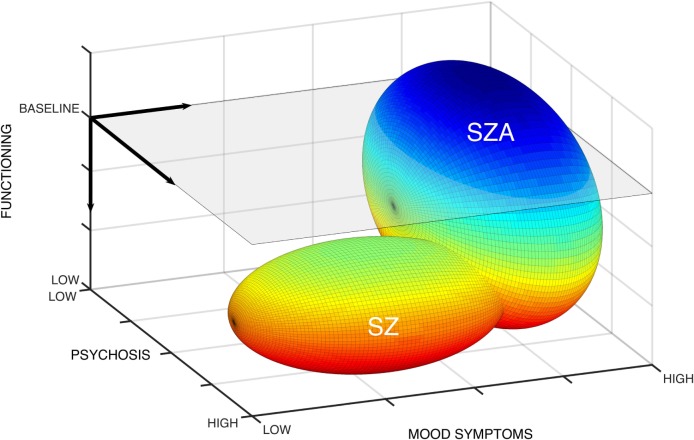
Clinical outcome studies of schizoaffective disorder patients have yielded conflicting results. One reason is the heterogeneity of samples drawn from the schizoaffective disorder population. Here, we studied schizoaffective disorder patients who showed marked functional impairment and continuous signs of illness for at least 6 months (i.e., DSM criteria B and C for schizophrenia).
We assessed 176 chronic psychosis patients with a structured interview (SCID-IV-TR) and the Diagnostic Interview for Genetic Studies schizoaffective disorder module. We diagnosed 114 patients with schizophrenia and 62 with schizoaffective disorder. The two groups were similar with regard to age, gender, and race. We tested for group differences in antecedent risk factors, clinical features, and functional outcome.
The schizoaffective disorder group differed from the schizophrenia group on two measures only: they showed higher rates of suicidality (more suicide attempts, < 0.01; more hospitalizations to prevent suicide, < 0.01) and higher anxiety disorder comorbidity ( < 0.01).
When schizoaffective disorder patients meet DSM criteria B and C for schizophrenia, they resemble schizophrenia patients on several measures used to assess validity. The increased rate of anxiety disorders and suicidality warrants clinical attention. Our data suggest that a more explicit definition of schizoaffective disorder reduces heterogeneity and may increase validity.
精神分裂症伴情感障碍患者的临床结局研究结果相互矛盾。一个原因是从精神分裂症伴情感障碍人群中抽取的样本具有异质性。在此,我们研究了那些表现出明显功能损害且疾病持续迹象至少达6个月(即精神分裂症的DSM标准B和C)的精神分裂症伴情感障碍患者。
我们通过结构化访谈(SCID-IV-TR)和基因研究诊断访谈的精神分裂症伴情感障碍模块对176例慢性精神病患者进行了评估。我们诊断出114例精神分裂症患者和62例精神分裂症伴情感障碍患者。两组在年龄、性别和种族方面相似。我们测试了两组在前驱危险因素、临床特征和功能结局方面的差异。
精神分裂症伴情感障碍组与精神分裂症组仅在两项指标上存在差异:他们的自杀率更高(自杀未遂更多,<0.01;为预防自杀而住院的次数更多,<0.01),且焦虑症共病率更高(<0.01)。
当精神分裂症伴情感障碍患者符合精神分裂症的DSM标准B和C时,在用于评估效度的多项指标上,他们与精神分裂症患者相似。焦虑症和自杀率的增加值得临床关注。我们的数据表明,对精神分裂症伴情感障碍进行更明确的定义可减少异质性,并可能提高效度。