Sinha-Hikim Amiya P, Sinha-Hikim Indrani, Friedman Theodore C
Division of Endocrinology, Metabolism and Molecular Medicine, Department of Internal Medicine, Charles R. Drew University of Medicine and Science, Los Angeles, CA, USA; David Geffen School of Medicine at University of California, Los Angeles, CA, USA.
Front Endocrinol (Lausanne). 2017 Feb 10;8:23. doi: 10.3389/fendo.2017.00023. eCollection 2017.
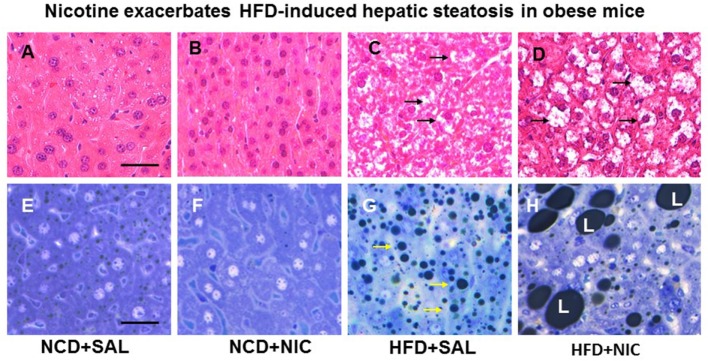
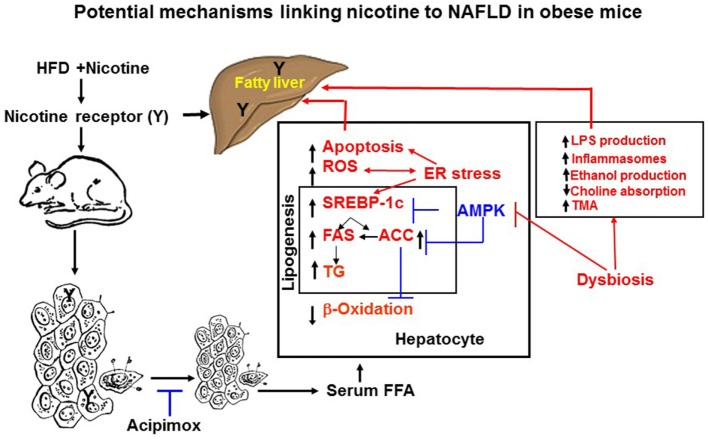
Non-alcoholic fatty liver disease (NAFLD) poses a serious health hazard affecting 20-40% of adults in the general population in the USA and over 70% of the obese and extremely obese people. In addition to obesity, nicotine is recognized as a risk factor for NAFLD, and it has been reported that nicotine can exaggerate obesity-induced hepatic steatosis. The development of NAFLD has serious clinical complications because of its potential progression from simple hepatic steatosis to non-alcoholic steatohepatitis (NASH), liver cirrhosis, and hepatocellular carcinoma. Multiple mechanisms can be involved in nicotine plus high-fat diet-induced (HFD) hepatic steatosis. Emerging evidence now suggests that nicotine exacerbates hepatic steatosis triggered by HFD, through increased oxidative stress and hepatocellular apoptosis, decreased phosphorylation (inactivation) of adenosine-5-monophosphate-activated protein kinase and, in turn, up-regulation of sterol response-element binding protein 1-c, fatty acid synthase, and activation of acetyl-coenzyme A-carboxylase, leading to increased hepatic lipogenesis. There is also growing evidence that chronic endoplasmic reticulum stress through regulation of several pathways leading to oxidative stress, inflammation, perturbed hepatic lipid homeostasis, apoptosis, and autophagy can induce hepatic steatosis and its progression to NASH. Evidence also suggests a central role of the gut microbiota in obesity and its related disorders, including NAFLD. This review explores the contribution of nicotine and obesity to the development of NAFLD and its molecular underpinning.
非酒精性脂肪性肝病(NAFLD)对健康构成严重危害,影响着美国普通人群中20%-40%的成年人以及超过70%的肥胖和极度肥胖者。除肥胖外,尼古丁被认为是NAFLD的一个风险因素,据报道尼古丁会加剧肥胖诱导的肝脏脂肪变性。NAFLD的发展会引发严重的临床并发症,因为它有可能从单纯性肝脂肪变性进展为非酒精性脂肪性肝炎(NASH)、肝硬化和肝细胞癌。尼古丁加高脂饮食(HFD)诱导的肝脏脂肪变性可能涉及多种机制。新出现的证据表明,尼古丁通过增加氧化应激和肝细胞凋亡、降低腺苷-5-单磷酸激活蛋白激酶的磷酸化(失活),进而上调固醇调节元件结合蛋白1-c、脂肪酸合酶,并激活乙酰辅酶A羧化酶,导致肝脏脂肪生成增加,从而加剧HFD引发的肝脏脂肪变性。越来越多的证据还表明,慢性内质网应激通过调节导致氧化应激、炎症、肝脏脂质稳态紊乱、凋亡和自噬的多种途径,可诱导肝脏脂肪变性及其向NASH的进展。证据还表明,肠道微生物群在肥胖及其相关疾病(包括NAFLD)中起核心作用。本综述探讨了尼古丁和肥胖对NAFLD发展的影响及其分子基础。