Shin Ji Hyun, Xu Liang, Wang Dong
Department of Cellular and Molecular Medicine, School of Medicine, Skaggs School of Pharmacy and Pharmaceutical Sciences, University of California San Diego, La Jolla, CA 92093 USA.
Cell Biosci. 2017 Feb 22;7:9. doi: 10.1186/s13578-016-0133-3. eCollection 2017.
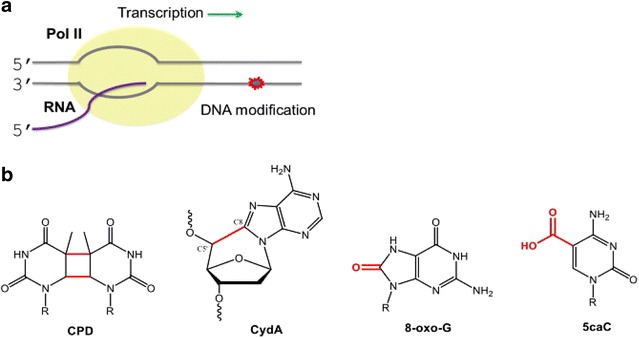
As a key enzyme for gene expression, RNA polymerase II (pol II) reads along the DNA template and catalyzes accurate mRNA synthesis during transcription. On the other hand, genomic DNA is under constant attack by endogenous and environmental stresses. These attack cause many DNA lesions. Pol II functions as a specific sensor that is able to recognize changes in DNA sequences and structures and induces different outcomes. A critical question in the field is how Pol II recognizes and senses these DNA modifications or lesions. Recent studies provided new insights into understanding this critical question. In this mini-review, we would like to focus on three classes of DNA lesions/modifications: (1) Bulky, DNA-distorting lesions that block pol II transcription, (2) small DNA lesions that promote pol II pausing and error-prone transcriptional bypass, and (3) endogenous enzyme-catalyzed DNA modifications that lead to pol II pausing and error-free transcriptional bypass.
作为基因表达的关键酶,RNA聚合酶II(pol II)沿着DNA模板移动,并在转录过程中催化精确的mRNA合成。另一方面,基因组DNA不断受到内源性和环境压力的攻击。这些攻击会导致许多DNA损伤。Pol II作为一种特殊的传感器,能够识别DNA序列和结构的变化并引发不同的结果。该领域的一个关键问题是Pol II如何识别和感知这些DNA修饰或损伤。最近的研究为理解这个关键问题提供了新的见解。在本综述中,我们将重点关注三类DNA损伤/修饰:(1)阻碍pol II转录的大的、使DNA扭曲的损伤;(2)促进pol II暂停和易出错转录绕过的小DNA损伤;(3)导致pol II暂停和无错误转录绕过的内源性酶催化的DNA修饰。