Clark Lindsay R, Berman Sara E, Rivera-Rivera Leonardo A, Hoscheidt Siobhan M, Darst Burcu F, Engelman Corinne D, Rowley Howard A, Carlsson Cynthia M, Asthana Sanjay, Turski Patrick, Wieben Oliver, Johnson Sterling C
Wisconsin Alzheimer's Institute, University of Wisconsin-Madison School of Medicine and Public Health, Madison, WI, USA; Alzheimer's Disease Research Center, University of Wisconsin-Madison School of Medicine and Public Health, Madison, WI, USA; Geriatric Research Education and Clinical Center, William. S. Middleton Memorial Veterans Hospital, Madison, WI, USA.
Alzheimer's Disease Research Center, University of Wisconsin-Madison School of Medicine and Public Health, Madison, WI, USA; Medical Scientist and Neuroscience Training Programs, University of Wisconsin-Madison School of Medicine and Public Health, Madison, WI, USA.
Alzheimers Dement (Amst). 2017 Jan 23;7:48-55. doi: 10.1016/j.dadm.2017.01.002. eCollection 2017.
Capillary hypoperfusion is reported in asymptomatic adults at-risk for Alzheimer's disease (AD), but the extent that can be explained by reduced flow in intracranial arteries is unknown.
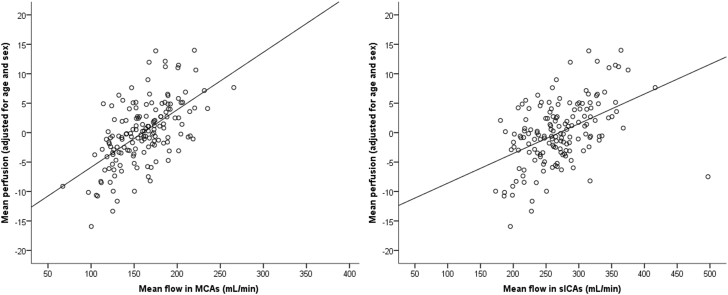
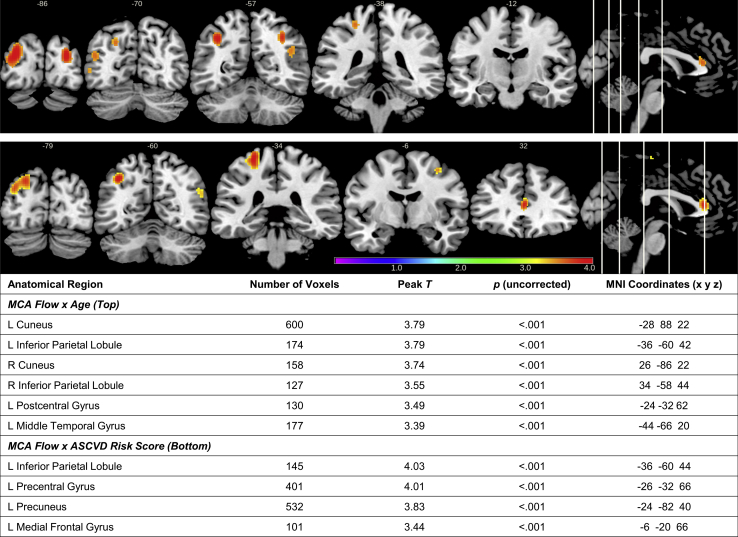
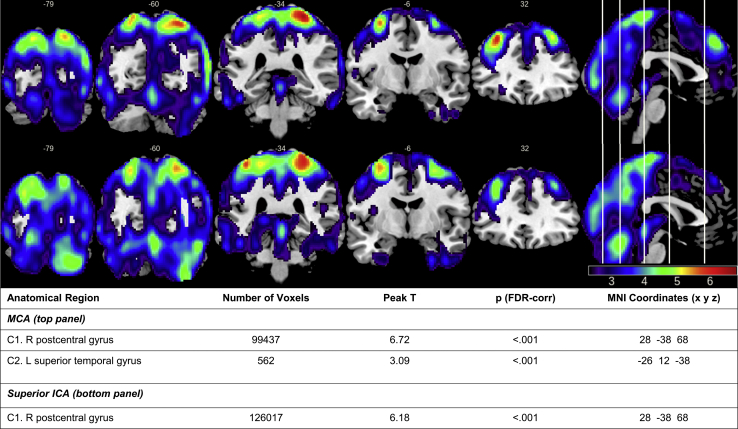
One hundred fifty-five asymptomatic adults enriched for AD risk (mean age 61 years) completed arterial spin labeling (pcASL) and 4D-flow MRI sequences. Voxel-wise regression models investigated the relationship between mean flow in bilateral cerebral arteries and capillary perfusion, and tested potential moderators of this relationship.
Mean arterial blood flow through middle cerebral arteries (MCAs) and internal carotid arteries was positively associated with perfusion in large cortical clusters ( < .05, false discovery rate corrected). Trends were observed for the interactions MCA flow × age and MCA flow × cardiovascular risk on cerebral perfusion ( < .001, uncorrected).
These findings provide evidence that capillary perfusion measured via pseudocontinuous arterial spin labeling is strongly dependent on inflow from larger cerebral arteries. Further studies are warranted to investigate possible alterations between macrovascular and microvascular flow in advanced age and elevated cardiovascular risk in asymptomatic adults at risk for AD.
有报道称,在有患阿尔茨海默病(AD)风险的无症状成年人中存在毛细血管灌注不足的情况,但颅内动脉血流减少所能解释的程度尚不清楚。
155名有AD风险的无症状成年人(平均年龄61岁)完成了动脉自旋标记(pcASL)和4D流磁共振成像序列。体素回归模型研究了双侧脑动脉平均血流与毛细血管灌注之间的关系,并测试了这种关系的潜在调节因素。
通过大脑中动脉(MCA)和颈内动脉的平均动脉血流与大皮质簇中的灌注呈正相关(<0.05,校正错误发现率)。观察到MCA血流×年龄和MCA血流×心血管风险对脑灌注的交互作用趋势(<0.001,未校正)。
这些发现提供了证据,表明通过伪连续动脉自旋标记测量的毛细血管灌注强烈依赖于来自较大脑动脉的流入。有必要进一步研究,以调查在有AD风险的无症状成年人中,高龄和心血管风险升高时大血管和微血管血流之间可能存在的改变。