
Rheb通过依赖PDE4D5的cAMP-PKA信号通路下调抑制白色脂肪组织的米色化。
Rheb Inhibits Beiging of White Adipose Tissue via PDE4D5-Dependent Downregulation of the cAMP-PKA Signaling Pathway.
作者信息
Meng Wen, Liang Xiuci, Chen Hongzhi, Luo Hairong, Bai Juli, Li Guangdi, Zhang Qinghai, Xiao Ting, He Sijia, Zhang Yacheng, Xu Zhipeng, Xiao Bo, Liu Meilian, Hu Fang, Liu Feng
机构信息
Department of Metabolism and Endocrinology, Metabolic Syndrome Research Center of Central South University, The Second Xiangya Hospital, Central South University, Changsha, Hunan, China.
Department of Pharmacology, University of Texas Health Science Center at San Antonio, San Antonio, TX.
出版信息
Diabetes. 2017 May;66(5):1198-1213. doi: 10.2337/db16-0886. Epub 2017 Feb 27.
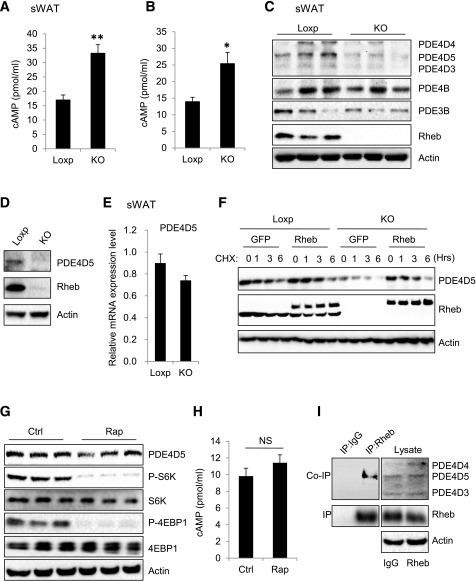
Beiging of white adipose tissue has potential antiobesity and antidiabetes effects, yet the underlying signaling mechanisms remain to be fully elucidated. Here we show that adipose-specific knockout of Rheb, an upstream activator of mechanistic target of rapamycin complex 1 (mTORC1), protects mice from high-fat diet-induced obesity and insulin resistance. On the one hand, Rheb deficiency in adipose tissue reduced mTORC1 signaling, increased lipolysis, and promoted beiging and energy expenditure. On the other hand, overexpression of Rheb in primary adipocytes significantly inhibited CREB phosphorylation and uncoupling protein 1 (UCP1) expression. Mechanistically, fat-specific knockout of Rheb increased cAMP levels, cAMP-dependent protein kinase (PKA) activity, and UCP1 expression in subcutaneous white adipose tissue. Interestingly, treating primary adipocytes with rapamycin only partially alleviated the suppressing effect of Rheb on UCP1 expression, suggesting the presence of a novel mechanism underlying the inhibitory effect of Rheb on thermogenic gene expression. Consistent with this notion, overexpression of Rheb stabilizes the expression of cAMP-specific phosphodiesterase 4D5 (PDE4D5) in adipocytes, whereas knockout of Rheb greatly reduced cellular levels of PDE4D5 concurrently with increased cAMP levels, PKA activation, and UCP1 expression. Taken together, our findings reveal Rheb as an important negative regulator of beige fat development and thermogenesis. In addition, Rheb is able to suppress the beiging effect through an mTORC1-independent mechanism.
白色脂肪组织的米色化具有潜在的抗肥胖和抗糖尿病作用,但其潜在的信号传导机制仍有待充分阐明。在此,我们表明,脂肪特异性敲除雷帕霉素复合物1(mTORC1)的上游激活剂Rheb,可保护小鼠免受高脂饮食诱导的肥胖和胰岛素抵抗。一方面,脂肪组织中Rheb的缺乏降低了mTORC1信号传导,增加了脂肪分解,并促进了米色化和能量消耗。另一方面,在原代脂肪细胞中过表达Rheb显著抑制了CREB磷酸化和解偶联蛋白1(UCP1)的表达。从机制上讲,脂肪特异性敲除Rheb可提高皮下白色脂肪组织中的cAMP水平、cAMP依赖性蛋白激酶(PKA)活性和UCP1表达。有趣的是,用雷帕霉素处理原代脂肪细胞只能部分缓解Rheb对UCP1表达的抑制作用,这表明存在一种新的机制来解释Rheb对产热基因表达的抑制作用。与此观点一致,Rheb的过表达可稳定脂肪细胞中cAMP特异性磷酸二酯酶4D5(PDE4D5)的表达,而敲除Rheb则在cAMP水平、PKA激活和UCP1表达增加的同时,大大降低了细胞内PDE4D5的水平。综上所述,我们的研究结果揭示了Rheb是米色脂肪发育和产热的重要负调节因子。此外,Rheb能够通过一种不依赖mTORC1的机制抑制米色化作用。


 Zotero 插件