Machicado Jorge D, Amann Stephen T, Anderson Michelle A, Abberbock Judah, Sherman Stuart, Conwell Darwin L, Cote Gregory A, Singh Vikesh K, Lewis Michele D, Alkaade Samer, Sandhu Bimaljit S, Guda Nalini M, Muniraj Thiruvengadam, Tang Gong, Baillie John, Brand Randall E, Gardner Timothy B, Gelrud Andres, Forsmark Christopher E, Banks Peter A, Slivka Adam, Wilcox C Mel, Whitcomb David C, Yadav Dhiraj
University of Pittsburgh Medical Center, Pittsburgh, Pennsylvania, USA.
North Mississippi Medical Center, Tupelo, Mississippi, USA.
Am J Gastroenterol. 2017 Apr;112(4):633-642. doi: 10.1038/ajg.2017.42. Epub 2017 Feb 28.
Chronic pancreatitis (CP) has a profound independent effect on quality of life (QOL). Our aim was to identify factors that impact the QOL in CP patients.
We used data on 1,024 CP patients enrolled in the three NAPS2 studies. Information on demographics, risk factors, co-morbidities, disease phenotype, and treatments was obtained from responses to structured questionnaires. Physical and mental component summary (PCS and MCS, respectively) scores generated using responses to the Short Form-12 (SF-12) survey were used to assess QOL at enrollment. Multivariable linear regression models determined independent predictors of QOL.
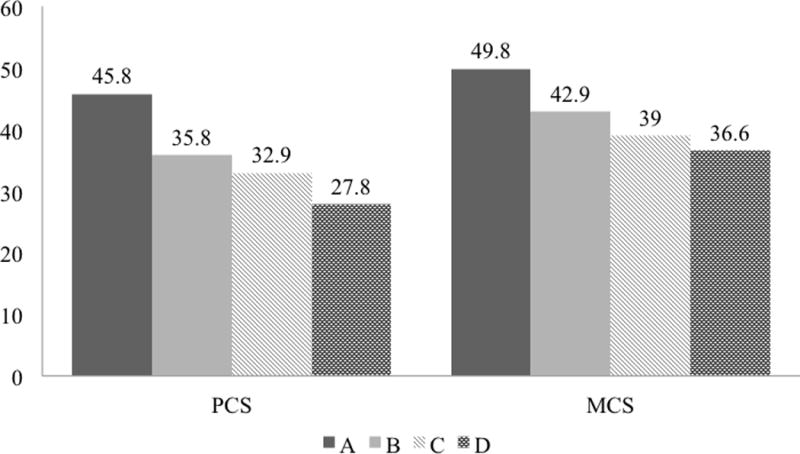
Mean PCS and MCS scores were 36.7±11.7 and 42.4±12.2, respectively. Significant (P<0.05) negative impact on PCS scores in multivariable analyses was noted owing to constant mild-moderate pain with episodes of severe pain or constant severe pain (10 points), constant mild-moderate pain (5.2), pain-related disability/unemployment (5.1), current smoking (2.9 points), and medical co-morbidities. Significant (P<0.05) negative impact on MCS scores was related to constant pain irrespective of severity (6.8-6.9 points), current smoking (3.9 points), and pain-related disability/unemployment (2.4 points). In women, disability/unemployment resulted in an additional 3.7 point reduction in MCS score. Final multivariable models explained 27% and 18% of the variance in PCS and MCS scores, respectively. Etiology, disease duration, pancreatic morphology, diabetes, exocrine insufficiency, and prior endotherapy/pancreatic surgery had no significant independent effect on QOL.
Constant pain, pain-related disability/unemployment, current smoking, and concurrent co-morbidities significantly affect the QOL in CP. Further research is needed to identify factors impacting QOL not explained by our analyses.
慢性胰腺炎(CP)对生活质量(QOL)有深远的独立影响。我们的目的是确定影响CP患者生活质量的因素。
我们使用了纳入三项NAPS2研究的1024例CP患者的数据。通过对结构化问卷的回答获取了人口统计学、危险因素、合并症、疾病表型和治疗方面的信息。使用对简式12项健康调查(SF-12)的回答生成的身体和心理成分总结(分别为PCS和MCS)分数来评估入组时的生活质量。多变量线性回归模型确定了生活质量的独立预测因素。
PCS和MCS的平均分数分别为36.7±11.7和42.4±12.2。在多变量分析中,持续的轻至中度疼痛伴重度疼痛发作或持续重度疼痛(10分)、持续的轻至中度疼痛(5.2分)、疼痛相关的残疾/失业(5.1分)、当前吸烟(2.9分)和合并症对PCS分数有显著(P<0.05)的负面影响。无论严重程度如何,持续疼痛(6.8 - 6.9分)、当前吸烟(3.9分)和疼痛相关的残疾/失业(2.4分)对MCS分数有显著(P<0.05)的负面影响。在女性中,残疾/失业导致MCS分数额外降低3.7分。最终的多变量模型分别解释了PCS和MCS分数变异的27%和18%。病因、病程、胰腺形态、糖尿病、外分泌功能不全以及先前的内镜治疗/胰腺手术对生活质量没有显著的独立影响。
持续疼痛、疼痛相关的残疾/失业、当前吸烟和合并症显著影响CP患者的生活质量。需要进一步研究以确定我们的分析未解释的影响生活质量的因素。