Division of Geological and Planetary Sciences, California Institute of Technology, Pasadena, California 91125, USA.
Department of the Geophysical Sciences, University of Chicago, Chicago, 60637 Illinois, USA.
Nat Commun. 2017 Mar 1;8:14596. doi: 10.1038/ncomms14596.
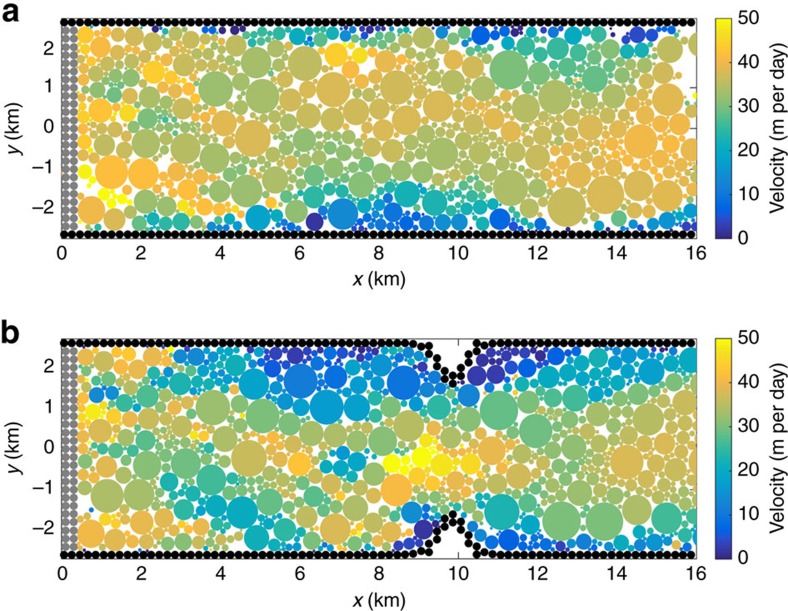
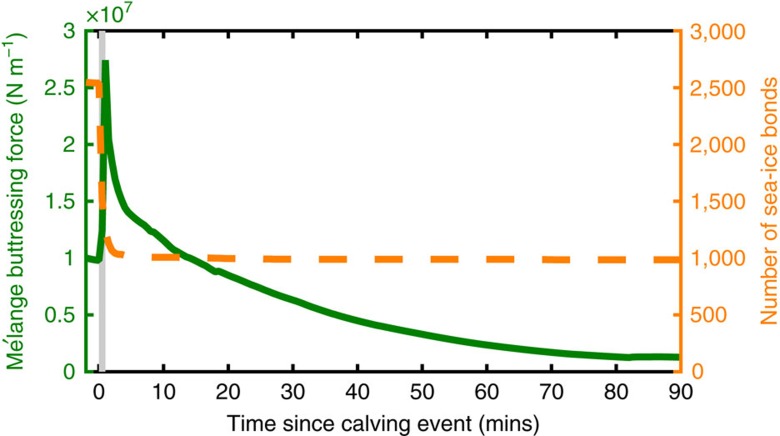
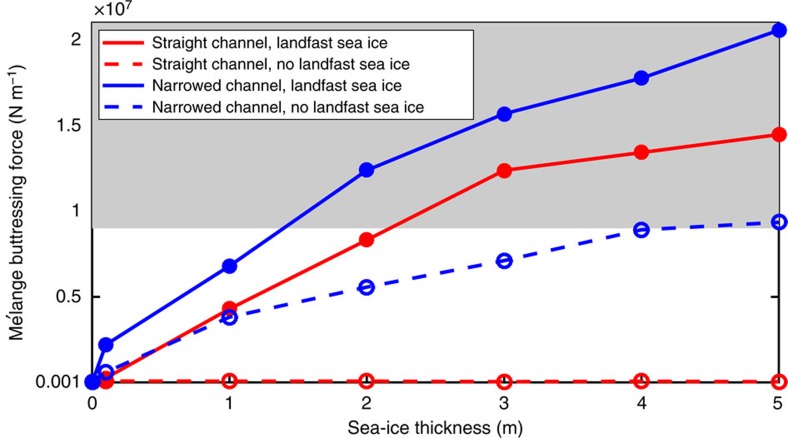
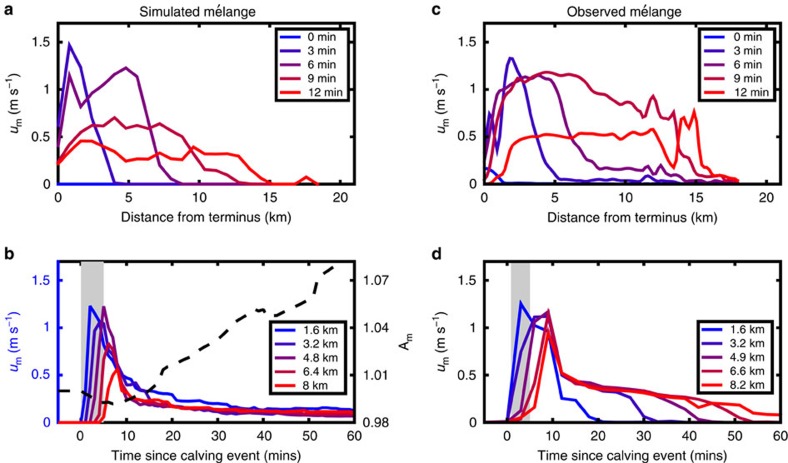
At many marine-terminating glaciers, the breakup of mélange, a floating aggregation of sea ice and icebergs, has been accompanied by an increase in iceberg calving and ice mass loss. Previous studies have argued that mélange may suppress calving by exerting a buttressing force directly on the glacier terminus. In this study, I adapt a discrete element model to explicitly simulate mélange as a cohesive granular material. Simulations show that mélange laden with thick landfast sea ice produces enough resistance to shut down calving at the terminus. When sea ice within mélange thins, the buttressing force on the terminus is reduced and calving is more likely to occur. When a calving event does occur, it initiates a propagating jamming wave within mélange, which causes local compression and then slow mélange expansion. The jamming wave can also initiate widespread fracture of sea ice and further increase the likelihood of subsequent calving events.
在许多海洋终端冰川中,混合物(一种由海冰和冰山漂浮聚集而成的混合物)的破裂伴随着冰山崩解和冰质量损失的增加。先前的研究认为,混合物可能通过直接对冰川末端施加支撑力来抑制崩解。在这项研究中,我改编了一个离散元模型来明确模拟作为粘性粒状材料的混合物。模拟表明,含有厚的陆缘海冰的混合物产生了足够的阻力,从而阻止了末端的崩解。当混合物中的海冰变薄时,对末端的支撑力减小,崩解更有可能发生。当崩解事件确实发生时,它会在混合物中引发一个传播的阻塞波,这会导致局部压缩,然后是混合物的缓慢膨胀。阻塞波也可以引发广泛的海冰断裂,并进一步增加随后崩解事件的可能性。