Yang Xin, Wang Qian, Pang Zeng-Run, Pan Meng-Ran, Zhang Wen
a School of Life Sciences , East China Normal University , Shanghai , P.R. China.
b Institute of Oncology , Shanghai 9th People's Hospital, Shanghai Jiao Tong University School of Medicine , Shanghai , P.R. China.
Pharm Biol. 2017 Dec;55(1):1207-1214. doi: 10.1080/13880209.2016.1278454.
Flavonoid-enriched extract from Hippophae rhamnoides L. (Elaeagnaceae) seed (FSH) has shown beneficial effects in anti-hypertension and lowering cholesterol level. However, evidence for its efficacy in treating obesity is limited.
We sought to determine if FSH can reduce body weight and regulate lipid metabolism disorder in high fat diet (HFD)-induced obese mouse model, and to investigate potential molecular targets involved.
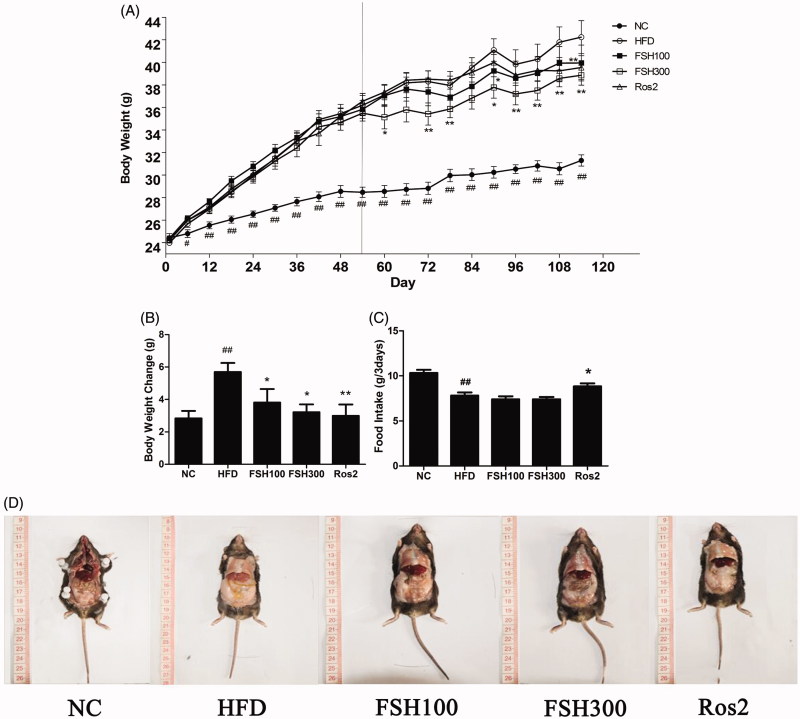
C57BL/6 mice were fed with HFD for 8 weeks to induce obesity. The modeled mice were divided into four groups and treated with vehicle, rosiglitazone (2 mg/kg), low (100 mg/kg) and high (300 mg/kg) dose of FSH, respectively. Normal control was also used. The treatments were administered orally for 9 weeks. We measured the effect of FSH on regulating body weight, various liver and serum parameters, and molecular targets that are key to lipid metabolism.
FSH administration at 100 and 300 mg/kg significantly reduced body weight gain by 33.06 and 43.51%, respectively. Additionally, triglyceride concentration in serum and liver were decreased by 15.67 and 49.56%, individually, after FSH (300 mg/kg) treatment. Upon FSH (100 and 300 mg/kg) treatment, PPARα mRNA expression was upregulated in liver (1.24- and 1.42-fold) and in adipose tissue (1.66- and 1.72-fold). Furthermore, FSH downregulated PPARγ protein level both in liver and adipose tissue. Moreover, FSH inhibited macrophage infiltration into adipose tissues, and downregulated TNFα mRNA expression in adipose tissue (38.01-47.70%).
This effect was mediated via regulation of PPARγ and PPARα gene expression, and suppression of adipose tissue inflammation.
沙棘(胡颓子科)种子富含类黄酮的提取物(FSH)已显示出抗高血压和降低胆固醇水平的有益作用。然而,其治疗肥胖症疗效的证据有限。
我们试图确定FSH是否能减轻高脂饮食(HFD)诱导的肥胖小鼠模型的体重并调节脂质代谢紊乱,并研究其中潜在的分子靶点。
C57BL/6小鼠喂食HFD 8周以诱导肥胖。将造模小鼠分为四组,分别用赋形剂、罗格列酮(2mg/kg)、低剂量(100mg/kg)和高剂量(300mg/kg)的FSH进行处理。同时设置正常对照组。处理经口服给药9周。我们测量了FSH对体重调节、各种肝脏和血清参数以及脂质代谢关键分子靶点的影响。
100mg/kg和300mg/kg的FSH给药分别使体重增加显著降低了33.06%和43.51%。此外,FSH(300mg/kg)处理后,血清和肝脏中的甘油三酯浓度分别降低了15.67%和49.56%。经FSH(100mg/kg和300mg/kg)处理后,肝脏(1.24倍和1.42倍)和脂肪组织(1.66倍和1.72倍)中的PPARα mRNA表达上调。此外,FSH下调了肝脏和脂肪组织中PPARγ蛋白水平。而且,FSH抑制巨噬细胞浸润到脂肪组织中,并下调脂肪组织中TNFα mRNA表达(38.01%-47.70%)。
这种作用是通过调节PPARγ和PPARα基因表达以及抑制脂肪组织炎症介导的。