Forsman Jonas, Keltanen Terhi, Liberg Benny, Sajantila Antti, Masterman Thomas, Lindroos Katarina
Jonas Forsman, Gotgatan 78, 11840, Stockholm, Sweden,
Croat Med J. 2017 Feb 28;58(1):34-39. doi: 10.3325/cmj.2017.58.34.
To determine whether antemortem blood levels of glycated hemoglobin (HbA1c) and glucose predict completed suicide and, by extension, whether markers of glucose metabolism might be associated with a prosuicidal trait or state.
From consecutively performed autopsies, samples of blood and vitreous humor from 17 suicide victims and 27 non-suicide controls were compared with regard to levels of glucose, lactate, and HbA1c.
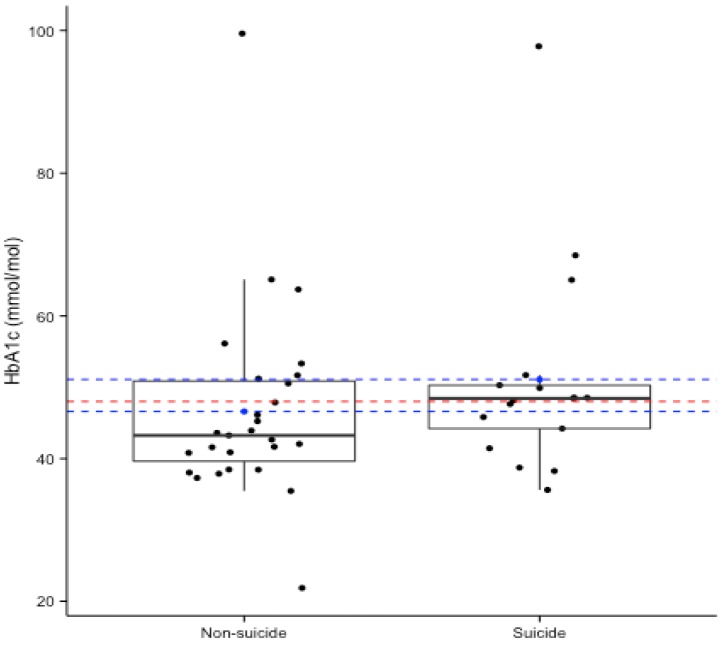
Mean HbA1c was higher, and mean estimated blood glucose lower, among suicide victims, although tests revealed no significant differences (P=0.171 and P=0.395, respectively). HbA1c levels exceeding 48.0 mmol/mol, which were indicative of persistent hyperglycemia, were twice as common in suicide victims (59% vs 30%; P=0.068).
The finding of this pilot study suggest that deranged glucose metabolism may reflect biological events antecedent to, or concomitant with, completed suicide, with the following clinical implications: recurring hyperglycemia due to defective glucose transport, which may give rise to depression and suicidal ideation, and elevated HbA1c levels, which may represent an assayable correlate to neurobiological conditions predisposing to suicide.
确定糖化血红蛋白(HbA1c)和血糖的生前血水平是否可预测自杀死亡,进而确定葡萄糖代谢标志物是否可能与自杀倾向或状态相关。
从连续进行的尸检中,比较了17名自杀受害者和27名非自杀对照者的血液和玻璃体液样本中的葡萄糖、乳酸和HbA1c水平。
自杀受害者的平均HbA1c较高,平均估计血糖较低,尽管测试显示无显著差异(分别为P = 0.171和P = 0.395)。HbA1c水平超过48.0 mmol/mol表明存在持续性高血糖,在自杀受害者中更为常见(59%对30%;P = 0.068)。
这项初步研究的结果表明,葡萄糖代谢紊乱可能反映自杀死亡之前或与之同时发生的生物学事件,具有以下临床意义:由于葡萄糖转运缺陷导致的反复高血糖可能引发抑郁和自杀观念,而HbA1c水平升高可能代表一种可检测的与易自杀的神经生物学状况相关的指标。