Shin Soo Hyun, Park Eun-Joo, Min Changki, Choi Sun Il, Jeon Soyeon, Kim Yun-Hee, Kim Daehong
Molecular Imaging & Therapy Branch, Division of Precision Medicine, National Cancer Center, Goyang, Korea.
Dept. of Radiology, Seoul National University Hospital, Seoul, Korea.
Theranostics. 2017 Jan 7;7(3):562-572. doi: 10.7150/thno.16895. eCollection 2017.
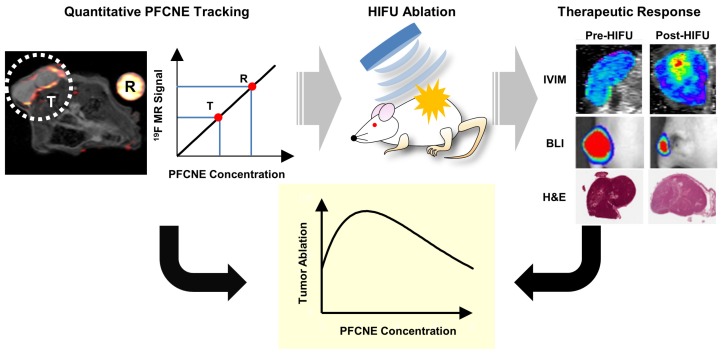
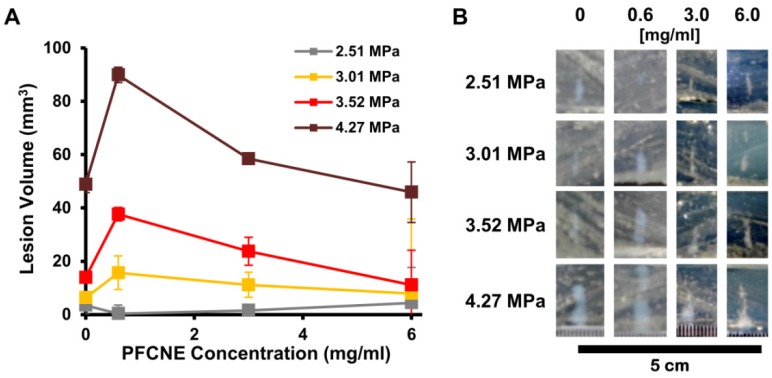
Perfluorocarbon nanoemulsions (PFCNEs) have recently been undergoing rigorous study to investigate their ability to improve the therapeutic efficacy of tumor ablation by high intensity focused ultrasound (HIFU). For precise control of PFCNE delivery and thermal ablation, their accumulation and distribution in a tumor should be quantitatively analyzed. Here, we used fluorine-19 (F) magnetic resonance imaging (MRI) to quantitatively track PFCNE accumulation in a tumor, and analyzed how intra-tumoral PFCNE quantities affect the therapeutic efficacy of HIFU treatment. Ablation outcomes were assessed by intra-voxel incoherent motion analysis and bioluminescent imaging up to 14 days after the procedure. Assessment of PFCNE delivery and treatment outcomes showed that 2-3 mg/mL of PFCNE in a tumor produces the largest ablation volume under the same HIFU insonation conditions. Histology showed varying degrees of necrosis depending on the amount of PFCNE delivered. F MRI promises to be a valuable platform for precisely guiding PFCNE-enhanced HIFU ablation of tumors.
全氟碳纳米乳剂(PFCNEs)最近正在接受严格研究,以探究其提高高强度聚焦超声(HIFU)肿瘤消融治疗效果的能力。为了精确控制PFCNE的递送和热消融,需要对它们在肿瘤中的蓄积和分布进行定量分析。在此,我们使用氟-19(F)磁共振成像(MRI)对肿瘤中PFCNE的蓄积进行定量追踪,并分析瘤内PFCNE的量如何影响HIFU治疗的疗效。在术后长达14天的时间里,通过体素内不相干运动分析和生物发光成像评估消融结果。对PFCNE递送和治疗结果的评估表明,在相同的HIFU照射条件下,肿瘤中2-3 mg/mL的PFCNE产生的消融体积最大。组织学显示,根据递送的PFCNE量不同,坏死程度也有所不同。F MRI有望成为精确指导PFCNE增强型HIFU肿瘤消融的重要平台。