Poenaru D, Pemberton J, Frankfurter C, Cameron B H, Stolk E
McMaster Pediatric Surgery Research Collaborative, Dept. of Surgery, McMaster University, Hamilton, Canada.
MyungSung Medical College, Addis Ababa, Ethiopia.
Popul Health Metr. 2017 Mar 4;15(1):8. doi: 10.1186/s12963-017-0125-5.
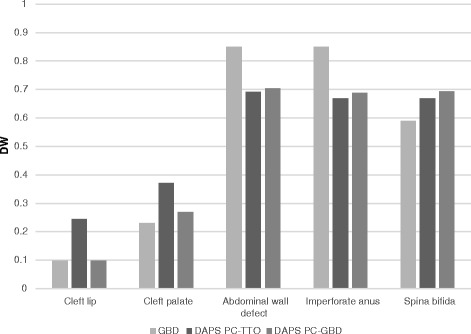
Burden of disease (BoD) as measured by Disability-Adjusted Life Years (DALYs) is one of the criteria for priority-setting in health care resource allocation. DALYs incorporate disability weights (DWs), which are currently expert-derived estimates or non-existent for most pediatric surgical conditions. The objective of this study is to establish DWs for a subset of key pediatric congenital anomalies using a range of health valuation metrics with caregivers in both high- and low-resource settings.
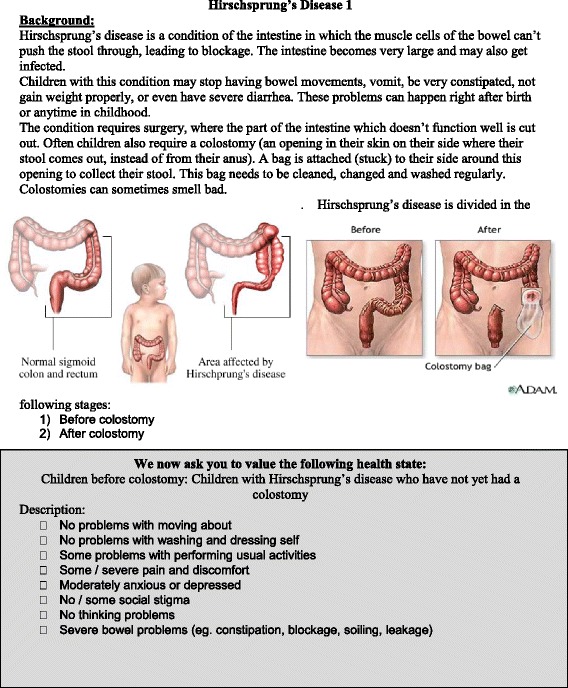
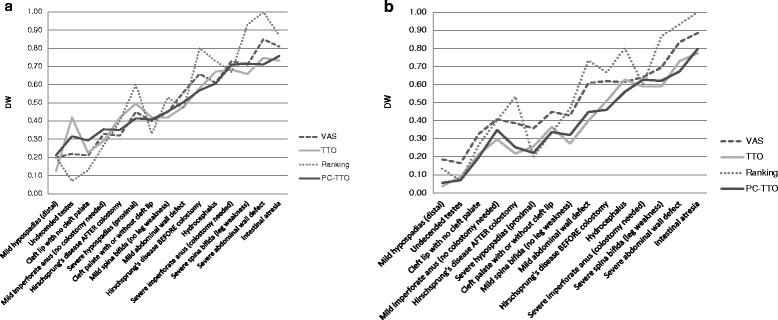
We described 15 health states to health professionals (physicians, nurses, social workers, and therapists) and community caregivers in Kenya and Canada. The health states summaries were expert- and community-derived, consisting of a narrated description of the disease and a functional profile described in EQ-5D-5 L style. DWs for each health state were elicited using four health valuation exercises (preference ranking, visual analogue scale (VAS), paired comparison (PC), and time trade-off (TTO)). The PC data were anchored internally to the TTO and externally to existing data to yield DWs for each health state on a scale from 0 (health) to 1 (dead). Any differences in DWs between the two countries were analyzed.
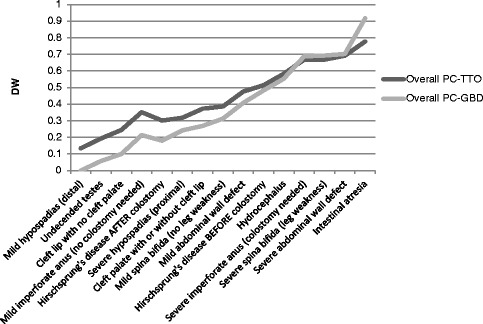
In total, 154 participants, matched by profession, were recruited from Kijabe, Kenya (n = 78) and Hamilton, Canada (n = 76). Overall calculated DWs for 15 health states ranged from 0.13 to 0.77, with little difference between countries (intra-class coefficient 0.97). However, DWs generated in Kenya for severe hypospadias and undescended testes were higher than Canadian-derived DWs (p = 0.04 and p < 0.003, respectively).
We have derived country-specific DWs for pediatric congenital anomalies using several low-cost methods and inter-professional and community caregivers. The TTO-anchored PC method appears best suited for future use. The majority of DWs do not appear to differ significantly between the two cultural contexts and could be used to inform further work of estimating the burden of global pediatric surgical disease. Care should be taken in comparing the DWs obtained in the current study to the existent list of DWs because methodological differences may impact on their compatibility.
以伤残调整生命年(DALYs)衡量的疾病负担是卫生保健资源分配中确定优先事项的标准之一。DALYs纳入了残疾权重(DWs),目前大多数儿科手术疾病的残疾权重是由专家得出的估计值,或者根本不存在。本研究的目的是使用一系列健康评估指标,在高资源和低资源环境中与护理人员一起,为一组关键的儿科先天性异常建立残疾权重。
我们向肯尼亚和加拿大的卫生专业人员(医生、护士、社会工作者和治疗师)以及社区护理人员描述了15种健康状态。健康状态总结由专家和社区得出,包括对疾病的叙述性描述以及用EQ-5D-5L格式描述的功能概况。使用四种健康评估方法(偏好排序、视觉模拟量表(VAS)、配对比较(PC)和时间权衡(TTO))得出每种健康状态的残疾权重。PC数据在内部以TTO为基准,在外部以现有数据为基准,以得出每种健康状态在从0(健康)到1(死亡)范围内的残疾权重。分析了两国之间残疾权重的任何差异。
总共从肯尼亚基贾贝(n = 78)和加拿大汉密尔顿(n = 76)招募了154名按职业匹配的参与者。15种健康状态总体计算出的残疾权重范围为0.13至0.77,两国之间差异不大(组内系数为0.97)。然而,肯尼亚得出的重度尿道下裂和隐睾症的残疾权重高于加拿大得出的值(分别为p = 0.04和p <0.003)。
我们使用几种低成本方法以及跨专业和社区护理人员得出了针对儿科先天性异常的特定国家残疾权重。以TTO为基准的PC方法似乎最适合未来使用。在这两种文化背景下,大多数残疾权重似乎没有显著差异,可用于为估计全球儿科手术疾病负担的进一步工作提供参考。在将本研究中获得的残疾权重与现有残疾权重列表进行比较时应谨慎,因为方法学差异可能会影响它们的兼容性。