Ishibashi Yuji, Matsui Takanori, Isami Fumiyuki, Abe Yumi, Sakaguchi Tatsuya, Higashimoto Yuichiro, Yamagishi Sho-Ichi
Department of Pathophysiology and Therapeutics of Diabetic Vascular Complications, Kurume University School of Medicine, Kurume, 830-0011, Japan.
Morinda Worldwide Inc., Tokyo, 160-0023, Japan.
BMC Complement Altern Med. 2017 Mar 4;17(1):137. doi: 10.1186/s12906-017-1641-3.
Advanced glycation end products (AGEs), senescent macroprotein derivatives formed during a normal aging process and acceleratedly under diabetic conditions, play a role in atherosclerotic cardiovascular disease. AGEs cause endothelial cell (EC) damage, an initial trigger for atherosclerosis through the interaction with a receptor for AGEs (RAGE). We have previously shown that n-butanol extracts of Morinda citrifolia (noni), a plant belonging to the family Rubiaceae, block the binding of AGEs to RAGE in vitro. In this study, we examined the effects of n-butanol extracts of noni on reactive oxygen species (ROS) generation and inflammatory reactions on AGE-exposed human umbilical vein ECs (HUVECs).
HUVECs were treated with 100 μg/ml AGE-bovine serum albumin (AGE-BSA) or non-glycated BSA in the presence or absence of 670 ng/ml n-butanol extracts of noni for 4 h. Then ROS generation and inflammatory and gene expression in HUVECs were evaluated by dihydroethidium staining and real-time reverse transcription-polymerase chain reaction analyses, respectively. THP-1 cell adhesion to HUVECs was measured after 2-day incubation of AGE-BSA or BSA in the presence or absence of 670 ng/ml n-butanol extracts of noni.
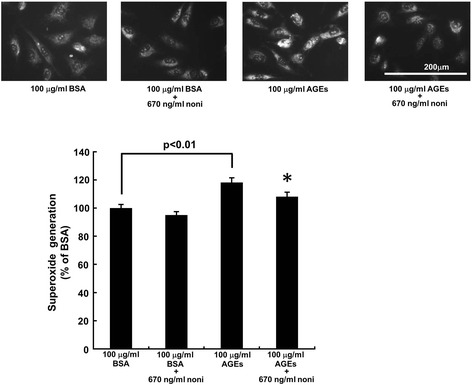
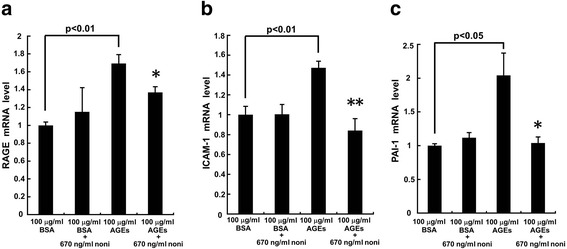
N-butanol extracts of noni at 670 ng/ml significantly inhibited the AGE-induced ROS generation and RAGE, intercellular adhesion molecule-1 and plasminogen activator inhibitor-1 gene expressions in HUVECs. AGEs significantly increased monocytic THP-1 cell adhesion to HUVECs, which was also prevented by 670 ng/ml n-butanol extracts of noni.
The present study demonstrated for the first time that N-butanol extracts of noni could suppress the AGE-induced inflammatory reactions in HUVECs through its anti-oxidative properties via blocking of the interaction of AGEs with RAGE. Inhibition of the AGE-RAGE axis by n-butanol extracts of noni may be a novel nutraceutical strategy for the treatment of cardiovascular disease.
晚期糖基化终产物(AGEs)是在正常衰老过程中形成的衰老大分子蛋白质衍生物,在糖尿病条件下会加速形成,其在动脉粥样硬化性心血管疾病中发挥作用。AGEs通过与AGE受体(RAGE)相互作用导致内皮细胞(EC)损伤,这是动脉粥样硬化形成的初始触发因素。我们之前已经表明,茜草科植物海巴戟(诺丽)的正丁醇提取物在体外可阻断AGEs与RAGE的结合。在本研究中,我们检测了诺丽正丁醇提取物对暴露于AGEs的人脐静脉内皮细胞(HUVECs)中活性氧(ROS)生成和炎症反应的影响。
将HUVECs在存在或不存在670 ng/ml诺丽正丁醇提取物的情况下,用100 μg/ml AGE - 牛血清白蛋白(AGE - BSA)或未糖基化的BSA处理4小时。然后分别通过二氢乙锭染色和实时逆转录 - 聚合酶链反应分析评估HUVECs中的ROS生成、炎症和基因表达。在存在或不存在670 ng/ml诺丽正丁醇提取物的情况下,将AGE - BSA或BSA孵育2天后,测量THP - 1细胞与HUVECs的黏附情况。
670 ng/ml的诺丽正丁醇提取物显著抑制了AGE诱导的HUVECs中ROS生成以及RAGE、细胞间黏附分子 - 1和纤溶酶原激活物抑制剂 - 1基因的表达。AGEs显著增加了单核细胞THP - 1细胞与HUVECs的黏附,670 ng/ml的诺丽正丁醇提取物也可阻止这种黏附。
本研究首次证明,诺丽正丁醇提取物可通过阻断AGEs与RAGE的相互作用,凭借其抗氧化特性抑制AGE诱导的HUVECs中的炎症反应。诺丽正丁醇提取物对AGE - RAGE轴的抑制作用可能是一种治疗心血管疾病的新型营养保健策略。