Plague Unit, Institut Pasteur de Madagascar, Antananarivo, Madagascar.
Ecole Doctorale Science de la Vie et de l'Environnement, Université d'Antananarivo, Antananarivo, Madagascar.
Parasit Vectors. 2017 Mar 4;10(1):125. doi: 10.1186/s13071-017-2061-4.
Rickettsiae are obligate intracellular bacteria responsible for many febrile syndromes around the world, including in sub-Saharan Africa. Vectors of these pathogens include ticks, lice, mites and fleas. In order to assess exposure to flea-associated Rickettsia species in Madagascar, human and small mammal samples from an urban and a rural area, and their associated fleas were tested.
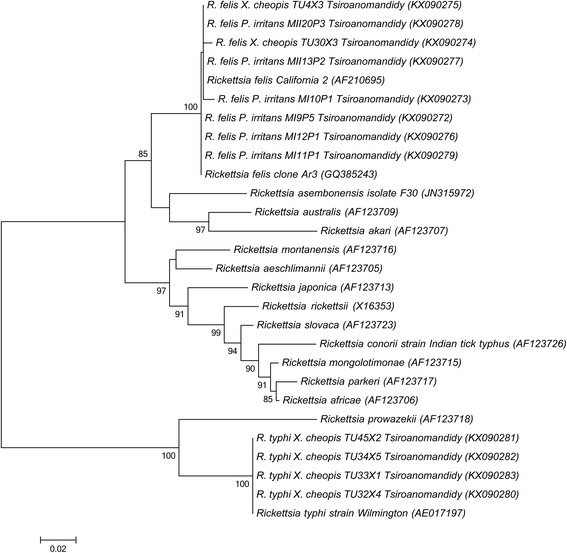
Anti-typhus group (TGR)- and anti-spotted fever group rickettsiae (SFGR)-specific IgG were detected in 24 (39%) and 21 (34%) of 62 human serum samples, respectively, using indirect ELISAs, with six individuals seropositive for both. Only two (2%) Rattus rattus out of 86 small mammals presented antibodies against TGR. Out of 117 fleas collected from small mammals, Rickettsia typhi, a TGR, was detected in 26 Xenopsylla cheopis (24%) collected from rodents of an urban area (n = 107), while two of these urban X. cheopis (2%) were positive for Rickettsia felis, a SFGR. R. felis DNA was also detected in eight (31%) out of 26 Pulex irritans fleas.
The general population in Madagascar are exposed to rickettsiae, and two flea-associated Rickettsia pathogens, R. typhi and R. felis, are present near or in homes. Although our results are from a single district, they demonstrate that rickettsiae should be considered as potential agents of undifferentiated fever in Madagascar.
立克次体是一种专性细胞内细菌,负责全世界许多发热综合征,包括撒哈拉以南非洲。这些病原体的媒介包括蜱、虱子、螨虫和跳蚤。为了评估马达加斯加与跳蚤相关的立克次体物种的暴露情况,对来自城市和农村地区的人类和小型哺乳动物样本及其相关跳蚤进行了测试。
使用间接 ELISA 法,在 62 个人血清样本中分别检测到 24 份(39%)和 21 份(34%)抗斑疹伤寒群(TGR)和抗斑点热群立克次体(SFGR)的特异性 IgG,其中 6 人对两者均呈血清阳性。在 86 只小型哺乳动物中,仅有 2 只(2%)Rattus rattus 呈现出针对 TGR 的抗体。从小型哺乳动物中采集的 117 只跳蚤中,在从城市地区的啮齿动物中采集的 26 只 Xenopsylla cheopis(24%)中检测到 TGR 立克次体,而这些城市 X. cheopis 中有 2 只(2%)呈 Rickettsia felis 阳性,这是一种 SFGR。在 26 只 Pulex irritans 跳蚤中,也检测到了 8 只(31%)的 R. felis DNA。
马达加斯加的一般人群接触立克次体,两种与跳蚤相关的立克次体病原体,R. typhi 和 R. felis,存在于家庭附近或家庭中。尽管我们的结果来自一个地区,但它们表明立克次体应被视为马达加斯加未分化发热的潜在病原体。