Wijngaard René R, van der Perk Marcel, van der Grift Bas, de Nijs Ton C M, Bierkens Marc F P
Department of Physical Geography, Faculty of Geosciences, Utrecht University, P.O. Box 80115, 3508 TC Utrecht, The Netherlands.
FutureWater, Costerweg 1V, 6702 AA Wageningen, The Netherlands.
Water Air Soil Pollut. 2017;228(3):107. doi: 10.1007/s11270-017-3261-4. Epub 2017 Feb 17.
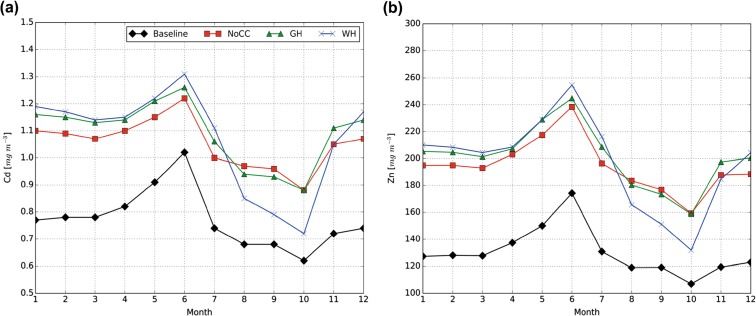
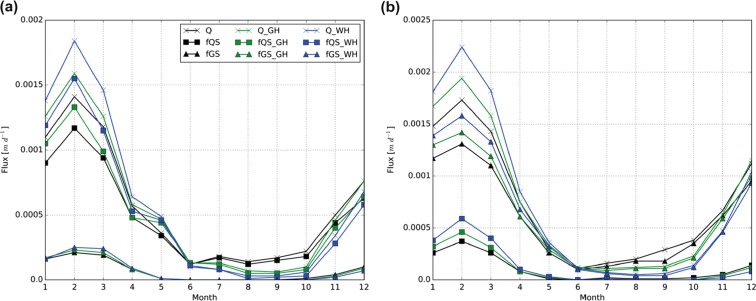
This study investigates the impact of future climate change on heavy metal (i.e., Cd and Zn) transport from soils to surface waters in a contaminated lowland catchment. The WALRUS hydrological model is employed in a semi-distributed manner to simulate current and future hydrological fluxes in the Dommel catchment in the Netherlands. The model is forced with climate change projections and the simulated fluxes are used as input to a metal transport model that simulates heavy metal concentrations and loads in quickflow and baseflow pathways. Metal transport is simulated under baseline climate ("2000-2010") and future climate ("2090-2099") conditions including scenarios for no climate change and climate change. The outcomes show an increase in Cd and Zn loads and the mean flux-weighted Cd and Zn concentrations in the discharged runoff, which is attributed to breakthrough of heavy metals from the soil system. Due to climate change, runoff enhances and leaching is accelerated, resulting in enhanced Cd and Zn loads. Mean flux-weighted concentrations in the discharged runoff increase during early summer and decrease during late summer and early autumn under the most extreme scenario of climate change. The results of this study provide improved understanding on the processes responsible for future changes in heavy metal contamination in lowland catchments.
本研究调查了未来气候变化对受污染低地流域土壤中重金属(即镉和锌)向地表水迁移的影响。采用WALRUS水文模型以半分布式方式模拟荷兰多梅尔流域当前和未来的水文通量。该模型以气候变化预测为驱动,模拟通量用作金属迁移模型的输入,该模型模拟快速流和基流路径中的重金属浓度和负荷。在基线气候(“2000 - 2010”)和未来气候(“2090 - 2099”)条件下模拟金属迁移,包括无气候变化和气候变化的情景。结果表明,排放径流中镉和锌的负荷以及平均通量加权镉和锌浓度有所增加,这归因于重金属从土壤系统中的突破。由于气候变化,径流增加且淋溶加速,导致镉和锌负荷增加。在最极端的气候变化情景下,排放径流中的平均通量加权浓度在初夏增加,在夏末和初秋降低。本研究结果有助于更好地理解低地流域未来重金属污染变化的相关过程。