Soares Sandra C, Maior Rafael S, Isbell Lynne A, Tomaz Carlos, Nishijo Hisao
Department of Education and Psychology, CINTESIS.UA, University of AveiroAveiro, Portugal; Division of Psychology, Department of Clinical Neuroscience, Karolinska InstituteStockholm, Sweden; William James Research Center, Instituto Superior de Psicologia AplicadaLisbon, Portugal.
Division of Psychology, Department of Clinical Neuroscience, Karolinska InstituteStockholm, Sweden; Department of Physiological Sciences, Primate Center, Institute of Biology, University of BrasíliaBrasília, Brazil.
Front Neurosci. 2017 Feb 17;11:67. doi: 10.3389/fnins.2017.00067. eCollection 2017.
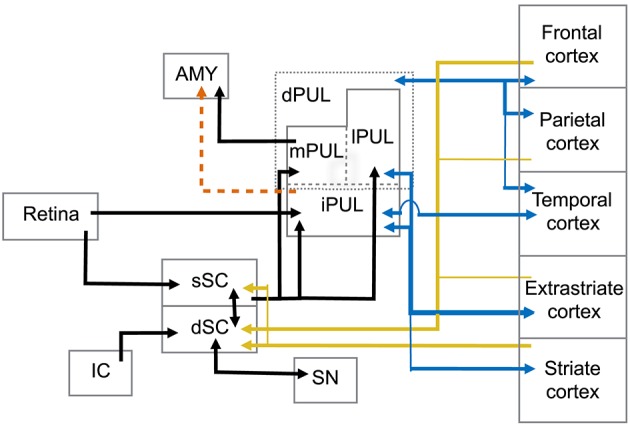
Primates are distinguished from other mammals by their heavy reliance on the visual sense, which occurred as a result of natural selection continually favoring those individuals whose visual systems were more responsive to challenges in the natural world. Here we describe two independent but also interrelated visual systems, one cortical and the other subcortical, both of which have been modified and expanded in primates for different functions. Available evidence suggests that while the cortical visual system mainly functions to give primates the ability to assess and adjust to fluid social and ecological environments, the subcortical visual system appears to function as a rapid detector and first responder when time is of the essence, i.e., when survival requires very quick action. We focus here on the subcortical visual system with a review of behavioral and neurophysiological evidence that demonstrates its sensitivity to particular, often emotionally charged, ecological and social stimuli, i.e., snakes and fearful and aggressive facial expressions in conspecifics. We also review the literature on subcortical involvement during another, less emotional, situation that requires rapid detection and response-visually guided reaching and grasping during locomotion-to further emphasize our argument that the subcortical visual system evolved as a rapid detector/first responder, a function that remains in place today. Finally, we argue that investigating deficits in this subcortical system may provide greater understanding of Parkinson's disease and Autism Spectrum disorders (ASD).
灵长类动物与其他哺乳动物的区别在于它们对视觉的高度依赖,这是自然选择持续青睐那些视觉系统对自然界挑战反应更灵敏的个体的结果。在此,我们描述两个独立但又相互关联的视觉系统,一个是皮层视觉系统,另一个是皮层下视觉系统,这两个系统在灵长类动物中都因不同功能而得到了改变和扩展。现有证据表明,皮层视觉系统的主要功能是使灵长类动物能够评估并适应动态的社会和生态环境,而皮层下视觉系统似乎在时间至关重要时,即生存需要迅速行动时,发挥快速探测器和第一反应者的作用。我们在此聚焦于皮层下视觉系统,回顾行为学和神经生理学证据,这些证据表明其对特定的、通常带有情感色彩的生态和社会刺激敏感,即对蛇以及同种个体恐惧和攻击性的面部表情敏感。我们还回顾了关于在另一种不那么情绪化的情况下皮层下参与的文献,这种情况需要快速检测和反应——即运动过程中的视觉引导伸手抓握——以进一步强调我们的观点,即皮层下视觉系统进化为快速探测器/第一反应者,这一功能至今仍然存在。最后,我们认为研究这个皮层下系统的缺陷可能会让我们对帕金森病和自闭症谱系障碍(ASD)有更深入的了解。