• 文献检索
  • 文档翻译
  • 深度研究
  • 学术资讯
  • Suppr Zotero 插件Zotero 插件
  • 邀请有礼
  • 套餐&价格
  • 历史记录
应用&插件
Suppr Zotero 插件Zotero 插件浏览器插件Mac 客户端Windows 客户端微信小程序
定价
高级版会员购买积分包购买API积分包
服务
文献检索文档翻译深度研究API 文档MCP 服务
关于我们
关于 Suppr公司介绍联系我们用户协议隐私条款
关注我们

Suppr 超能文献

核心技术专利:CN118964589B侵权必究
粤ICP备2023148730 号-1Suppr @ 2026

文献检索

告别复杂PubMed语法,用中文像聊天一样搜索,搜遍4000万医学文献。AI智能推荐,让科研检索更轻松。

立即免费搜索

文件翻译

保留排版,准确专业,支持PDF/Word/PPT等文件格式,支持 12+语言互译。

免费翻译文档

深度研究

AI帮你快速写综述,25分钟生成高质量综述,智能提取关键信息,辅助科研写作。

立即免费体验

中风康复中的有氧运动处方:对美国物理治疗师的一项基于网络的调查。

Aerobic Exercise Prescription in Stroke Rehabilitation: A Web-Based Survey of US Physical Therapists.

作者信息

Boyne Pierce, Billinger Sandra, MacKay-Lyons Marilyn, Barney Brian, Khoury Jane, Dunning Kari

机构信息

Department of Rehabilitation Sciences, College of Allied Health Sciences, University of Cincinnati (P.B., B.B., K.D.), Department of Environmental Health, College of Medicine, University of Cincinnati (P.B., J.K., K.D.), and Division of Biostatistics and Epidemiology, Cincinnati Children's Hospital Medical Center (J.K.), Cincinnati, Ohio; Department of Physical Therapy and Rehabilitation Science, School of Health Professions, University of Kansas Medical Center, Kansas City (S.B.); and School of Physiotherapy, Dalhousie University, Halifax, Nova Scotia, Canada (M.M.-L.).

出版信息

J Neurol Phys Ther. 2017 Apr;41(2):119-128. doi: 10.1097/NPT.0000000000000177.

DOI:10.1097/NPT.0000000000000177
PMID:28263254
原文链接:https://pmc.ncbi.nlm.nih.gov/articles/PMC5357184/
Abstract

BACKGROUND AND PURPOSE

Best practice recommendations indicate that aerobic exercise (AEX) should be incorporated into stroke rehabilitation. However, this may be challenging in clinical settings. The purpose of this study was to assess physical therapist (PT) AEX prescription for patients with stroke, including AEX utilization, barriers to AEX prescription, dosing parameters, and safety considerations.

METHODS

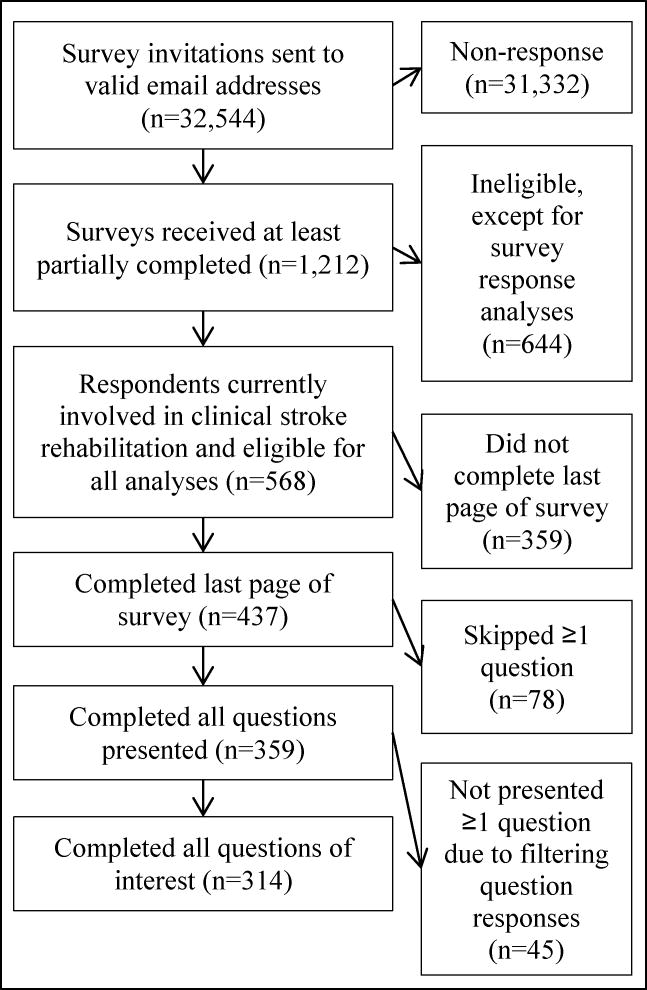
A cross-sectional Web-based survey study was conducted. Physical therapists with valid e-mail addresses on file with the state boards of Florida, New Jersey, Ohio, Texas, and Wyoming were eligible to participate. Survey invitations were e-mailed to all licensed PT in these states. Analysis focused on respondents who were currently involved with clinical stroke rehabilitation in common practice settings.

RESULTS

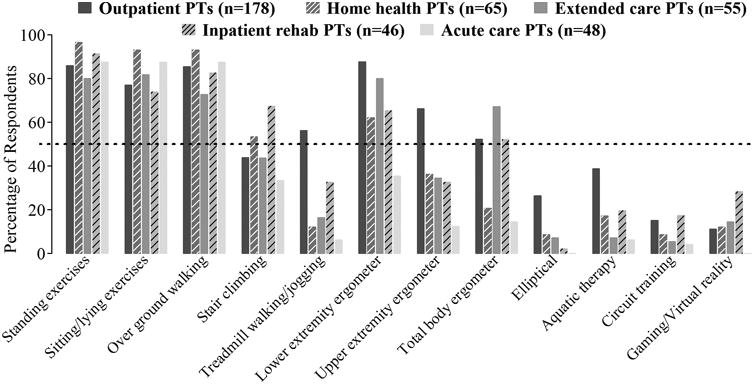
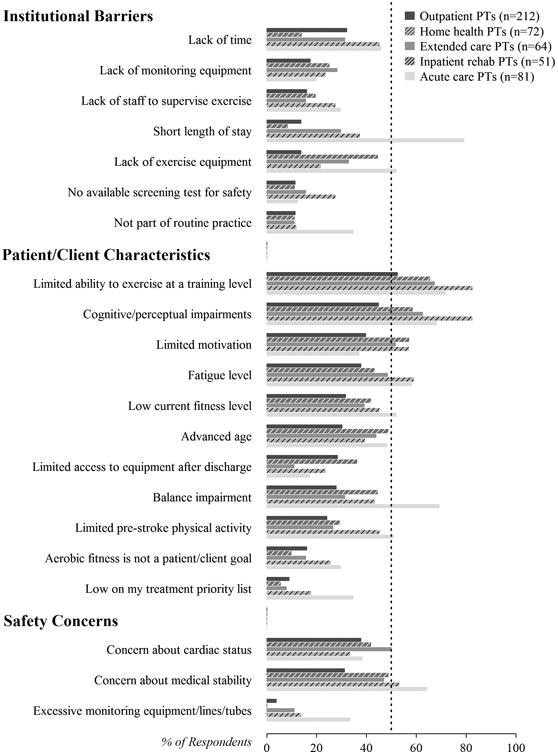
Results from 568 respondents were analyzed. Most respondents (88%) agreed that AEX should be incorporated into stroke rehabilitation, but 84% perceived at least one barrier. Median prescribed AEX volume varied between practice settings from 20- to 30-minute AEX sessions, 3 to 5 days per week for 2 to 8 weeks. Prescribed intensity was most commonly light or moderate; intensity was determined by the general response to AEX and patient feedback. Only 2% of respondents reported that the majority of their patients with stroke had stress tests.

DISCUSSION AND CONCLUSIONS

Most US PTs appear to recognize the importance of AEX for persons poststroke, but clinical implementation can be challenging. Future studies and consensus are needed to clarify best practices and to develop implementation interventions to optimize AEX utilization in stroke rehabilitation.Video Abstract available for more insights from the authors (see Video, Supplemental Digital Content 1, http://links.lww.com/JNPT/A167).

摘要

背景与目的

最佳实践建议指出,有氧运动(AEX)应纳入中风康复治疗中。然而,在临床环境中这可能具有挑战性。本研究的目的是评估物理治疗师(PT)为中风患者开具的AEX处方,包括AEX的使用情况、AEX处方的障碍、剂量参数和安全考虑因素。

方法

进行了一项基于网络的横断面调查研究。在佛罗里达州、新泽西州、俄亥俄州、得克萨斯州和怀俄明州州立委员会存档有有效电子邮件地址的物理治疗师有资格参与。向这些州的所有持牌PT发送了调查邀请电子邮件。分析集中在当前在常见实践环境中参与临床中风康复的受访者。

结果

分析了568名受访者的结果。大多数受访者(88%)同意AEX应纳入中风康复,但84%的人认为至少存在一个障碍。不同实践环境中规定的AEX时长中位数为每次20至30分钟,每周3至5天,持续2至8周。规定的强度最常见的是轻度或中度;强度由对AEX的总体反应和患者反馈决定。只有2%的受访者报告说他们的大多数中风患者进行了压力测试。

讨论与结论

大多数美国物理治疗师似乎认识到AEX对中风后患者的重要性,但临床实施可能具有挑战性。需要未来的研究和共识来阐明最佳实践,并制定实施干预措施,以优化中风康复中AEX的使用。可获取视频摘要以获得作者更多见解(见视频,补充数字内容1,http://links.lww.com/JNPT/A167)。
https://cdn.ncbi.nlm.nih.gov/pmc/blobs/57fc/5357184/a9028feeb544/nihms845897f3.jpg
https://cdn.ncbi.nlm.nih.gov/pmc/blobs/57fc/5357184/371ad7769d34/nihms845897f1.jpg
https://cdn.ncbi.nlm.nih.gov/pmc/blobs/57fc/5357184/f8433f27381d/nihms845897f2.jpg
https://cdn.ncbi.nlm.nih.gov/pmc/blobs/57fc/5357184/a9028feeb544/nihms845897f3.jpg
https://cdn.ncbi.nlm.nih.gov/pmc/blobs/57fc/5357184/371ad7769d34/nihms845897f1.jpg
https://cdn.ncbi.nlm.nih.gov/pmc/blobs/57fc/5357184/f8433f27381d/nihms845897f2.jpg
https://cdn.ncbi.nlm.nih.gov/pmc/blobs/57fc/5357184/a9028feeb544/nihms845897f3.jpg

相似文献

1
Aerobic Exercise Prescription in Stroke Rehabilitation: A Web-Based Survey of US Physical Therapists.中风康复中的有氧运动处方:对美国物理治疗师的一项基于网络的调查。
J Neurol Phys Ther. 2017 Apr;41(2):119-128. doi: 10.1097/NPT.0000000000000177.
2
Utilization of aerobic exercise in adult neurological rehabilitation by physical therapists in Canada.加拿大物理治疗师在成人神经康复中对有氧运动的应用。
J Neurol Phys Ther. 2013 Mar;37(1):20-6. doi: 10.1097/NPT.0b013e318282975c.
3
Adverse Events During Submaximal Aerobic Exercise Testing in People With Subacute Stroke: A Scoping Review.亚急性脑卒中患者次最大有氧运动试验期间的不良事件:范围综述。
J Neurol Phys Ther. 2024 Jan 1;48(1):27-37. doi: 10.1097/NPT.0000000000000445. Epub 2023 May 15.
4
Factors That Influence the Clinical Implementation of Aerobic Exercise in Stroke Rehabilitation: A Theory-Informed Qualitative Study.影响脑卒中康复中有氧运动实施的因素:一项基于理论的定性研究。
Phys Ther. 2022 Jun 3;102(6). doi: 10.1093/ptj/pzac014.
5
Aerobic Training in Canadian Stroke Rehabilitation Programs.加拿大脑卒中康复项目中的有氧运动训练。
J Neurol Phys Ther. 2018 Oct;42(4):248-255. doi: 10.1097/NPT.0000000000000237.
6
Barriers and Facilitators to Aerobic Exercise Implementation in Stroke Rehabilitation: A Scoping Review.在脑卒中康复中实施有氧运动的障碍和促进因素:范围综述。
J Neurol Phys Ther. 2020 Jul;44(3):179-187. doi: 10.1097/NPT.0000000000000318.
7
Facilitating Community-Based Exercise for People With Stroke: Cross-Sectional e-Survey of Physical Therapist Practice and Perceived Needs.促进中风患者的社区锻炼:物理治疗师实践与感知需求的横断面电子调查
Phys Ther. 2016 Apr;96(4):469-78. doi: 10.2522/ptj.20150117. Epub 2015 Aug 20.
8
Treadmill exercise rehabilitation improves ambulatory function and cardiovascular fitness in patients with chronic stroke: a randomized, controlled trial.跑步机运动康复改善慢性卒中患者的步行功能和心血管健康:一项随机对照试验。
Stroke. 2005 Oct;36(10):2206-11. doi: 10.1161/01.STR.0000181076.91805.89. Epub 2005 Sep 8.
9
Factors Influencing the Efficacy of Aerobic Exercise for Improving Fitness and Walking Capacity After Stroke: A Meta-Analysis With Meta-Regression.影响有氧运动改善中风后体能和步行能力效果的因素:一项Meta回归Meta分析
Arch Phys Med Rehabil. 2017 Mar;98(3):581-595. doi: 10.1016/j.apmr.2016.08.484. Epub 2016 Oct 12.
10
Aerobic exercise and consecutive task-specific training (AExaCTT) for upper limb recovery after stroke: A randomized controlled pilot study.有氧运动和连续特定任务训练(AExaCTT)对中风后上肢恢复的影响:一项随机对照试验性研究
Physiother Res Int. 2019 Jul;24(3):e1775. doi: 10.1002/pri.1775. Epub 2019 Apr 3.

引用本文的文献

1
Exploring physiotherapists' knowledge and perception of exercise intensity in outpatient stroke rehabilitation: A qualitative study.探索物理治疗师在门诊中风康复中对运动强度的知识和认知:一项定性研究。
PLoS One. 2025 Jun 11;20(6):e0325098. doi: 10.1371/journal.pone.0325098. eCollection 2025.
2
Is training speed an accurate predictor of who attains a minimal clinically important difference in the six-minute walk test in people with chronic stroke?训练速度能否准确预测慢性中风患者在六分钟步行测试中达到最小临床重要差异的情况?
Top Stroke Rehabil. 2025 Jun 9:1-11. doi: 10.1080/10749357.2025.2513260.
3
Using Exercise Intensity to Predict a Minimal Clinically Important Difference in the Six-Minute Walk Test in People with Chronic Stroke.

本文引用的文献

1
Socially Desirable Responding in Web-Based Questionnaires: A Meta-Analytic Review of the Candor Hypothesis.基于网络问卷的社会赞许性反应:坦诚假设的元分析综述。
Assessment. 2017 Sep;24(6):746-762. doi: 10.1177/1073191115624547. Epub 2016 Jan 6.
2
Heart Disease and Stroke Statistics-2016 Update: A Report From the American Heart Association.《2016年心脏病和中风统计数据更新:美国心脏协会报告》
Circulation. 2016 Jan 26;133(4):e38-360. doi: 10.1161/CIR.0000000000000350. Epub 2015 Dec 16.
3
Predicting Heart Rate at the Ventilatory Threshold for Aerobic Exercise Prescription in Persons With Chronic Stroke.
利用运动强度预测慢性卒中患者六分钟步行试验中最小临床重要差异
medRxiv. 2025 Apr 16:2025.04.15.25325882. doi: 10.1101/2025.04.15.25325882.
4
High Intensity Interval Training POst-STroke (HIIT-POST): Perspectives of People Living With Stroke and Health Professionals.高强度间歇训练中风后(HIIT-POST):中风患者和健康专业人员的观点
Neurorehabil Neural Repair. 2025 May;39(5):343-354. doi: 10.1177/15459683251317185. Epub 2025 Feb 11.
5
Taking the Next Step in Neurologic Rehabilitation: Contributions of Intensity and Variability of Stepping Tasks During Locomotor Training.在神经康复领域迈出下一步:步行训练中步行动作任务的强度和变异性的作用
Phys Ther. 2025 Mar 3;105(3). doi: 10.1093/ptj/pzaf005.
6
Duration and Efficiency of Combined versus Isolated Aerobic Training Interventions in Post-Stroke Cognition: A Systematic Review.中风后认知中联合与单独有氧训练干预的持续时间和效率:一项系统综述。
Port J Public Health. 2024 Jan 8;42(1):43-62. doi: 10.1159/000535272. eCollection 2024 Apr.
7
High-Intensity Exercise Training Impact on Cardiorespiratory Fitness, Gait Ability, and Balance in Stroke Survivors: A Systematic Review and Meta-Analysis.高强度运动训练对脑卒中幸存者心肺适能、步态能力和平衡的影响:一项系统评价和荟萃分析
J Clin Med. 2024 Sep 17;13(18):5498. doi: 10.3390/jcm13185498.
8
Feasibility of a Recumbent Stepper for Short-Interval, Low-Volume High-Intensity Interval Exercise in Stroke.卧式踏步机用于中风患者短间歇、低容量高强度间歇运动的可行性
J Neurol Phys Ther. 2025 Apr 1;49(2):82-89. doi: 10.1097/NPT.0000000000000482. Epub 2024 Jun 24.
9
An 8-week Forced-rate Aerobic Cycling Program Improves Cardiorespiratory Fitness in Persons With Chronic Stroke: A Randomized Controlled Trial.一项为期 8 周的强制有氧骑车计划可改善慢性脑卒中患者的心肺功能适应性:一项随机对照试验。
Arch Phys Med Rehabil. 2024 May;105(5):835-842. doi: 10.1016/j.apmr.2024.01.018. Epub 2024 Feb 11.
10
Aerobic Exercise Improves Cortical Inhibitory Function After Stroke: A Preliminary Investigation.有氧运动改善脑卒中后皮质抑制功能:初步研究。
J Neurol Phys Ther. 2024 Apr 1;48(2):83-93. doi: 10.1097/NPT.0000000000000453. Epub 2023 Jul 10.
预测慢性中风患者有氧运动处方通气阈值时的心率
J Neurol Phys Ther. 2015 Oct;39(4):233-40. doi: 10.1097/NPT.0000000000000102.
4
Facilitating Community-Based Exercise for People With Stroke: Cross-Sectional e-Survey of Physical Therapist Practice and Perceived Needs.促进中风患者的社区锻炼:物理治疗师实践与感知需求的横断面电子调查
Phys Ther. 2016 Apr;96(4):469-78. doi: 10.2522/ptj.20150117. Epub 2015 Aug 20.
5
Does aerobic exercise and the FITT principle fit into stroke recovery?有氧运动和FITT原则是否适用于中风康复?
Curr Neurol Neurosci Rep. 2015;15(2):519. doi: 10.1007/s11910-014-0519-8.
6
Physical activity and exercise recommendations for stroke survivors: a statement for healthcare professionals from the American Heart Association/American Stroke Association.身体活动和锻炼对脑卒中幸存者的推荐:美国心脏协会/美国卒中协会发布的一份针对医疗保健专业人员的声明。
Stroke. 2014 Aug;45(8):2532-53. doi: 10.1161/STR.0000000000000022. Epub 2014 May 20.
7
Utilization of aerobic exercise in adult neurological rehabilitation by physical therapists in Canada.加拿大物理治疗师在成人神经康复中对有氧运动的应用。
J Neurol Phys Ther. 2013 Mar;37(1):20-6. doi: 10.1097/NPT.0b013e318282975c.
8
Inclusion of stroke in cardiovascular risk prediction instruments: a statement for healthcare professionals from the American Heart Association/American Stroke Association.将中风纳入心血管风险预测工具:美国心脏协会/美国中风协会向医疗保健专业人员发出的声明。
Stroke. 2012 Jul;43(7):1998-2027. doi: 10.1161/STR.0b013e31825bcdac. Epub 2012 May 24.
9
The feasibility of cardiopulmonary exercise testing for prescribing exercise to people after stroke.心肺运动试验在指导脑卒中后人群进行运动处方中的可行性。
Stroke. 2012 Apr;43(4):1075-81. doi: 10.1161/STROKEAHA.111.635128. Epub 2012 Feb 9.
10
Reduced cardiorespiratory fitness after stroke: biological consequences and exercise-induced adaptations.中风后心肺适能下降:生物学后果及运动诱导的适应性变化
Stroke Res Treat. 2012;2012:959120. doi: 10.1155/2012/959120. Epub 2011 Aug 14.