Euesden Jack, Danese Andrea, Lewis Cathryn M, Maughan Barbara
MRC SGDP Centre, Institute of Psychiatry, Psychology and Neuroscience, King's College London, London, United Kingdom.
Integrative Epidemiology Unit, University of Bristol, Bristol, United Kingdom.
PLoS One. 2017 Mar 6;12(3):e0173015. doi: 10.1371/journal.pone.0173015. eCollection 2017.
Depression and the autoimmune disorders are comorbid-the two classes of disorders overlap in the same individuals at a higher frequency than chance. The immune system may influence the pathological processes underlying depression; understanding the origins of this comorbidity may contribute to dissecting the mechanisms underlying these disorders.
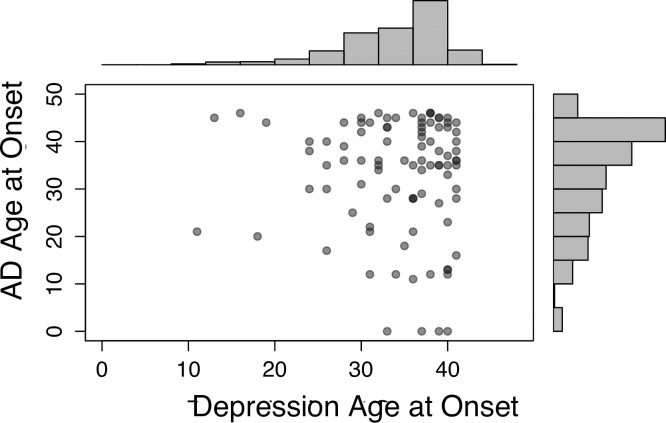
We used population cohort data from the 1958 British birth cohort study (the National Child Development Study) to investigate the ages at onset of depression and 23 autoimmune disorders. We used self-report data to ascertain life-time history of depression, autoimmune disorders and their ages at onset. We modelled the effect of depression onset on subsequent autoimmune disorder onset, and vice versa, and incorporated polygenic risk scores for depression and autoimmune disorder risk.
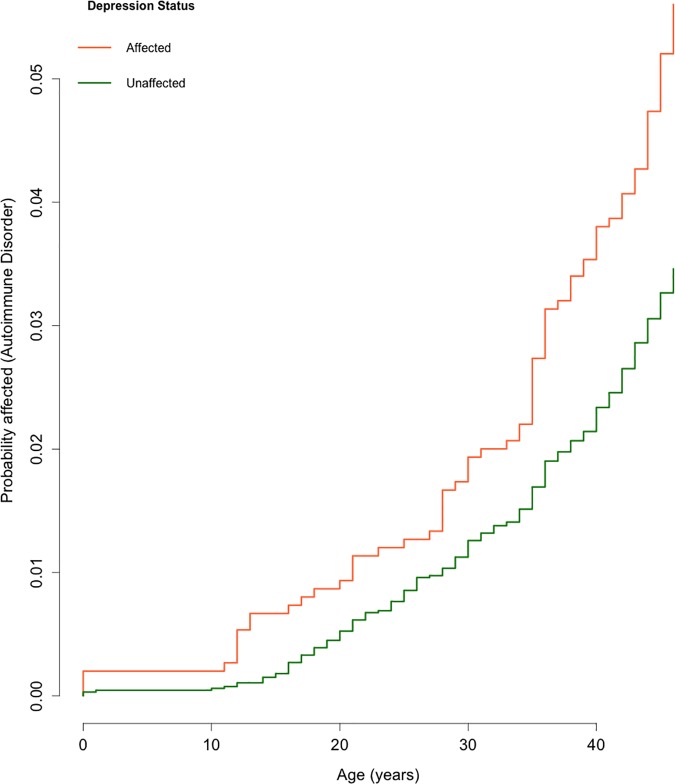
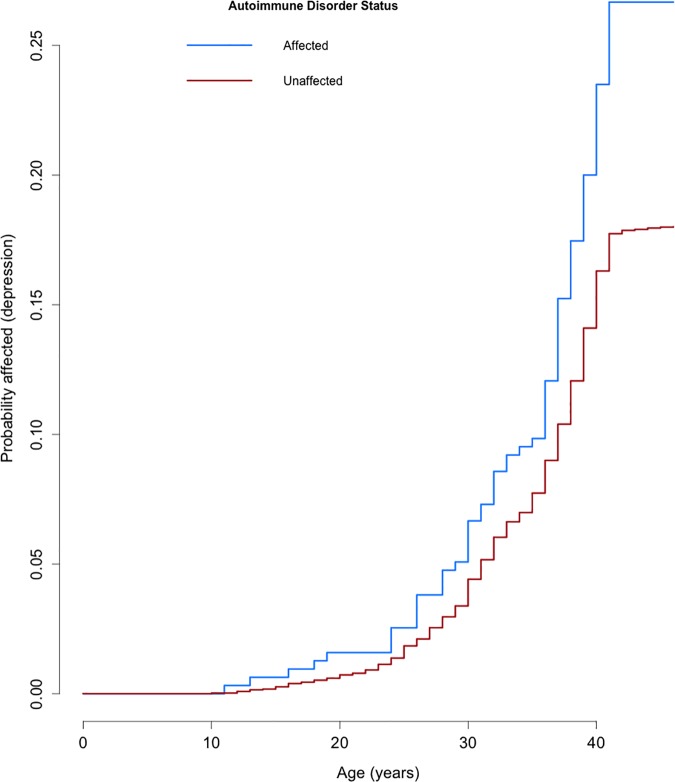
In our analytic sample of 8174 individuals, 315 reported ever being diagnosed with an autoimmune disorder (3.9%), 1499 reported ever experiencing depression (18.3%). There was significant comorbidity between depression and the autoimmune disorders (OR = 1.66, 95% CI = 1.27-2.15). Autoimmune disorder onset associated with increased subsequent hazard of depression onset (HR = 1.39, 95% CI = 1.11-1.74, P = 0.0037), independently of depression genetic risk. Finally, depression increased subsequent hazard of autoimmune disorder onset (HR = 1.40, 95% CI = 1.09-1.80, P = 0.0095), independently of autoimmune disorder genetic risk.
Our results point to a bidirectional relationship between depression and the autoimmune disorders. This suggests that shared risk factors may contribute to this relationship, including both common environmental exposures that increase baseline inflammation levels, and shared genetic factors.
抑郁症与自身免疫性疾病存在共病现象——这两类疾病在同一人群中的重叠频率高于随机概率。免疫系统可能会影响抑郁症的病理过程;了解这种共病的起源可能有助于剖析这些疾病的潜在机制。
我们使用了1958年英国出生队列研究(全国儿童发展研究)的人群队列数据,以调查抑郁症和23种自身免疫性疾病的发病年龄。我们使用自我报告数据来确定抑郁症、自身免疫性疾病的终生病史及其发病年龄。我们对抑郁症发病对随后自身免疫性疾病发病的影响进行了建模,反之亦然,并纳入了抑郁症和自身免疫性疾病风险的多基因风险评分。
在我们8174名个体的分析样本中,315人报告曾被诊断患有自身免疫性疾病(3.9%),1499人报告曾经历过抑郁症(18.3%)。抑郁症与自身免疫性疾病之间存在显著的共病现象(比值比=1.66,95%置信区间=1.27-2.15)。自身免疫性疾病发病与随后抑郁症发病风险增加相关(风险比=1.39,95%置信区间=1.11-1.74,P=0.0037),独立于抑郁症遗传风险。最后,抑郁症增加了随后自身免疫性疾病发病的风险(风险比=1.40,95%置信区间=1.09-1.80,P=0.0095),独立于自身免疫性疾病遗传风险。
我们的结果表明抑郁症与自身免疫性疾病之间存在双向关系。这表明共同的风险因素可能促成了这种关系,包括增加基线炎症水平的常见环境暴露以及共同的遗传因素。