Babina Magda, Artuc Metin, Guhl Sven, Zuberbier Torsten
Department of Dermatology and Allergy, Charité Universitätsmedizin Berlin, 10117 Berlin, Germany.
Int J Mol Sci. 2017 Feb 28;18(3):525. doi: 10.3390/ijms18030525.
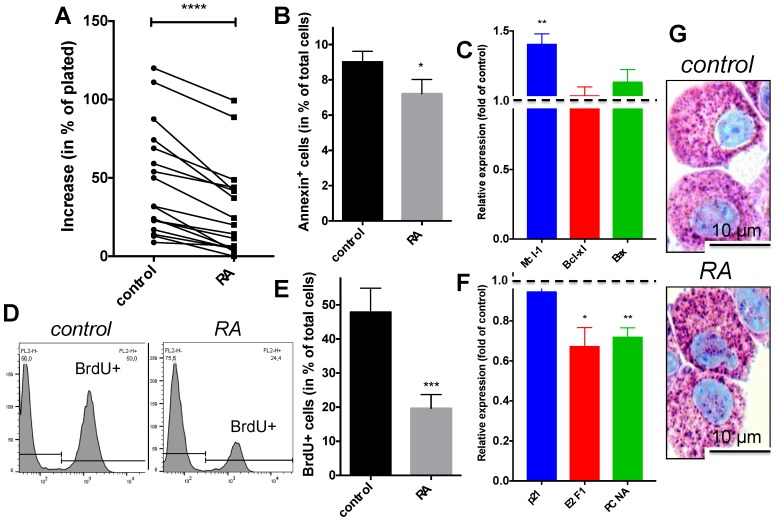
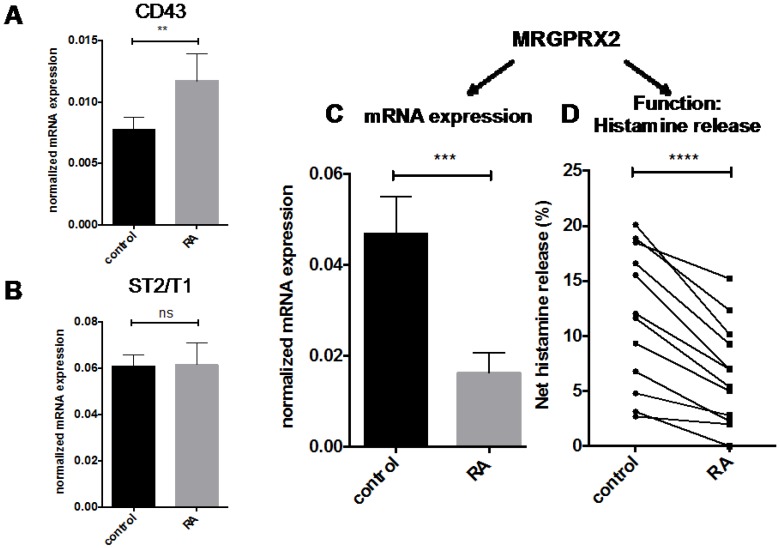
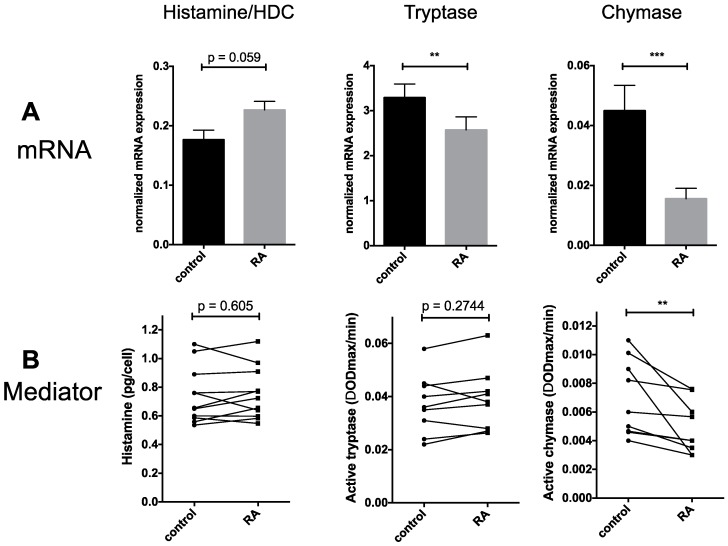
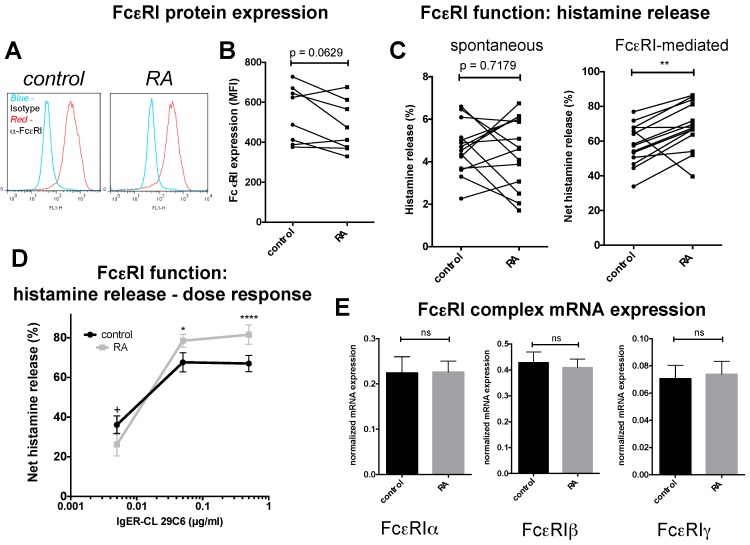
The Vitamin-A-metabolite retinoic acid (RA) acts as a master regulator of cellular programs. Mast cells (MCs) are primary effector cells of type-I-allergic reactions. We recently uncovered that human cutaneous MCs are enriched with RA network components over other skin cells. Yet, direct experimental evidence on the significance of the RA-MC axis is limited. Here, skin-derived cultured MCs were exposed to RA for seven days and investigated by flow-cytometry (BrdU incorporation, Annexin/PI, FcεRI), microscopy, RT-qPCR, histamine quantitation, protease activity, and degranulation assays. We found that while MC size and granularity remained unchanged, RA potently interfered with MC proliferation. Conversely, a modest survival-promoting effect from RA was noted. The granule constituents, histamine and tryptase, remained unaffected, while RA had a striking impact on MC chymase, whose expression dropped by gene and by peptidase activity. The newly uncovered performed similarly to chymase. Intriguingly, RA fostered allergic MC degranulation, in a way completely uncoupled from FcεRI expression, but it simultaneously restricted MRGPRX2-triggered histamine release in agreement with the reduced receptor expression. Vitamin-A-derived hormones thus re-shape skin-derived MCs numerically, phenotypically, and functionally. A general theme emerges, implying RA to skew MCs towards processes associated with (allergic) inflammation, while driving them away from the skin-imprinted MC ("MCs containing tryptase and chymase") signature (chymase, MRGPRX2). Collectively, MCs are substantial targets of the skin retinoid network.
维生素A代谢产物视黄酸(RA)是细胞程序的主要调节因子。肥大细胞(MCs)是I型过敏反应的主要效应细胞。我们最近发现,与其他皮肤细胞相比,人类皮肤MCs富含RA网络成分。然而,关于RA-MC轴重要性的直接实验证据有限。在这里,将皮肤来源的培养MCs暴露于RA中7天,并通过流式细胞术(BrdU掺入、膜联蛋白/碘化丙啶、FcεRI)、显微镜检查、RT-qPCR、组胺定量、蛋白酶活性和脱颗粒试验进行研究。我们发现,虽然MC的大小和颗粒度保持不变,但RA强烈干扰MC的增殖。相反,观察到RA有适度的促进存活的作用。颗粒成分组胺和类胰蛋白酶不受影响,而RA对MC糜蛋白酶有显著影响,其表达在基因水平和肽酶活性方面均下降。新发现的 与糜蛋白酶表现相似。有趣的是,RA促进了过敏性MC脱颗粒,其方式与FcεRI表达完全无关,但同时它限制了MRGPRX2触发的组胺释放,这与受体表达降低一致。因此,维生素A衍生的激素在数量、表型和功能上重塑了皮肤来源的MCs。一个普遍的主题出现了,这意味着RA使MCs倾向于与(过敏)炎症相关的过程,同时使它们远离皮肤印记的MC(“含有类胰蛋白酶和糜蛋白酶的MCs”)特征(糜蛋白酶、MRGPRX2)。总的来说,MCs是皮肤类视黄醇网络的重要靶点。