Ma Feiya, Liu Fei, Ding Liang, You Ming, Yue Huimin, Zhou Yujie, Hou Yayi
a The State Key Laboratory of Pharmaceutical Biotechnology, Division of Immunology , Medical School, Nanjing University , Nanjing , PR China.
b The Affiliated Drum Tower Hospital of Nanjing University Medical School , Nanjing , PR China.
Pharm Biol. 2017 Dec;55(1):1263-1273. doi: 10.1080/13880209.2017.1297838.
The natural polyphenolic compound curcumin has been proved to modulate innate immune responses and possess anti-inflammatory properties. Nevertheless, the mechanism remains poorly understood, particularly regarding curcumin-regulated miRNAs under inflammatory response.
This study investigates the role of miRNA-155 in the effects of curcumin on inflammatory response in cell and a mouse model.
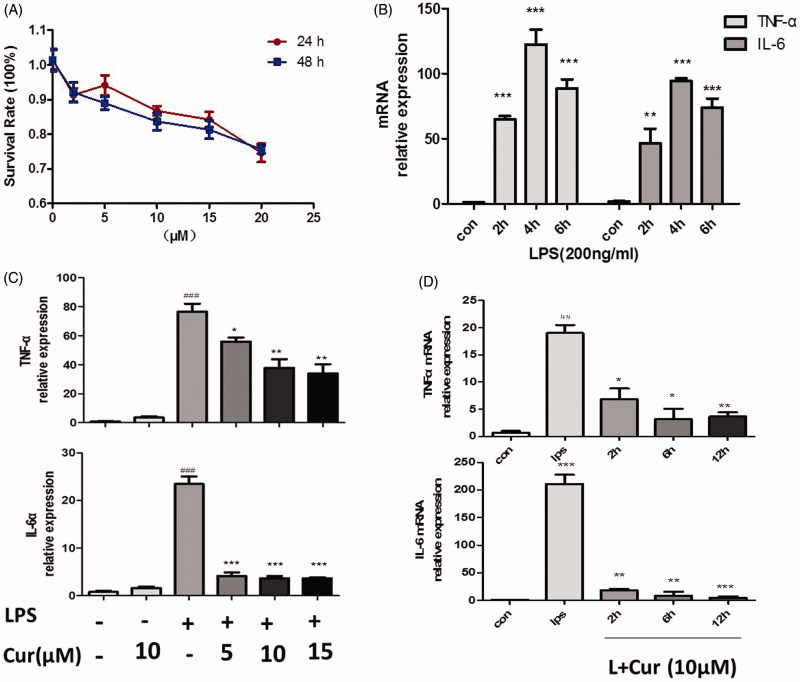
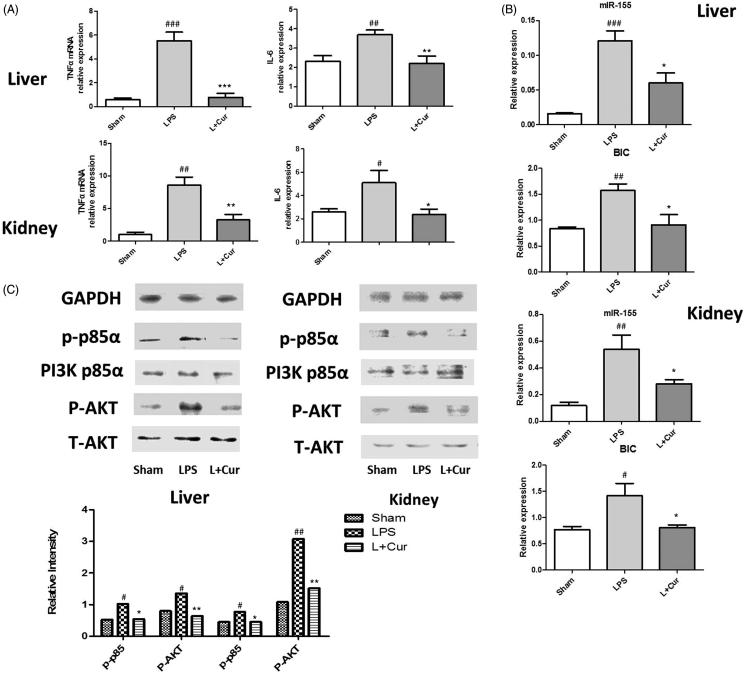
The anti-inflammatory activity of curcumin (5, 10 and 15 μM, 2 h) in lipopolysaccharide (LPS, 200 ng/mL)-induced cells were measured by quantitative PCR. The animals were treated orally by 20 mg/kg curcumin for 3 days before an LPS intraperitoneal injection (10 mg/kg, 16 h). MicroRNA (miRNA) expression and the underlying molecular mechanisms were assessed using transfection technique and western blotting.
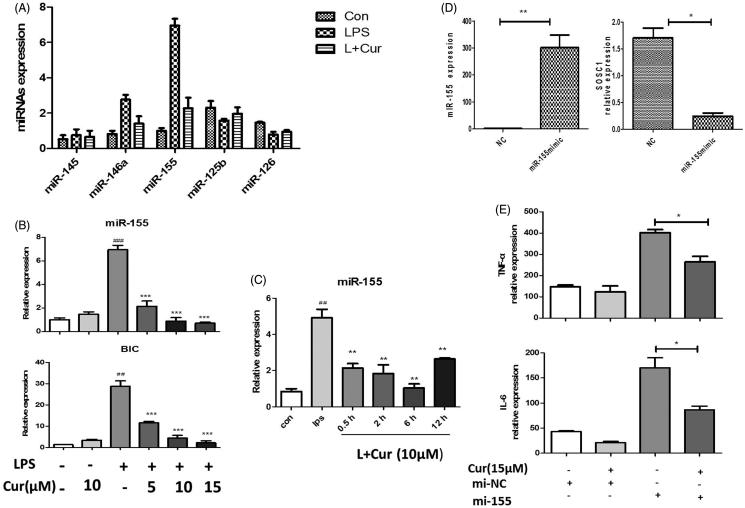
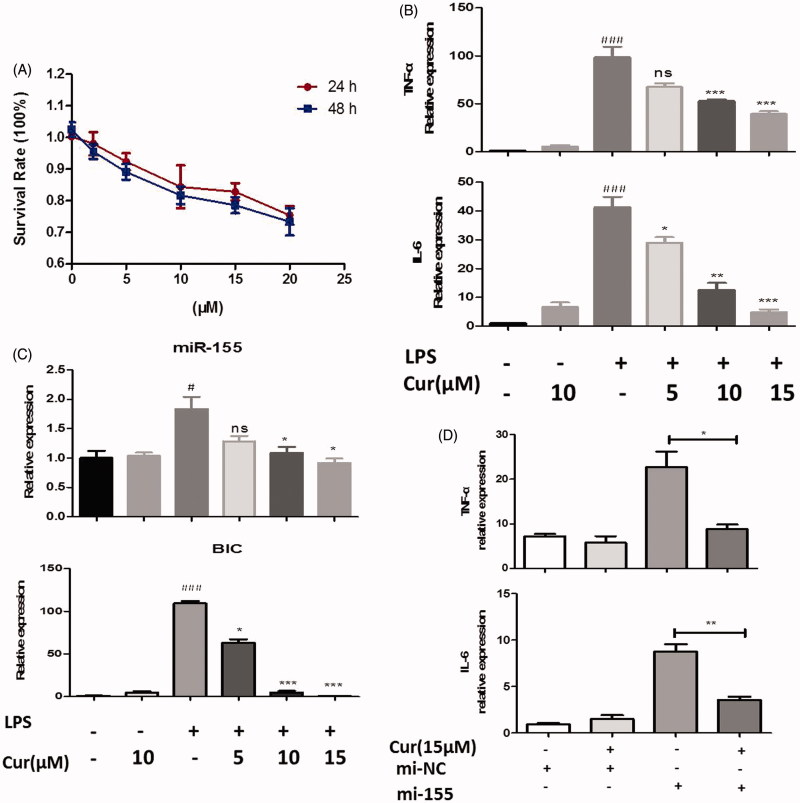
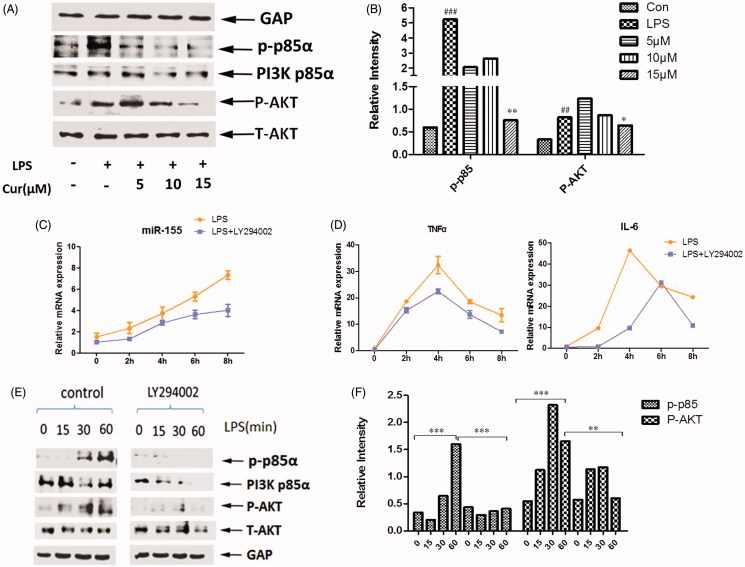
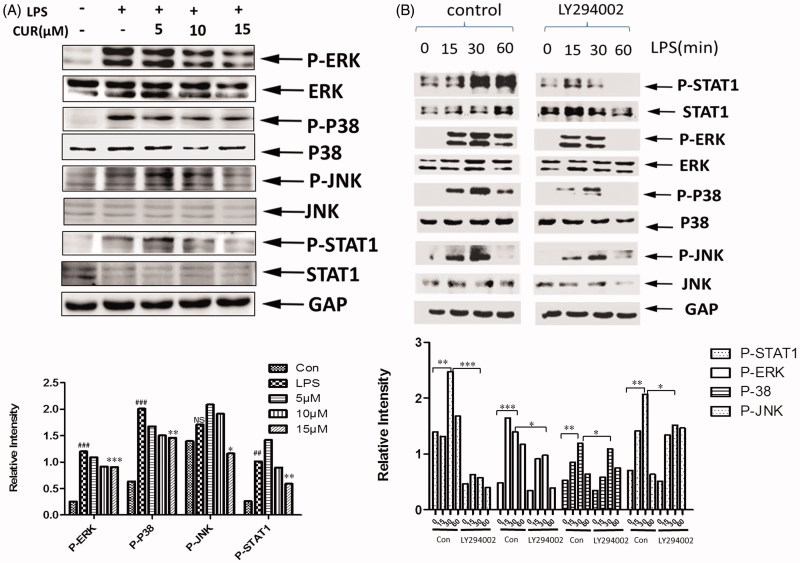
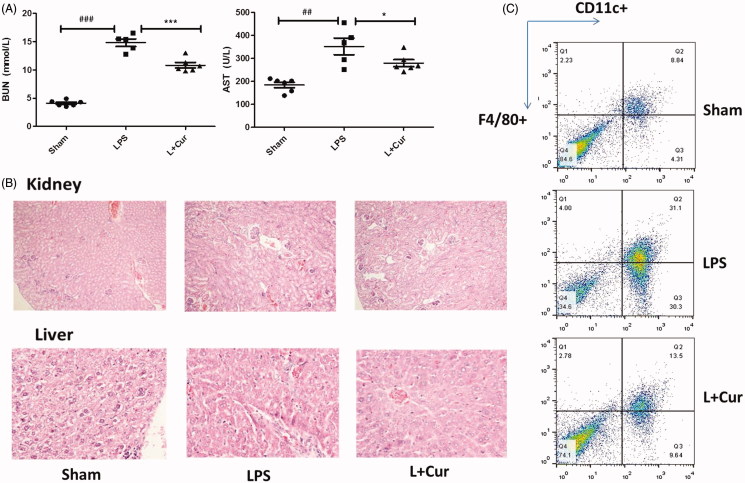
Curcumin efficiently inhibited LPS-induced cytokines (TNF-α, IL-6) and microRNA-155 (miR-155) expression (p < 0.05) without affecting the normally growth of Raw264.7 and THP-1 cells (IC 21.8 and 22.3 μM at 48 h, respectively). Moreover, the levels of cytokines were suppressed by curcumin in miR-155 mimics transfected cells (p < 0.05). A blockade of PI3K/AKT signalling pathways resulted in a decreased level of miR-155 (p < 0.05). Curcumin effectively protected mice from sepsis as evidenced by decreasing histological damage, reducing AST (352.0 vs 279.3 U/L), BUN (14.8 vs 10.8 mmol/L) levels and the proportion of macrophages in spleen (31.1% vs 13.5%). MicroRNA-155 level and cytokines were also reduced in curcumin-treated mice (p < 0.05).
Curcumin's ability to suppress LPS-induced inflammatory response may be due to the inhibition of miR-155.
天然多酚化合物姜黄素已被证明可调节先天性免疫反应并具有抗炎特性。然而,其机制仍知之甚少,尤其是在炎症反应中姜黄素调节的微小RNA(miRNA)方面。
本研究探讨miRNA-155在姜黄素对细胞和小鼠模型炎症反应影响中的作用。
通过定量聚合酶链反应(PCR)检测姜黄素(5、10和15μM,2小时)对脂多糖(LPS,200 ng/mL)诱导细胞的抗炎活性。在腹腔注射LPS(10 mg/kg,16小时)前3天,给动物口服20 mg/kg姜黄素。使用转染技术和蛋白质免疫印迹法评估微小RNA(miRNA)表达及潜在分子机制。
姜黄素有效抑制LPS诱导的细胞因子(肿瘤坏死因子-α、白细胞介素-6)和微小RNA-155(miR-155)表达(p<0.05),且不影响Raw264.7和THP-1细胞的正常生长(48小时时IC分别为21.8和22.3μM)。此外,在转染miR-155模拟物的细胞中,姜黄素抑制了细胞因子水平(p<0.05)。PI3K/AKT信号通路的阻断导致miR-155水平降低(p<0.05)。姜黄素有效保护小鼠免受败血症侵害,表现为组织损伤减轻、天冬氨酸转氨酶(AST,352.0对279.3 U/L)、尿素氮(BUN,14.8对10.8 mmol/L)水平降低以及脾脏中巨噬细胞比例降低(31.1%对13.5%)。姜黄素处理的小鼠中微小RNA-155水平和细胞因子也降低(p<0.05)。
姜黄素抑制LPS诱导的炎症反应的能力可能归因于对miR-155的抑制。