LoRusso Patricia M, Infante Jeffrey R, Kim Kevin B, Burris Howard A, Curt Gregory, Emeribe Ugochi, Clemett Delyth, Tomkinson Helen K, Cohen Roger B
Yale Cancer Center, PO Box 208028, New Haven, CT, 06520-8028, USA.
Sarah Cannon Research Institute, Nashville, TN, USA.
BMC Cancer. 2017 Mar 6;17(1):173. doi: 10.1186/s12885-017-3143-6.
The RAS/RAF/MEK/ERK pathway is constitutively activated in many cancers. Selumetinib (AZD6244, ARRY-142886) is an oral, potent and highly selective, allosteric MEK1/2 inhibitor with a short half-life that has shown clinical activity as monotherapy in phase I and II studies of advanced cancer. Preclinical data suggest that selumetinib may enhance the activity of chemotherapeutic agents. We assessed the safety, tolerability, and pharmacokinetics (PK) of selumetinib (AZD6244, ARRY-142886) in combination with docetaxel or dacarbazine in patients with advanced solid tumors.
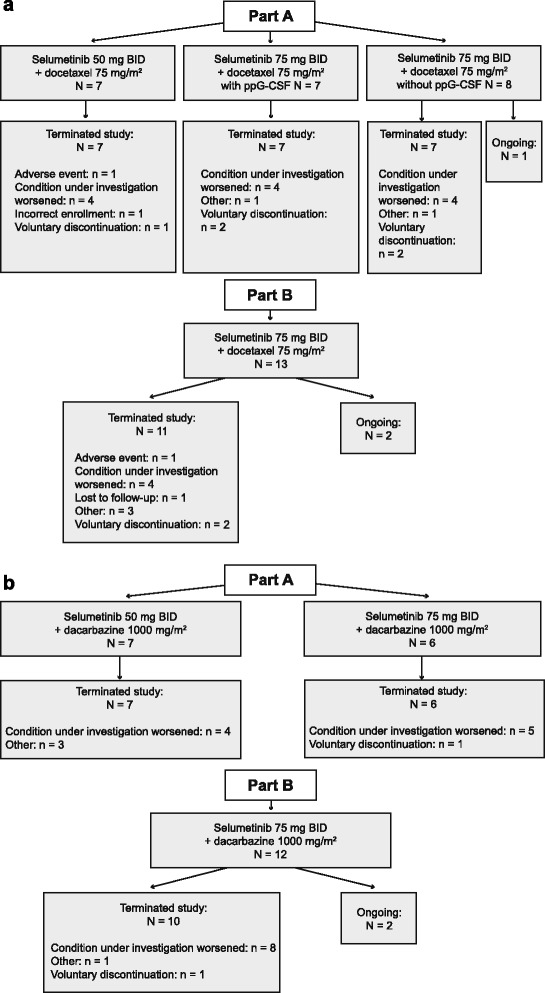
This study was a phase I, open-label, multicenter study in patients aged ≥18 years with advanced solid tumors who were candidates for docetaxel or dacarbazine treatment. Part A of the study (dose escalation) evaluated safety, tolerability, PK, and maximum tolerated dose (MTD) of selumetinib twice daily (BID) with docetaxel 75 mg/m or dacarbazine 1000 mg/m administered every 21 days. Patients receiving docetaxel could be administered primary prophylactic granulocyte-colony stimulating factor according to standard guidelines. Part B of the study (dose expansion) further evaluated safety, tolerability, and PK in 12 additional patients at the MTD combinations determined in part A.
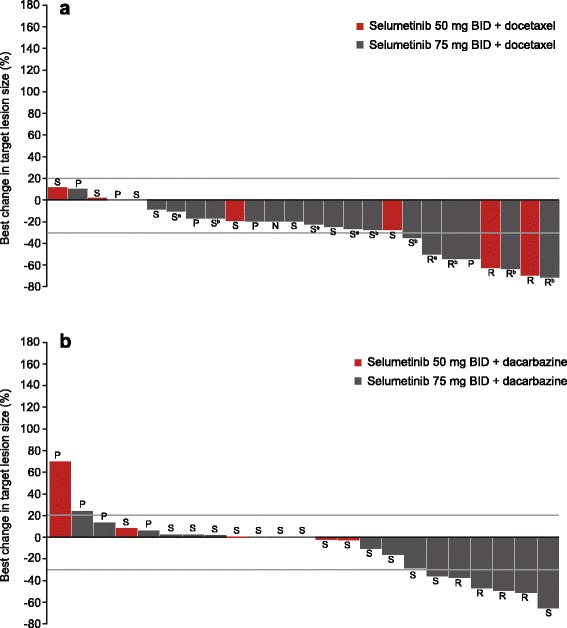
A total of 35 patients received selumetinib plus docetaxel, and 25 received selumetinib plus dacarbazine. The MTD of selumetinib was 75 mg BID in combination with either docetaxel (two dose-limiting toxicity [DLT] events: neutropenia with fever, and thrombocytopenia) or dacarbazine (one DLT event: thrombocytopenia). Common adverse events occurring with each treatment combination were diarrhea, peripheral/periorbital edema, fatigue, and nausea. PK parameters for selumetinib and docetaxel or dacarbazine were similar when administered alone or in combination. Partial responses were reported in 6/35 patients receiving selumetinib plus docetaxel and 4/25 patients receiving selumetinib plus dacarbazine.
The combinations of selumetinib plus docetaxel and selumetinib plus dacarbazine demonstrated manageable safety and tolerability profiles and preliminary signs of clinical activity in patients with advanced solid tumors.
ClinicalTrials.gov NCT00600496; registered 8 July 2009.
RAS/RAF/MEK/ERK通路在许多癌症中持续激活。司美替尼(AZD6244,ARRY - 142886)是一种口服、强效且高度选择性的变构MEK1/2抑制剂,半衰期短,在晚期癌症的I期和II期研究中作为单药治疗已显示出临床活性。临床前数据表明司美替尼可能增强化疗药物的活性。我们评估了司美替尼(AZD6244,ARRY - 142886)联合多西他赛或达卡巴嗪在晚期实体瘤患者中的安全性、耐受性和药代动力学(PK)。
本研究是一项I期、开放标签、多中心研究,纳入年龄≥18岁、患有晚期实体瘤且适合多西他赛或达卡巴嗪治疗的患者。研究的A部分(剂量递增)评估司美替尼每日两次(BID)联合每21天给予75 mg/m²多西他赛或1000 mg/m²达卡巴嗪时的安全性、耐受性、PK和最大耐受剂量(MTD)。接受多西他赛治疗的患者可根据标准指南给予一级预防性粒细胞集落刺激因子。研究的B部分(剂量扩展)在A部分确定的MTD联合方案下,对另外12例患者进一步评估安全性、耐受性和PK。
共有35例患者接受司美替尼加多西他赛治疗,25例患者接受司美替尼加达卡巴嗪治疗。司美替尼与多西他赛联合(2例剂量限制毒性[DLT]事件:发热性中性粒细胞减少和血小板减少)或与达卡巴嗪联合(1例DLT事件:血小板减少)时的MTD为75 mg BID。每种治疗联合方案常见的不良事件包括腹泻、外周/眶周水肿、疲劳和恶心。司美替尼与多西他赛或达卡巴嗪单独使用或联合使用时的PK参数相似。接受司美替尼加多西他赛治疗的35例患者中有6例报告部分缓解,接受司美替尼加达卡巴嗪治疗的25例患者中有4例报告部分缓解。
司美替尼加多西他赛和司美替尼加达卡巴嗪联合方案在晚期实体瘤患者中显示出可控的安全性和耐受性概况以及临床活性的初步迹象。
ClinicalTrials.gov NCT00600496;于2009年7月8日注册。