Newman Jonathan D, Echagarruga Christina T, Ogando Yoscar M, Montenont Emilie, Chen Yu, Fisher Edward A, Berger Jeffrey S
Division of Cardiology and the Center for the Prevention of Cardiovascular Disease, Department of Medicine, New York University School of Medicine, TRB rm. 853, New York, NY, 10016, USA.
Department of Medicine, Marc and Ruti Bell Program in Vascular Biology and Disease, New York University Medical Center, New York, NY, USA.
J Transl Med. 2017 Mar 6;15(1):55. doi: 10.1186/s12967-017-1148-1.
Low to moderate inorganic arsenic (iAs) exposure is independently associated with cardiovascular disease (CVD), particularly for patients with diabetes mellitus (DM). The mechanism of increased CVD risk from iAs exposure in DM has not been adequately characterized. We evaluated whether increasing concentrations of glucose enhance the effects of iAs on platelet and megakaryocyte activity, key steps in atherothrombosis.
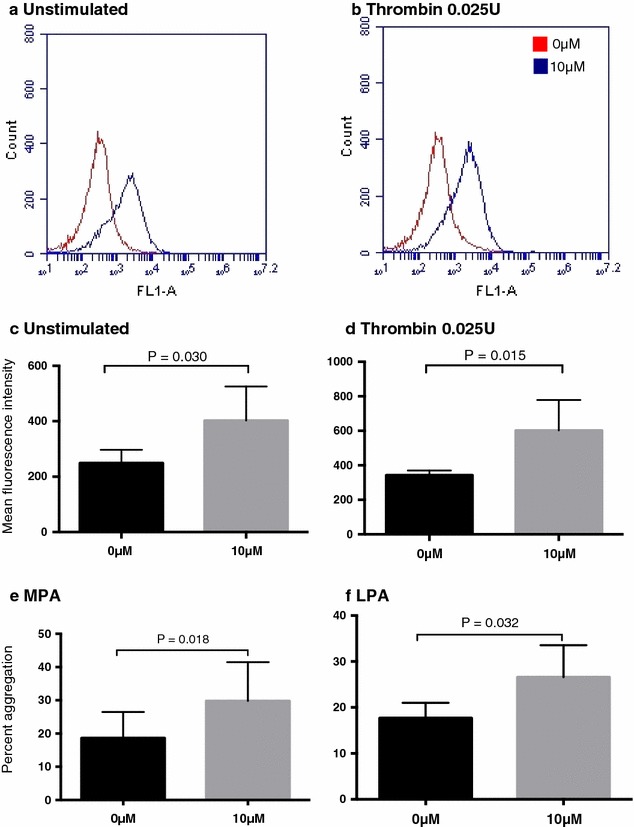
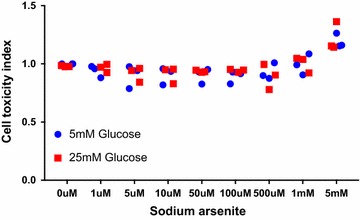
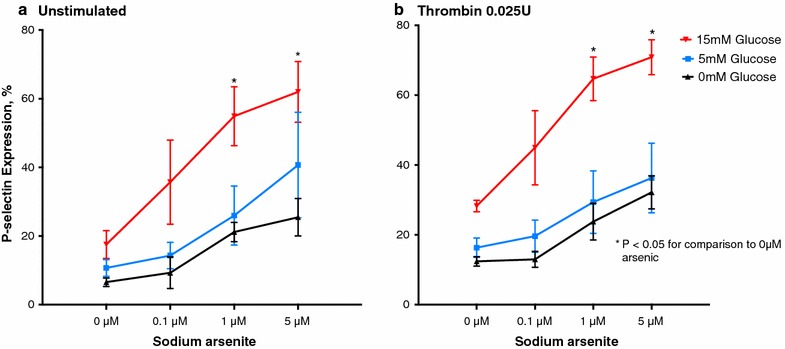
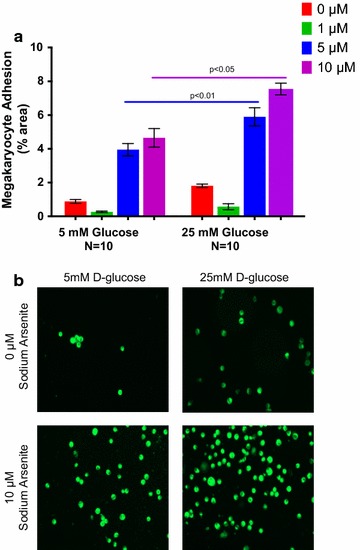
Healthy donor whole blood was prepared in a standard fashion and incubated with sodium arsenite in a range from 0 to 10 µM. iAs-induced platelet activation was assessed by platelet receptor CD62P (P-selectin) expression and monocyte-platelet and leukocyte-platelet aggregation (MPA and LPA, respectively) in the presence of increasing sodium arsenite and glucose concentrations. Megakaryocyte (Meg-01) cell adhesion and gene expression was assessed after incubation with or without iAs and increasing concentrations of D-glucose.
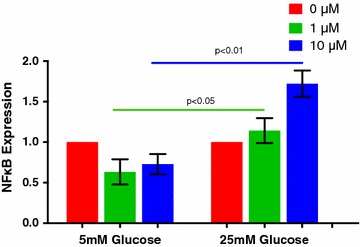
Platelet activity markers increased significantly with 10 vs. 0 µM iAs (P < 0.05 for all) and with higher D-glucose concentrations. Platelet activity increased significantly following co incubation of 1 and 5 µM iAs concentrations with hyperglycemic D-glucose (P < 0.01 for both) but not after incubation with euglycemic D-glucose. Megakaryocyte adhesion was more pronounced after co incubation with iAs and hyperglycemic than euglycemic D-glucose, while gene expression increased significantly to iAs only after co incubation with hyperglycemic D-glucose.
We demonstrate that glucose concentrations common in DM potentiate the effect of inorganic arsenic exposure on markers of platelet and megakaryocyte activity. Our results support recent observational cohort data that DM enhances the vasculotoxic effects of arsenic exposure, and suggest that activation of the platelet-megakaryocyte hemostatic axis is a pathway through which inorganic arsenic confers atherothrombotic risk, particularly for patients with DM.
低至中度的无机砷(iAs)暴露与心血管疾病(CVD)独立相关,尤其是糖尿病(DM)患者。DM患者因iAs暴露导致CVD风险增加的机制尚未得到充分阐明。我们评估了血糖浓度升高是否会增强iAs对血小板和巨核细胞活性的影响,而这是动脉粥样硬化血栓形成过程中的关键步骤。
以标准方式制备健康供体的全血,并与0至10 μM的亚砷酸钠孵育。在亚砷酸钠和葡萄糖浓度增加的情况下,通过血小板受体CD62P(P-选择素)表达以及单核细胞-血小板和白细胞-血小板聚集(分别为MPA和LPA)来评估iAs诱导的血小板活化。在与或不与iAs以及不同浓度的D-葡萄糖孵育后,评估巨核细胞(Meg-01)的细胞黏附及基因表达。
与0 μM的iAs相比,10 μM的iAs使血小板活性标志物显著增加(所有P < 0.05),且随着D-葡萄糖浓度升高而增加。1 μM和5 μM的iAs浓度与高血糖D-葡萄糖共同孵育后,血小板活性显著增加(两者均P < 0.01),但与正常血糖D-葡萄糖孵育后未出现此情况。与iAs和高血糖D-葡萄糖共同孵育后,巨核细胞黏附比与正常血糖D-葡萄糖共同孵育时更明显,而仅在与高血糖D-葡萄糖共同孵育后,巨核细胞基因表达才显著增加至iAs诱导水平。
我们证明,DM中常见的葡萄糖浓度可增强无机砷暴露对血小板和巨核细胞活性标志物的影响。我们的结果支持了最近的观察性队列数据,即DM会增强砷暴露的血管毒性作用,并表明血小板-巨核细胞止血轴的激活是无机砷赋予动脉粥样硬化血栓形成风险的一条途径,尤其是对DM患者而言。