Ubellacker Jessalyn M, Haider Marie-Therese, DeCristo Molly J, Allocca Gloria, Brown Nicola J, Silver Daniel P, Holen Ingunn, McAllister Sandra S
Department of Medicine, Harvard Medical School, Boston, MA, 02115, USA.
Hematology Division, Brigham & Women's Hospital, Boston, MA, 02115, USA.
Breast Cancer Res. 2017 Mar 6;19(1):23. doi: 10.1186/s13058-017-0815-8.
The bone-targeting agent zoledronic acid (ZOL) increases breast cancer survival in subsets of patients, but the underlying reasons for this protective effect are unknown. ZOL modulates the activity of osteoclasts and osteoblasts, which form hematopoietic stem cell niches, and therefore may affect hematopoietic cells that play a role in breast cancer progression.
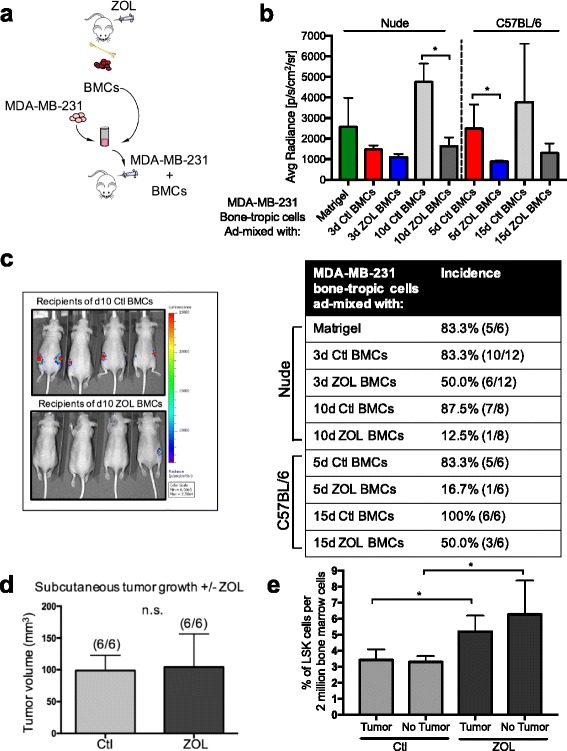
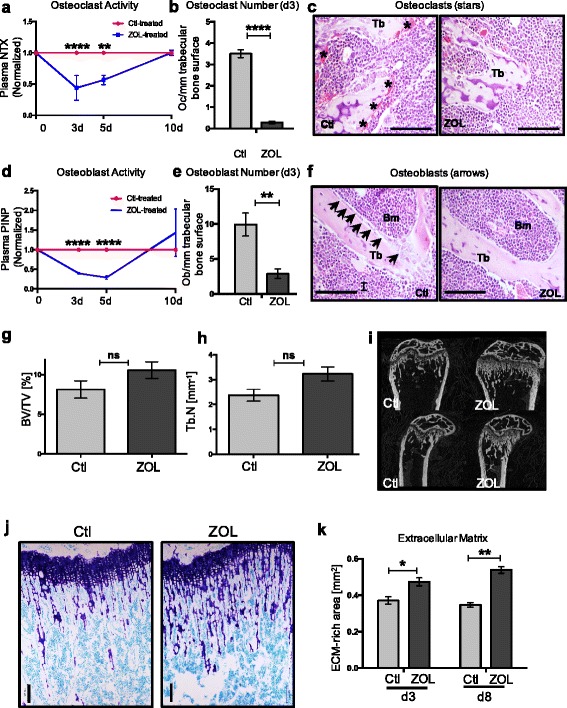
Immunocompetent and immunocompromised strains of mice commonly used for breast cancer research were injected with a single, clinically relevant dose of ZOL (100 μg/kg) or vehicle control. The effects of ZOL on the bone marrow microenvironment (bone volume, bone cell number/activity, extracellular matrix composition) were established at various time points following treatment, using micro-computed tomography (μCT) analysis, histomorphometry, ELISA and immunofluorescence. The effects on peripheral blood and bone marrow hematopoietic progenitor populations were assessed using a HEMAVET® hematology analyzer and multicolor flow cytometry, respectively. Tumor support function of bone marrow cells was determined using an in vivo functional assay developed in our laboratory.
Using multiple mouse strains, we observed transient changes in numbers of hematopoietic stem cells, myeloid-biased progenitor cells, and lymphoid-biased cells concurrent with changes to hematopoietic stem cell niches following ZOL administration. Importantly, bone marrow cells from mice treated with a single, clinically relevant dose of ZOL inhibited breast tumor outgrowth in vivo. The ZOL-induced tumor suppressive function of the bone marrow persisted beyond the time point at which numbers of hematopoietic progenitor cells had returned to baseline.
These findings provide novel evidence that alterations to the bone marrow play a role in the anti-tumor activity of ZOL and suggest possibilities for capitalizing on the beneficial effects of ZOL in reducing breast cancer development and progression.
骨靶向药物唑来膦酸(ZOL)可提高部分乳腺癌患者的生存率,但其产生这种保护作用的潜在原因尚不清楚。ZOL可调节破骨细胞和成骨细胞的活性,而成骨细胞形成造血干细胞龛,因此ZOL可能会影响在乳腺癌进展中起作用的造血细胞。
给常用于乳腺癌研究的免疫健全和免疫受损小鼠品系注射单一临床相关剂量的ZOL(100μg/kg)或溶剂对照。在治疗后的不同时间点,使用微型计算机断层扫描(μCT)分析、组织形态计量学、酶联免疫吸附测定(ELISA)和免疫荧光技术,确定ZOL对骨髓微环境(骨体积、骨细胞数量/活性、细胞外基质组成)的影响。分别使用HEMAVET®血液分析仪和多色流式细胞术评估对外周血和骨髓造血祖细胞群体的影响。使用我们实验室开发的体内功能测定法确定骨髓细胞的肿瘤支持功能。
使用多种小鼠品系,我们观察到给药后造血干细胞、髓系偏向祖细胞和淋巴系偏向细胞数量的短暂变化,同时造血干细胞龛也发生了变化。重要的是,用单一临床相关剂量的ZOL治疗的小鼠的骨髓细胞在体内抑制了乳腺肿瘤的生长。ZOL诱导的骨髓肿瘤抑制功能在造血祖细胞数量恢复到基线后的时间点仍持续存在。
这些发现提供了新的证据,表明骨髓的改变在ZOL的抗肿瘤活性中起作用,并提示了利用ZOL在减少乳腺癌发生和进展方面的有益作用的可能性。