Han Lichun, Wang Wei, Ding Wei, Zhang Lijian
Department of Oncology, The Affiliated Hospital of Qingdao University, Qingdao, Shandong, China.
School of Pharmacy, Qingdao University, Qingdao, Shandong, China.
J Cell Mol Med. 2017 Sep;21(9):2000-2008. doi: 10.1111/jcmm.13120. Epub 2017 Mar 7.
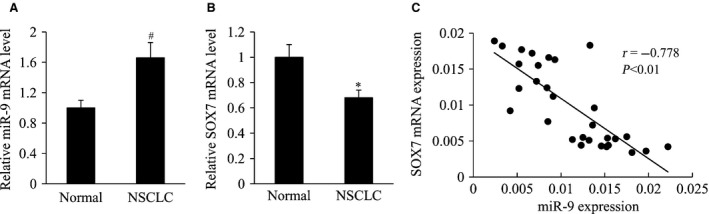
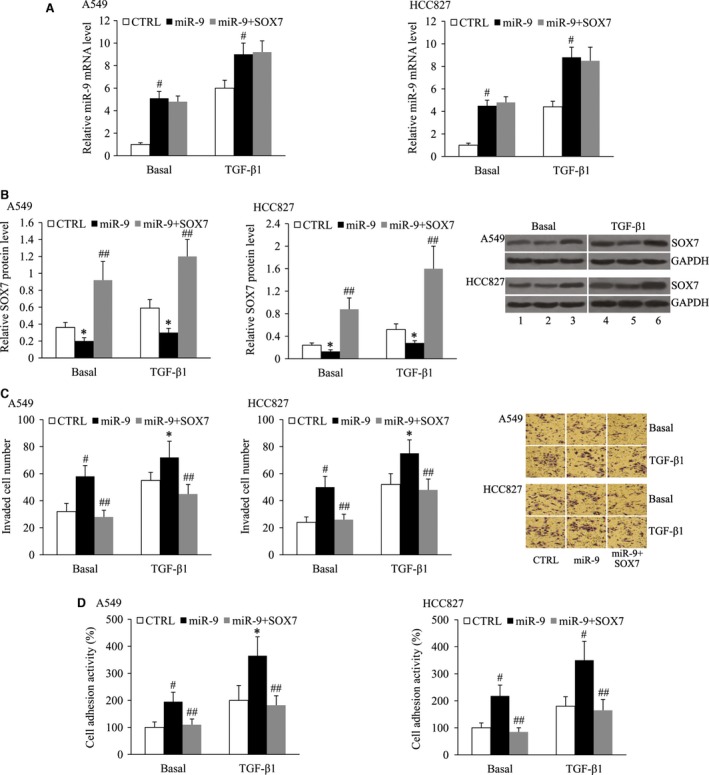
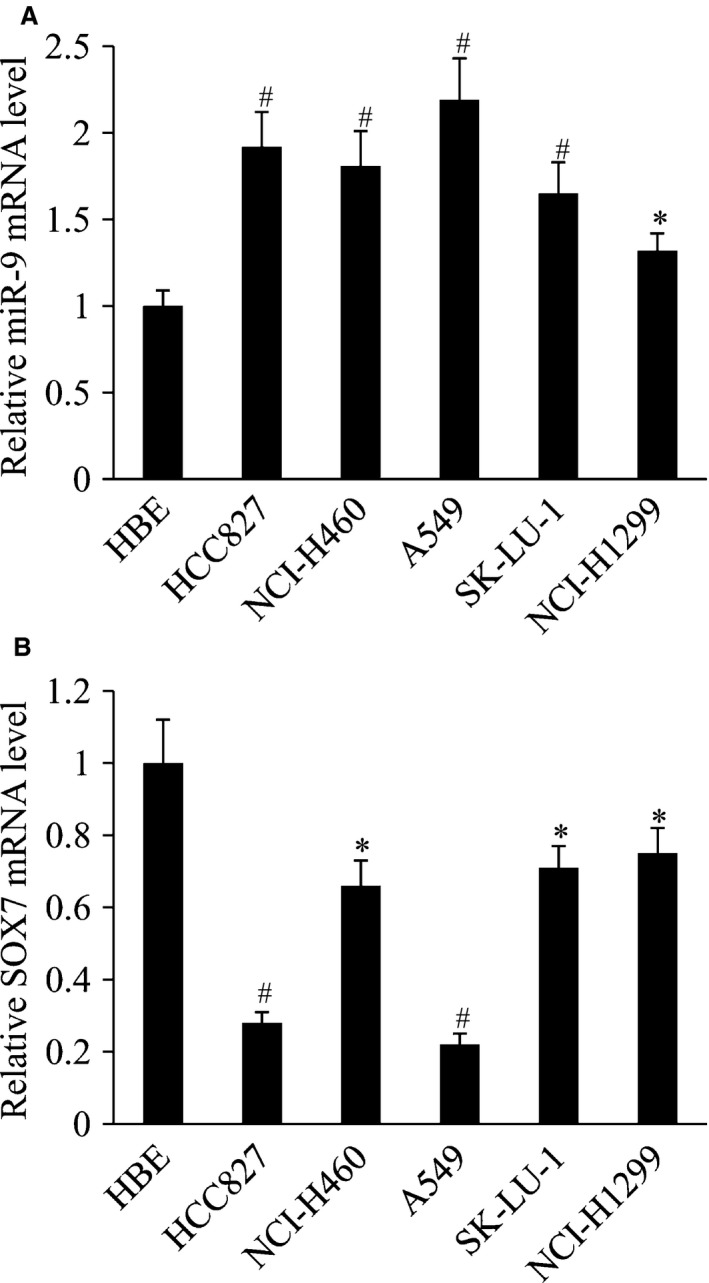
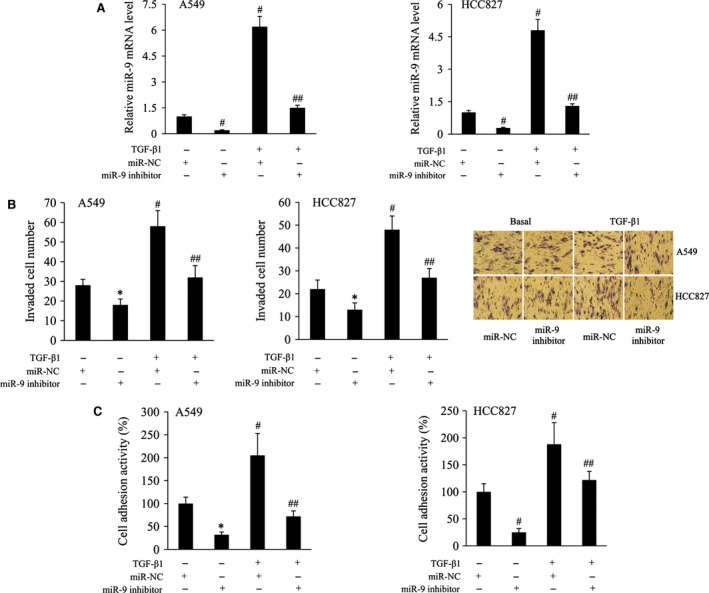
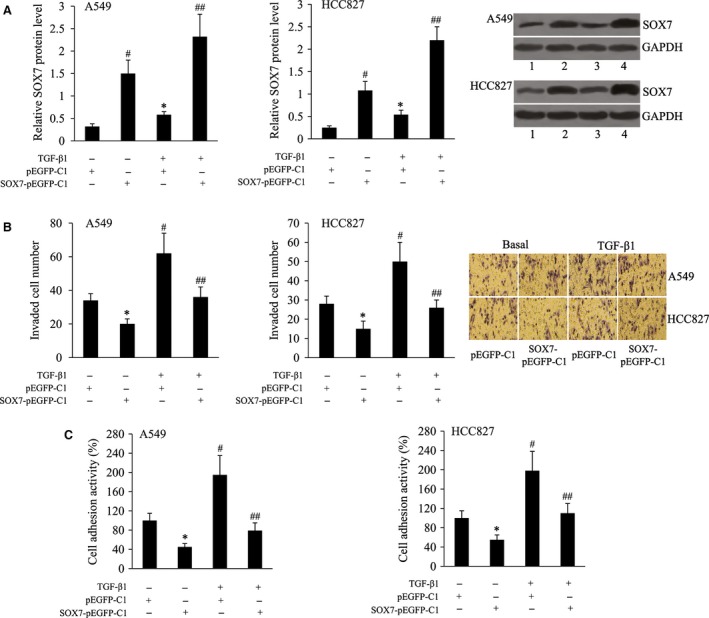
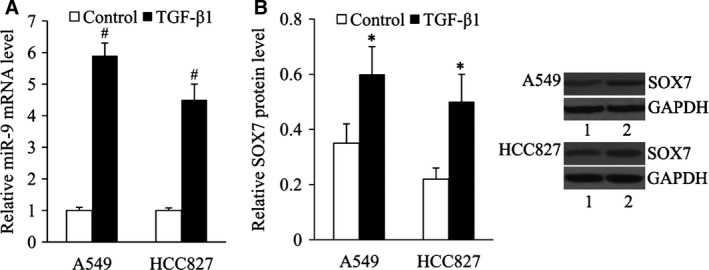
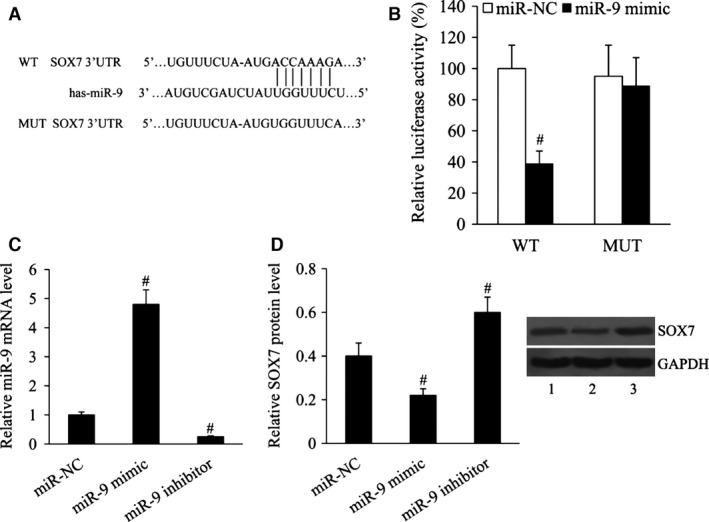
MicroRNA (miR)-9 plays different roles in different cancer types. Here, we investigated the role of miR-9 in non-small-cell lung cancer (NSCLC) cell invasion and adhesion in vitro and explored whether miR-9 was involved in transforming growth factor-beta 1 (TGF-β1)-induced NSCLC cell invasion and adhesion by targeting SOX7. The expression of miR-9 and SOX7 in human NSCLC tissues and cell lines was examined by reverse transcription-quantitative polymerase chain reaction. Gain-of-function and loss-of-function experiments were performed on A549 and HCC827 cells to investigate the effect of miR-9 and SOX7 on NSCLC cell invasion and adhesion in the presence or absence of TGF-β1. Transwell-Matrigel assay and cell adhesion assay were used to examine cell invasion and adhesion abilities. Luciferase reporter assay was performed to determine whether SOX7 was a direct target of miR-9. We found miR-9 was up-regulated and SOX7 was down-regulated in human NSCLC tissues and cell lines. Moreover, SOX7 expression was negatively correlated with miR-9 expression. miR-9 knockdown or SOX7 overexpression could suppress TGF-β1-induced NSCLC cell invasion and adhesion. miR-9 directly targets the 3' untranslated region of SOX7, and SOX7 protein expression was down-regulated by miR-9. TGF-β1 induced miR-9 expression in NSCLC cells. miR-9 up-regulation led to enhanced NSCLC cell invasion and adhesion; however, these effects could be attenuated by SOX7 overexpression. We concluded that miR-9 expression was negatively correlated with SOX7 expression in human NSCLC. miR-9 was up-regulated by TGF-β1 and contributed to TGF-β1-induced NSCLC cell invasion and adhesion by directly targeting SOX7.
微小RNA(miR)-9在不同类型的癌症中发挥着不同的作用。在此,我们研究了miR-9在体外非小细胞肺癌(NSCLC)细胞侵袭和黏附中的作用,并探讨了miR-9是否通过靶向SOX7参与转化生长因子-β1(TGF-β1)诱导的NSCLC细胞侵袭和黏附。通过逆转录-定量聚合酶链反应检测人NSCLC组织和细胞系中miR-9和SOX7的表达。在A549和HCC827细胞上进行功能获得和功能缺失实验,以研究在有或无TGF-β1的情况下miR-9和SOX7对NSCLC细胞侵袭和黏附的影响。采用Transwell-基质胶实验和细胞黏附实验检测细胞侵袭和黏附能力。进行荧光素酶报告基因实验以确定SOX7是否为miR-9的直接靶点。我们发现人NSCLC组织和细胞系中miR-9上调而SOX7下调。此外,SOX7表达与miR-9表达呈负相关。敲低miR-9或过表达SOX7可抑制TGF-β1诱导的NSCLC细胞侵袭和黏附。miR-9直接靶向SOX7的3'非翻译区,且miR-9可下调SOX7蛋白表达。TGF-β1诱导NSCLC细胞中miR-9表达。miR-9上调导致NSCLC细胞侵袭和黏附增强;然而,这些作用可被SOX7过表达减弱。我们得出结论,在人NSCLC中miR-9表达与SOX7表达呈负相关。miR-9被TGF-β1上调,并通过直接靶向SOX7促进TGF-β1诱导的NSCLC细胞侵袭和黏附。