Savulich G, Riccelli R, Passamonti L, Correia M, Deakin J F W, Elliott R, Flechais R S A, Lingford-Hughes A R, McGonigle J, Murphy A, Nutt D J, Orban C, Paterson L M, Reed L J, Smith D G, Suckling J, Tait R, Taylor E M, Sahakian B J, Robbins T W, Ersche K D
Department of Psychiatry, University of Cambridge, Cambridge, UK.
Behavioural and Clinical Neuroscience Institute, University of Cambridge, Cambridge, UK.
Transl Psychiatry. 2017 Mar 7;7(3):e1054. doi: 10.1038/tp.2017.34.
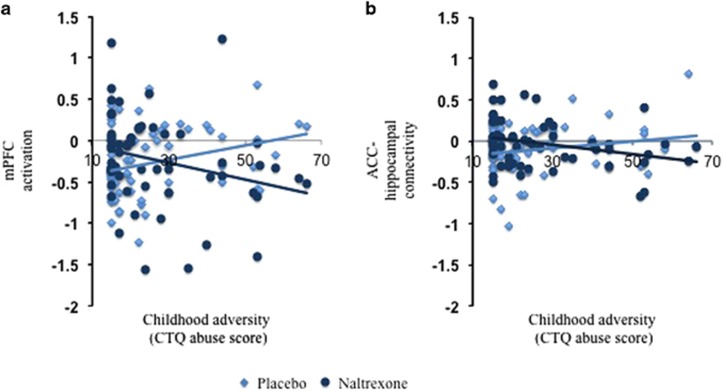
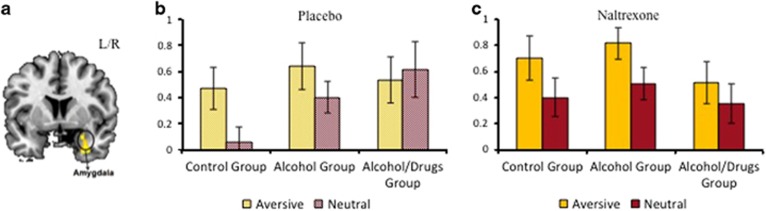
Naltrexone is an opioid receptor antagonist used in the management of alcohol dependence. Although the endogenous opioid system has been implicated in emotion regulation, the effects of mu-opioid receptor blockade on brain systems underlying negative emotional processing are not clear in addiction. Individuals meeting criteria for alcohol dependence alone (n=18, alcohol) and in combination with cocaine and/or opioid dependence (n=21, alcohol/drugs) and healthy individuals without a history of alcohol or drug dependence (n=21) were recruited. Participants were alcohol and drug abstinent before entered into this double-blind, placebo-controlled, randomized, crossover study. Functional magnetic resonance imaging was used to investigate brain response while viewing aversive and neutral images relative to baseline on 50 mg of naltrexone and placebo. We found that naltrexone modulated task-related activation in the medial prefrontal cortex and functional connectivity between the anterior cingulate cortex and the hippocampus as a function of childhood adversity (for aversive versus neutral images) in all groups. Furthermore, there was a group-by-treatment-by-condition interaction in the right amygdala, which was mainly driven by a normalization of response for aversive relative to neutral images under naltrexone in the alcohol/drugs group. We conclude that early childhood adversity is one environmental factor that influences pharmacological response to naltrexone. Pharmacotherapy with naltrexone may also have some ameliorative effects on negative emotional processing in combined alcohol and drug dependence, possibly due to alterations in endogenous opioid transmission or the kappa-opioid receptor antagonist actions of naltrexone.
纳曲酮是一种用于治疗酒精依赖的阿片受体拮抗剂。虽然内源性阿片系统与情绪调节有关,但在成瘾过程中,μ-阿片受体阻断对负性情绪加工相关脑系统的影响尚不清楚。招募了仅符合酒精依赖标准的个体(n = 18,酒精组)、同时符合酒精依赖与可卡因和/或阿片类药物依赖标准的个体(n = 21,酒精/药物组)以及无酒精或药物依赖史的健康个体(n = 21)。在进入这项双盲、安慰剂对照、随机、交叉研究之前,参与者均已戒酒和戒毒。使用功能磁共振成像来研究在服用50毫克纳曲酮和安慰剂时,相对于基线状态,观看厌恶和中性图像时的脑反应。我们发现,在所有组中,纳曲酮调节了内侧前额叶皮质中与任务相关的激活,以及前扣带回皮质与海马体之间的功能连接,且这种调节是童年逆境(针对厌恶图像与中性图像)的函数。此外,右侧杏仁核存在组×治疗×条件交互作用,这主要是由酒精/药物组中纳曲酮作用下厌恶图像相对于中性图像反应的正常化所驱动。我们得出结论,童年早期逆境是影响对纳曲酮药理反应的一个环境因素。纳曲酮药物治疗可能对合并酒精和药物依赖时的负性情绪加工也有一些改善作用,这可能是由于内源性阿片传递的改变或纳曲酮的κ-阿片受体拮抗作用。