Vamvakopoulou Ioanna A, Fonville Leon, Hayes Alexandra, McGonigle John, Elliott Rebecca, Ersche Karen D, Flechais Remy, Orban Csaba, Murphy Anna, Smith Dana G, Suckling John, Taylor Eleanor M, Deakin Bill, Robbins Trevor W, Nutt David J, Lingford-Hughes Anne R, Paterson Louise M
Division of Psychiatry, Department of Brain Sciences, Imperial College London, London, United Kingdom.
Neuroscience and Psychiatry Unit, Institute of Brain, Behaviour and Mental Health, The University of Manchester, Manchester, United Kingdom.
Front Psychiatry. 2022 Oct 19;13:998844. doi: 10.3389/fpsyt.2022.998844. eCollection 2022.
Negative affective states contribute to the chronic-relapsing nature of addiction. Mesolimbic dopamine D3 receptors are well placed to modulate emotion and are dysregulated in substance dependence. Selective antagonists might restore dopaminergic hypofunction, thus representing a potential treatment target. We investigated the effects of selective D3 antagonist, GSK598809, on the neural response to negative emotional processing in substance dependent individuals and healthy controls.
Functional MRI BOLD response was assessed during an evocative image task, 2 h following acute administration of GSK598809 (60 mg) or placebo in a multi-site, double-blind, pseudo-randomised, cross-over design. Abstinent drug dependent individuals (DD, = 36) comprising alcohol-only (AO, = 19) and cocaine-alcohol polydrug (PD, = 17) groups, and matched controls ( = 32) were presented with aversive and neutral images in a block design (contrast of interest: aversive > neutral). Whole-brain mixed-effects and ROI analyses tested for group and drug effects, with identical models exploring subgroup effects.
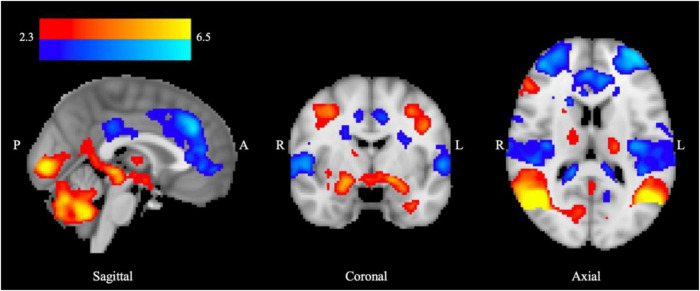
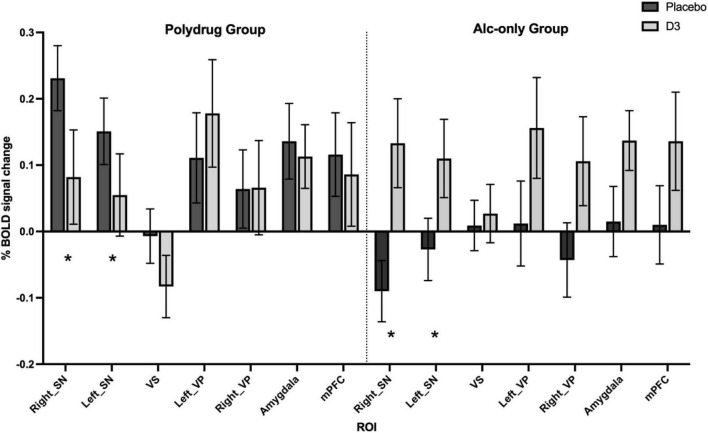
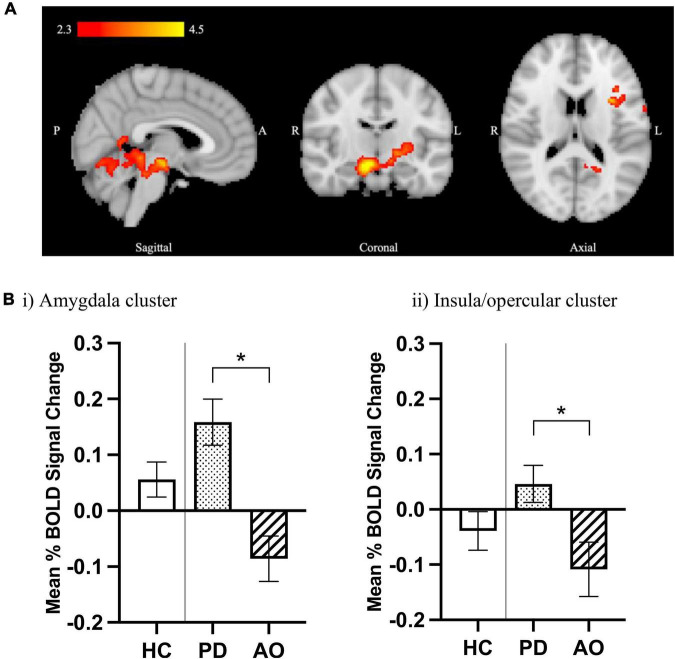
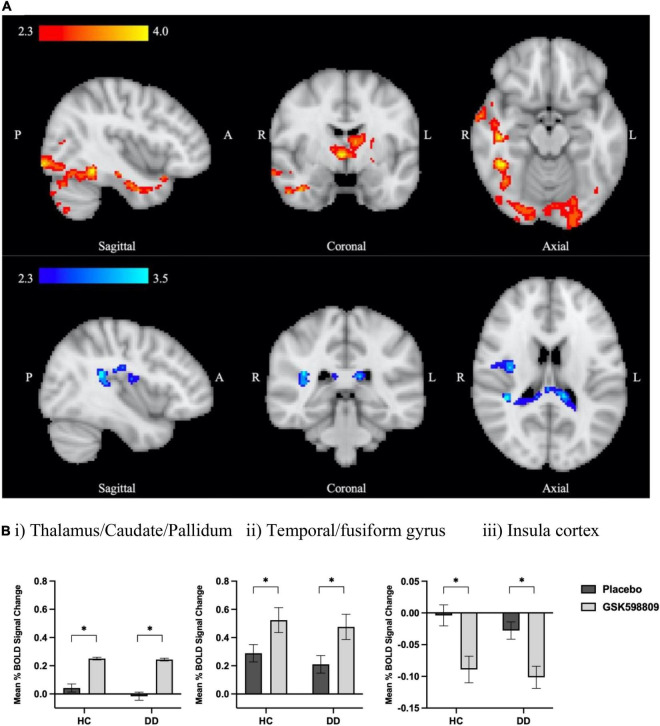
No group differences in task-related BOLD signal were identified between DD and controls. However, subgroup analysis revealed greater amygdala/insular BOLD signal in PD compared with AO groups. Following drug administration, GSK598809 increased BOLD response across HC and DD groups in thalamus, caudate, putamen, and pallidum, and reduced BOLD response in insular and opercular cortices relative to placebo. Multivariate analyses in ROIs revealed differential effects of D3 antagonism according to subgroup in substantia nigra; GSK598809 increased BOLD response in AO and decreased response in PD groups.
Acute GSK598809 modulates the BOLD response to aversive image processing, providing evidence that D3 antagonism may impact emotional regulation. Enhanced BOLD response within D3-rich mesolimbic regions is consistent with its pharmacology and with attenuation of substance-related hypodopaminergic function. However, the lack of group differences in task-related BOLD response and the non-specific effect of GSK598809 between groups makes it difficult to ascertain whether D3 antagonism is likely to be normalising or restorative in our abstinent populations. The suggestion of differential D3 modulation between AO and PD subgroups is intriguing, raising the possibility of divergent treatment responses. Further study is needed to determine whether D3 antagonism should be recommended as a treatment target in substance dependence.
消极情绪状态促成了成瘾的慢性复发性本质。中脑边缘多巴胺D3受体在调节情绪方面具有重要作用,且在物质依赖中功能失调。选择性拮抗剂可能恢复多巴胺能功能减退,因此代表了一个潜在的治疗靶点。我们研究了选择性D3拮抗剂GSK598809对物质依赖个体和健康对照者负性情绪加工神经反应的影响。
在一项唤起性图像任务期间,采用多中心、双盲、伪随机、交叉设计,在急性给予GSK598809(60毫克)或安慰剂2小时后,评估功能磁共振成像血氧水平依赖(BOLD)反应。将戒断的药物依赖个体(DD,n = 36)分为仅酒精依赖组(AO,n = 19)和可卡因 - 酒精多药依赖组(PD,n = 17),并与匹配的对照组(n = 32)进行区组设计,呈现厌恶和中性图像(感兴趣的对比:厌恶>中性)。全脑混合效应和感兴趣区(ROI)分析测试组间和药物效应,采用相同模型探索亚组效应。
DD组和对照组之间未发现与任务相关的BOLD信号存在组间差异。然而,亚组分析显示,与AO组相比,PD组杏仁核/岛叶的BOLD信号更强。给药后,与安慰剂相比,GSK-598809增加了丘脑、尾状核、壳核和苍白球中健康对照者和药物依赖者组的BOLD反应,并降低了岛叶和 opercular 皮质的BOLD反应。在感兴趣区的多变量分析显示,根据黑质亚组,D3拮抗作用存在差异效应;GSK598809增加了AO组的BOLD反应,降低了PD组的反应。
急性给予GSK598809可调节对厌恶图像加工的BOLD反应,这表明D3拮抗作用可能影响情绪调节。富含D3的中脑边缘区域BOLD反应增强与其药理学以及物质相关的多巴胺能功能减退的减轻相一致。然而任务相关BOLD反应缺乏组间差异以及GSK598809在组间的非特异性效应使得难以确定D3拮抗作用在我们的戒断人群中是否可能是正常化或恢复性的。AO组和PD亚组之间D3调节差异的提示很有趣,这增加了不同治疗反应的可能性。需要进一步研究以确定D3拮抗作用是否应被推荐为物质依赖的治疗靶点。