Etheridge Jody, Slade Pauline
Alder Hey Children's NHS Foundation Trust, Eaton Road, West Derby, Liverpool, L12 2AP, UK.
Institute of Psychology Health and Society, Whelan Building, The Quadrangle, Brownlow Hill, Liverpool, L69 3GB, UK.
BMC Pregnancy Childbirth. 2017 Mar 7;17(1):80. doi: 10.1186/s12884-017-1259-y.
Given the limited research into men's experiences of being present at childbirth this study explored the experiences of fathers who found childbirth traumatic. The aim of the research was to investigate how men coped with these experiences; the impact on their lives; and their views on what may have helped to reduce distress.
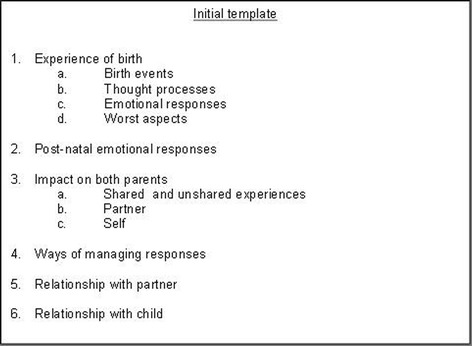
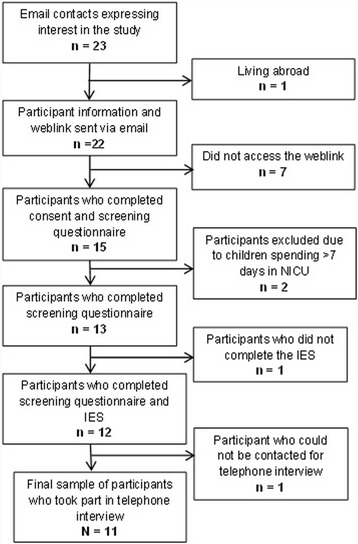
Participants were recruited via websites relating to birth trauma and parenthood. A consent and screening questionnaire was used to ensure that participants met the inclusion criteria of: being resident in the UK; being 16 years or older; having been present at the birth and answering yes to the question "At some point during the childbirth I experienced feelings of intense fear, helplessness or horror". Semi-structured telephone interviews were completed with 11 fathers who reported finding childbirth traumatic. Participants also completed the Impact of Event Scale as a measure of trauma symptoms. Template Analysis was used to analyse the interview data.
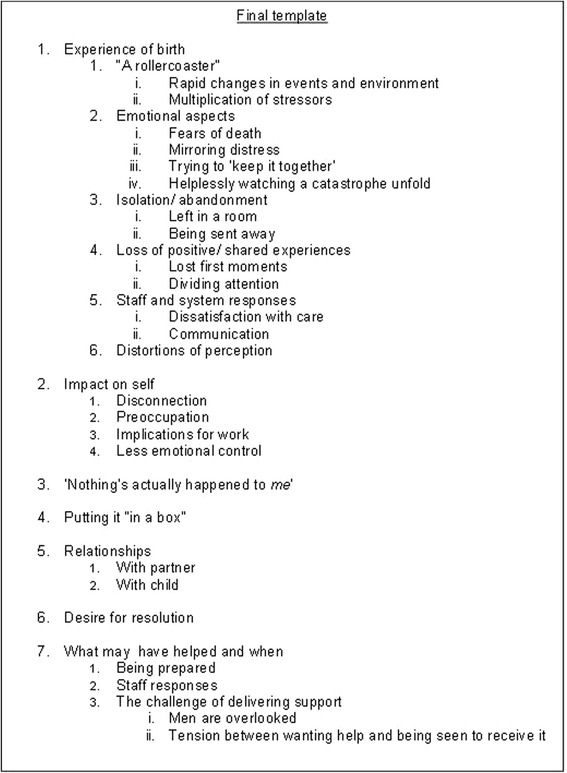
Childbirth was experienced as "a rollercoaster of emotion" because of the speed and unexpectedness of events. Men described fears of death, mirroring their partner's distress; trying 'to keep it together' and helplessly watching a catastrophe unfold. Fathers felt themselves abandoned by staff with a lack of information. Men were subsequently distressed and preoccupied with the birth events but tended to feel that their responses were unjustified and tried to cope through avoidance. Men described the need for support but reluctance to receive it.
Fathers may experience extreme distress as a result of childbirth which is exacerbated by aspects of current maternity care. Maternity services need to be aware of the potential impacts of fathers' attendance at childbirth and attend to fathers', as well as mothers', emotional responses.
鉴于对男性分娩陪产经历的研究有限,本研究探讨了那些认为分娩具有创伤性的父亲们的经历。该研究的目的是调查男性如何应对这些经历;对他们生活的影响;以及他们对于可能有助于减轻痛苦的因素的看法。
通过与分娩创伤和为人父母相关的网站招募参与者。使用一份同意书和筛查问卷,以确保参与者符合以下纳入标准:居住在英国;年龄在16岁及以上;在分娩时在场,并且对“在分娩过程中的某个时刻,我经历了强烈的恐惧、无助或恐惧情绪”这一问题回答“是”。对11名报告称分娩具有创伤性的父亲进行了半结构化电话访谈。参与者还完成了事件影响量表,作为创伤症状的一种测量。采用模板分析法对访谈数据进行分析。
由于事件的快速发展和意外性,分娩被体验为“情绪的过山车”。男性描述了对死亡的恐惧,反映出他们伴侣的痛苦;努力“保持镇定”,却无助地看着灾难发生。父亲们感到自己被医护人员抛弃,得不到信息。随后,男性因分娩事件而痛苦并念念不忘,但往往觉得自己的反应不合理,并试图通过回避来应对。男性表示需要支持,但又不愿接受。
父亲们可能会因分娩而经历极度痛苦,而当前产科护理的某些方面会加剧这种痛苦。产科服务需要意识到父亲陪产可能产生的影响,并关注父亲以及母亲的情绪反应。