Sakane Naoki, Sato Juichi, Tsushita Kazuyo, Tsujii Satoru, Kotani Kazuhiko, Tominaga Makoto, Kawazu Shoji, Sato Yuzo, Usui Takeshi, Kamae Isao, Yoshida Toshihide, Kiyohara Yutaka, Sato Shigeaki, Tsuzaki Kokoro, Nirengi Shinsuke, Takahashi Kaoru, Kuzuya Hideshi, Group Jdpp Research
Division of Preventive Medicine, Clinical Research Institute, National Hospital Organization Kyoto Medical Center, Kyoto, Japan.
Department of General Medicine/Family & Community Medicine, University Graduate School of Medicine, Nagoya, Japan.
J Clin Med Res. 2017 Apr;9(4):360-365. doi: 10.14740/jocmr2928w. Epub 2017 Feb 21.
Limited evidence is available about the relationship of lifestyle factors with glycated hemoglobin (HbA1c) in subjects with impaired glucose tolerance. The aim of study was to identify such determinant factors of HbA1c in subjects with impaired glucose tolerance.
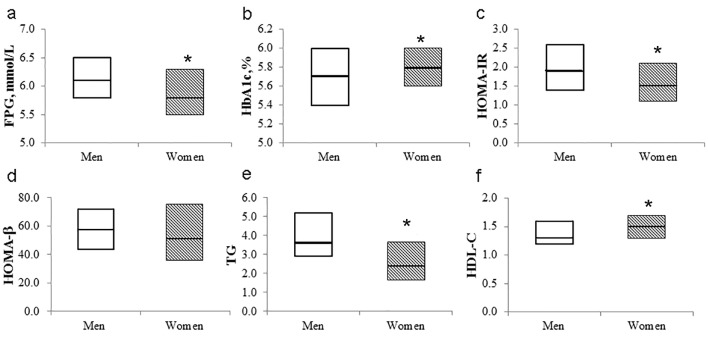
This cross-sectional study included 121 men and 124 women with impaired glucose tolerance, who were diagnosed based on a 75-g oral glucose tolerance test. Demographic and biochemical parameters, including the body mass index (BMI), fasting plasma glucose (FPG), 2-h post-load glucose (2-h PG), and HbA1c, were measured. The pancreatic β-cell function and insulin resistance were assessed using homeostasis model assessment (HOMA-β). Dietary intake was assessed by a food frequency questionnaire.
The levels of FPG, 2-h PG, and carbohydrate intake were correlated with the HbA1c level in men, while the FPG and 2-h PG levels were correlated with the HbA1c level in women. In multiple regression analyses, BMI, FPG, 2-h PG, and white rice intake were associated with HbA1c levels in men, while BMI, FPG, HOMA-β, and bread intake were associated with HbA1c levels in women.
The present findings suggest that a substantial portion of HbA1c may be composed of not only glycemic but also several lifestyle factors in men with impaired glucose tolerance. These factors can be taken into consideration as modifiable determinants in assessing the HbA1c level for the diagnosis and therapeutic monitoring of the disease course.
关于糖耐量受损患者生活方式因素与糖化血红蛋白(HbA1c)之间的关系,现有证据有限。本研究的目的是确定糖耐量受损患者中HbA1c的此类决定因素。
这项横断面研究纳入了121名男性和124名糖耐量受损女性,他们是根据75克口服葡萄糖耐量试验确诊的。测量了人口统计学和生化参数,包括体重指数(BMI)、空腹血糖(FPG)、负荷后2小时血糖(2-h PG)和HbA1c。使用稳态模型评估(HOMA-β)评估胰腺β细胞功能和胰岛素抵抗。通过食物频率问卷评估饮食摄入量。
男性的FPG、2-h PG水平和碳水化合物摄入量与HbA1c水平相关,而女性的FPG和2-h PG水平与HbA1c水平相关。在多元回归分析中,BMI、FPG、2-h PG和白米摄入量与男性的HbA1c水平相关,而BMI、FPG、HOMA-β和面包摄入量与女性的HbA1c水平相关。
目前的研究结果表明,在糖耐量受损的男性中,很大一部分HbA1c可能不仅由血糖组成,还由多种生活方式因素组成。在评估HbA1c水平以用于疾病进程的诊断和治疗监测时,这些因素可作为可改变的决定因素加以考虑。