Park Ji Eun, Chun Se-Eun, Reichel Derek, Min Jee Sun, Lee Su-Chan, Han Songhee, Ryoo Gongmi, Oh Yunseok, Park Shin-Hyung, Ryu Heon-Min, Kim Kyung Bo, Lee Ho-Young, Bae Soo Kyung, Bae Younsoo, Lee Wooin
College of Pharmacy and Research Institute of Pharmaceutical Sciences, Seoul National University, Seoul, South Korea.
Department of Pharmaceutical Sciences, College of Pharmacy, University of Kentucky, Lexington, Kentucky, United States of America.
PLoS One. 2017 Mar 8;12(3):e0173247. doi: 10.1371/journal.pone.0173247. eCollection 2017.
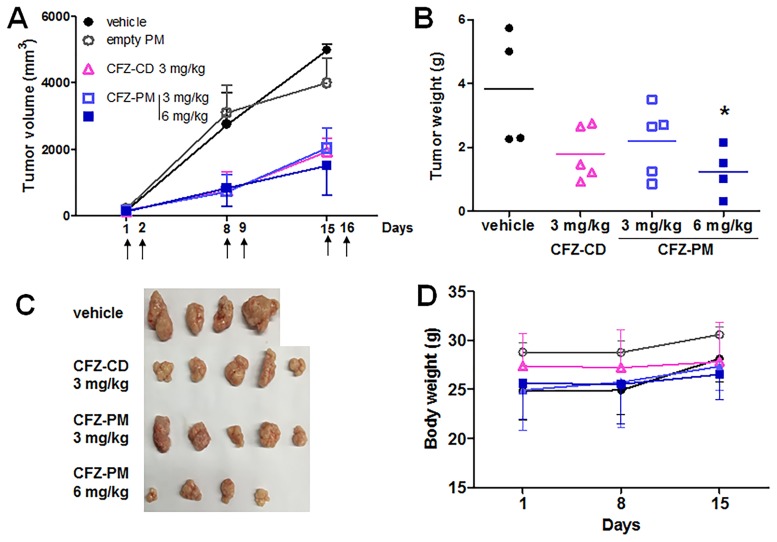
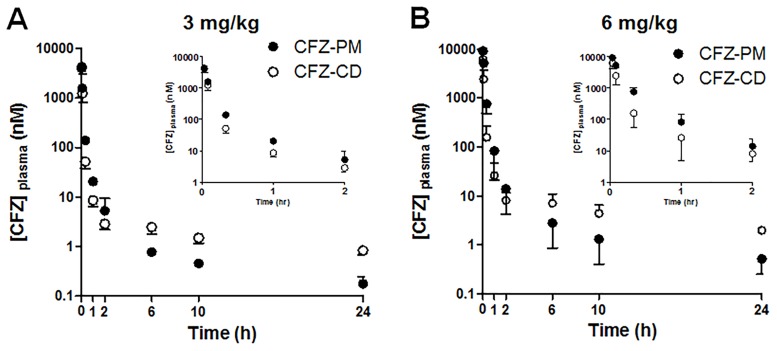
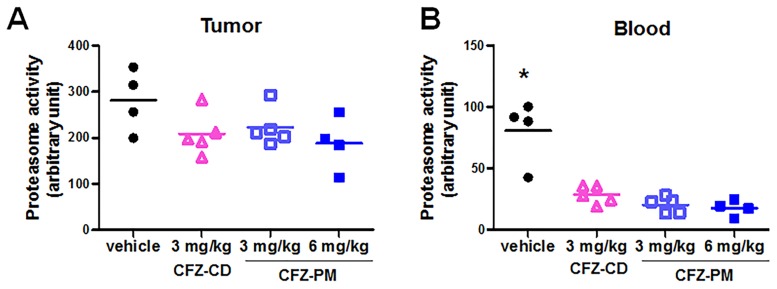
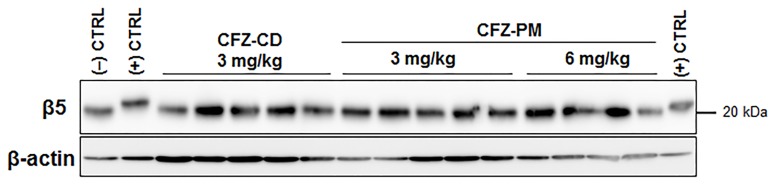
Carfilzomib (CFZ) is a peptide epoxyketone proteasome inhibitor approved for the treatment of multiple myeloma (MM). Despite the remarkable efficacy of CFZ against MM, the clinical trials in patients with solid cancers yielded rather disappointing results with minimal clinical benefits. Rapid degradation of CFZ in vivo and its poor penetration to tumor sites are considered to be major factors limiting its efficacy against solid cancers. We previously reported that polymer micelles (PMs) composed of biodegradable block copolymers poly(ethylene glycol) (PEG) and poly(caprolactone) (PCL) can improve the metabolic stability of CFZ in vitro. Here, we prepared the CFZ-loaded PM, PEG-PCL-deoxycholic acid (CFZ-PM) and assessed its in vivo anticancer efficacy and pharmacokinetic profiles. Despite in vitro metabolic protection of CFZ, CFZ-PM did not display in vivo anticancer efficacy in mice bearing human lung cancer xenograft (H460) superior to that of the clinically used cyclodextrin-based CFZ (CFZ-CD) formulation. The plasma pharmacokinetic profiles of CFZ-PM were also comparable to those of CFZ-CD and the residual tumors that persisted in xenograft mice receiving CFZ-PM displayed an incomplete proteasome inhibition. In summary, our results showed that despite its favorable in vitro performances, the current CFZ-PM formulation did not improve in vivo anticancer efficacy and accessibility of active CFZ to solid cancer tissues over CFZ-CD. Careful consideration of the current results and potential confounding factors may provide valuable insights into the future efforts to validate the potential of CFZ-based therapy for solid cancer and to develop effective CFZ delivery strategies that can be used to treat solid cancers.
卡非佐米(CFZ)是一种已被批准用于治疗多发性骨髓瘤(MM)的肽环氧酮蛋白酶体抑制剂。尽管CFZ对MM具有显著疗效,但在实体癌患者中进行的临床试验结果却相当令人失望,临床获益微乎其微。CFZ在体内的快速降解及其对肿瘤部位的低渗透性被认为是限制其对实体癌疗效的主要因素。我们之前报道过,由可生物降解的嵌段共聚物聚乙二醇(PEG)和聚己内酯(PCL)组成的聚合物胶束(PMs)可以在体外提高CFZ的代谢稳定性。在此,我们制备了负载CFZ的PM,即聚乙二醇-聚己内酯-脱氧胆酸(CFZ-PM),并评估了其体内抗癌疗效和药代动力学特征。尽管CFZ在体外具有代谢保护作用,但CFZ-PM在携带人肺癌异种移植瘤(H460)的小鼠体内并未显示出优于临床使用的基于环糊精的CFZ(CFZ-CD)制剂的抗癌疗效。CFZ-PM的血浆药代动力学特征也与CFZ-CD相当,并且在接受CFZ-PM治疗的异种移植小鼠中持续存在的残留肿瘤显示出不完全的蛋白酶体抑制作用。总之,我们的结果表明,尽管CFZ-PM在体外表现良好,但目前的CFZ-PM制剂在体内抗癌疗效以及活性CFZ对实体癌组织的可及性方面并未比CFZ-CD有所改善。仔细考虑当前结果和潜在的混杂因素可能会为未来验证基于CFZ的实体癌治疗潜力以及开发可用于治疗实体癌的有效CFZ递送策略的努力提供有价值的见解。