Salaheldin Ahmed H, Veits Jutta, Abd El-Hamid Hatem S, Harder Timm C, Devrishov Davud, Mettenleiter Thomas C, Hafez Hafez M, Abdelwhab Elsayed M
Institute of Poultry Diseases, Free University of Berlin, Königsweg 63, 14163, Berlin, Germany.
Department of Poultry Diseases, Faculty of Veterinary Medicine, Alexandria University, Alexandria, Egypt.
Virol J. 2017 Mar 9;14(1):48. doi: 10.1186/s12985-017-0697-5.
Vaccination of poultry to control highly pathogenic avian influenza virus (HPAIV) H5N1 is used in several countries. HPAIV H5N1 of clade 2.2.1 which is endemic in Egypt has diversified into two genetic clades. Clade 2.2.1.1 represents antigenic drift variants in vaccinated commercial poultry while clade 2.2.1.2 variants are detected in humans and backyard poultry. Little is known about H5N1 infection in vaccinated turkeys under field conditions.
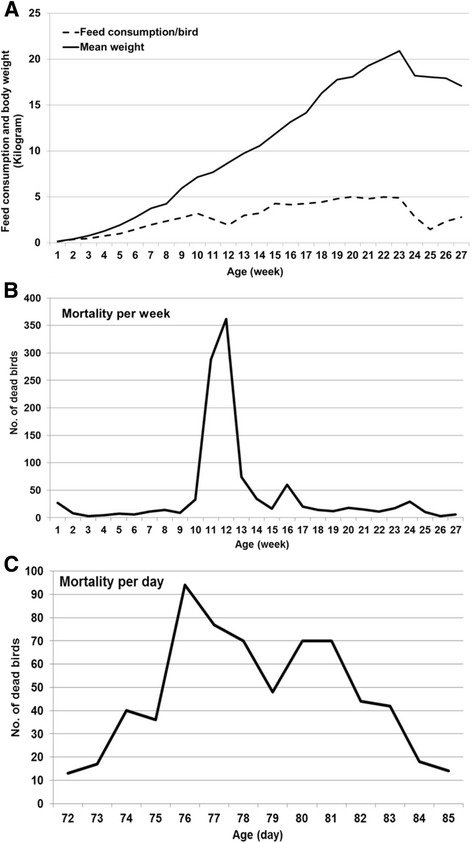
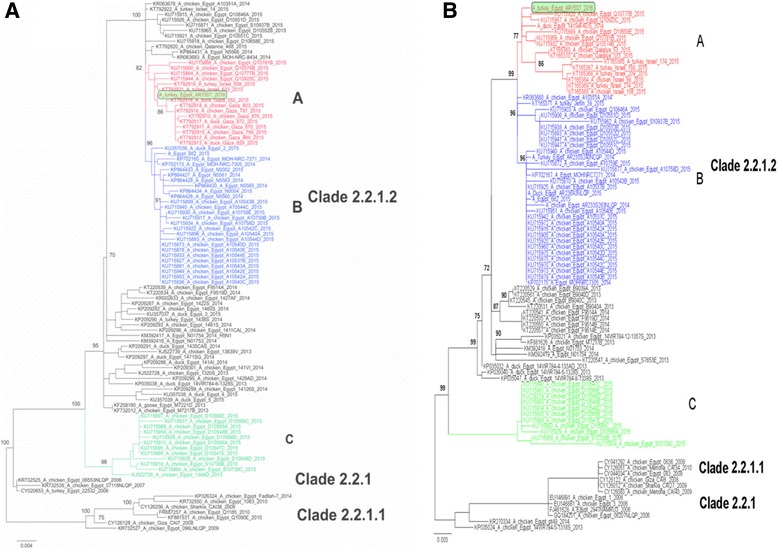
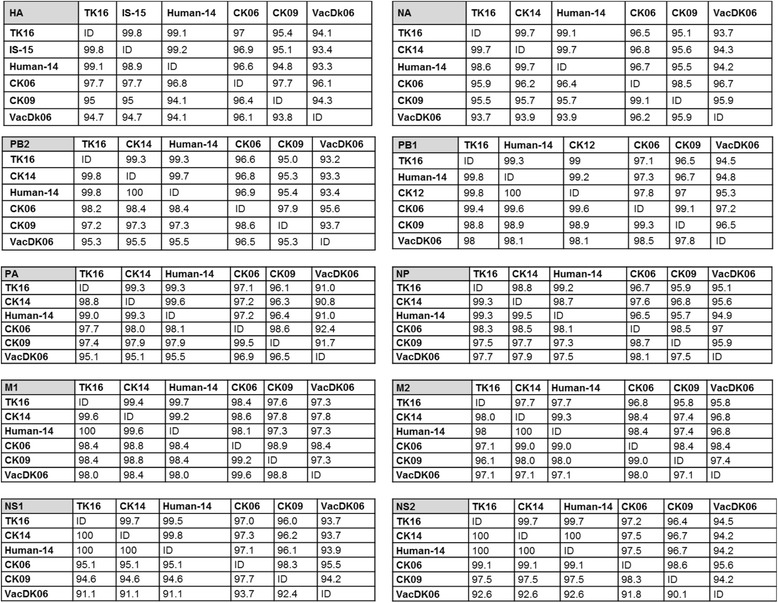
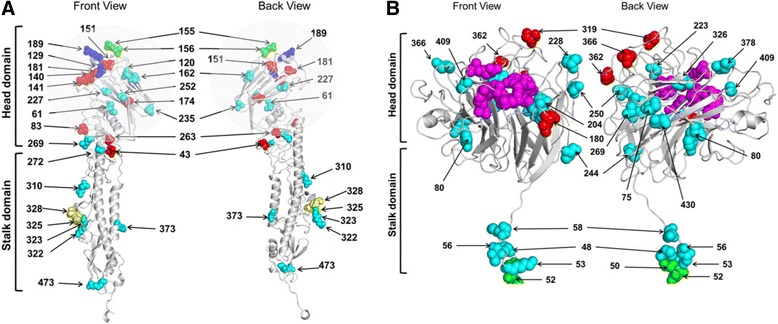
Here, we describe an HPAI H5N1 outbreak in a vaccinated meat-turkey flock in Egypt. Birds were vaccinated with inactivated H5N2 and H5N1 vaccines at 8 and 34 days of age, respectively. At 72 day of age (38 days post last vaccination), turkeys exhibited mild respiratory signs, cyanosis of snood and severe congestion of the internal organs. Survivors had a reduction in feed consumption and body gain. A mortality of ~29% cumulated within 10 days after the onset of clinical signs. Laboratory diagnosis using RT-qPCRs revealed presence of H5N1 but was negative for H7 and H9 subtypes. A substantial antigenic drift against different serum samples from clade 2.2.1.1 and clade 2.3.4.4 was observed. Based on full genome sequence analysis the virus belonged to clade 2.2.1.2 but clustered with recent H5N1 viruses from 2015 in poultry in Israel, Gaza and Egypt in a novel subclade designated here 2.2.1.2a which is distinct from 2014/2015 2.2.1.2 viruses. These viruses possess 2.2.1.2 clade-specific genetic signatures and also mutations in the HA similar to those in clade 2.2.1.1 that enabled evasion from humoral immune response. Taken together, this manuscript describes a recent HPAI H5N1 outbreak in vaccinated meat-turkeys in Egypt after infection with a virus representing novel distinct 2.2.1.2a subclade.
Infection with HPAIV H5N1 in commercial turkeys resulted in significant morbidity and mortality despite of vaccination using H5 vaccines. The isolated virus showed antigenic drift and clustered in a novel cluster designated here 2.2.1.2a related to viruses in poultry in Israel, Gaza and Egypt. Enforcement of biosecurity and constant update of vaccine virus strains may be helpful to protect vaccinated birds and prevent spillover infection to neighbouring countries.
多个国家采用家禽接种疫苗的方式来防控高致病性禽流感病毒(HPAIV)H5N1。在埃及呈地方性流行的2.2.1进化枝的HPAIV H5N1已分化为两个遗传分支。2.2.1.1分支代表接种疫苗的商业家禽中的抗原漂移变异株,而2.2.1.2分支变异株在人类和后院家禽中被检测到。关于野外条件下接种疫苗的火鸡感染H5N1的情况知之甚少。
在此,我们描述了埃及一个接种疫苗的肉用火鸡群中发生的HPAI H5N1疫情。这些火鸡分别在8日龄和34日龄时接种了灭活的H5N2和H5N1疫苗。在72日龄(最后一次接种疫苗后38天)时,火鸡出现轻微呼吸道症状、肉垂发绀和内脏严重充血。存活的火鸡采食量和体重增加量减少。临床症状出现后10天内累计死亡率约为29%。使用逆转录定量聚合酶链反应(RT-qPCR)进行实验室诊断显示存在H5N1,但H7和H9亚型呈阴性。观察到与2.2.1.1分支和2.3.4.4分支的不同血清样本存在明显的抗原漂移。基于全基因组序列分析,该病毒属于2.2.1.2分支,但在一个新的亚分支中与2015年以色列、加沙和埃及家禽中最近的H5N1病毒聚集在一起,在此命名为2.2.1.2a,它与2014/2015年 的病毒不同。这些病毒具有2.2.1.2分支特异性的基因特征,并且血凝素(HA)中也存在与2.2.1.1分支中相似的突变,从而能够逃避体液免疫反应。综上所述,本手稿描述了埃及接种疫苗的肉用火鸡在感染代表新的独特2.2.1.2a亚分支的病毒后最近发生的HPAI H5N1疫情。
尽管接种了H5疫苗,但商业火鸡感染HPAIV H5N1仍导致了显著的发病率和死亡率。分离出的病毒显示出抗原漂移,并聚集在一个新的簇中,在此命名为2.2.1.2a,与以色列、加沙和埃及家禽中的病毒有关。加强生物安全措施和不断更新疫苗病毒株可能有助于保护接种疫苗的禽类,并防止病毒传播到邻国。