Furler John, O'Neal David, Speight Jane, Manski-Nankervis Jo-Anne, Gorelik Alexandra, Holmes-Truscott Elizabeth, Ginnivan Louise, Young Doris, Best James, Patterson Elizabeth, Liew Danny, Segal Leonie, May Carl, Blackberry Irene
Department of General Practice, University of Melbourne, Carlton, Melbourne, VIC, 3053, Australia
Department of Medicine, St Vincent's Hospital, University of Melbourne, Melbourne, Australia.
BMJ. 2017 Mar 8;356:j783. doi: 10.1136/bmj.j783.
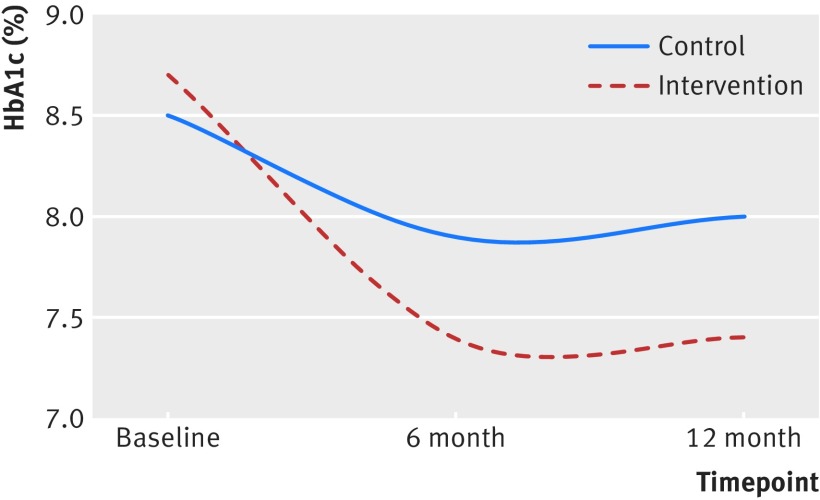
To compare the effectiveness of a novel model of care ("Stepping Up") with usual primary care in normalising insulin initiation for type 2 diabetes, leading to improved glycated haemoglobin (HbA1c) levels. Cluster randomised controlled trial. Primary care practices in Victoria, Australia, with a practice nurse and at least one consenting eligible patient (HbA1c ≥7.5% with maximal oral treatment). 266 patients with type 2 diabetes and 74 practices (mean cluster size 4 (range 1-8) patients), followed up for 12 months. The Stepping Up model of care intervention involved theory based change in practice systems and reorientation of the roles of health professionals in the primary care diabetes team. The core components were an enhanced role for the practice nurse in leading insulin initiation and mentoring by a registered nurse with diabetes educator credentials. The primary endpoint was change in HbA1c. Secondary endpoints included the proportion of participants who transitioned to insulin, proportion who achieved target HbA1c, and a change in depressive symptoms (patient health questionnaire, PHQ-9), diabetes specific distress (problem areas in diabetes scale, PAID), and generic health status (assessment of quality of life instrument, AQoL-8D). HbA1c improved in both arms, with a clinically significant between arm difference (mean difference -0.6%, 95% confidence interval -0.9% to -0.3%), favouring the intervention. At 12 months, in intervention practices, 105/151 (70%) of participants had started insulin, compared with 25/115 (22%) in control practices (odds ratio 8.3, 95% confidence interval 4.5 to 15.4, P<0.001). Target HbA1c (≤7% (53 mmol/mol)) was achieved by 54 (36%) intervention participants and 22 (19%) control participants (odds ratio 2.2, 1.2 to 4.3, P=0.02). Depressive symptoms did not worsen at 12 months (PHQ-9: -1.1 (3.5) -0.1 (2.9), P=0.05). A statistically significant difference was found between arms in the mean change in mental health (AQoL mental component summary: 0.04 (SD 0.16) -0.002 (0.13), mean difference 0.04 (95% confidence interval 0.002 to 0.08), P=0.04), favouring the intervention, but no significant difference in physical health (AQoL physical component summary: 0.03 (0.15) 0.02 (0.13)) nor diabetes specific distress (5.6 (15.5) -2.4 (15.4)). No severe hypoglycaemia events were reported. The Stepping Up model of care was associated with increased insulin initiation rates in primary care, and improvements in glycated haemoglobin without worsening emotional wellbeing. Australian and New Zealand Clinical Trials Registry ACTRN12612001028897.
为比较一种新型护理模式(“逐步推进”)与常规初级护理在使2型糖尿病患者胰岛素起始治疗正常化方面的效果,从而改善糖化血红蛋白(HbA1c)水平。整群随机对照试验。澳大利亚维多利亚州的初级护理机构,配备一名执业护士以及至少一名同意参与的符合条件患者(口服最大剂量治疗时HbA1c≥7.5%)。266例2型糖尿病患者和74个机构(平均每组规模为4名患者(范围1 - 8名)),随访12个月。“逐步推进”护理模式干预包括基于理论的实践系统变革以及初级护理糖尿病团队中卫生专业人员角色的重新定位。核心组成部分是执业护士在主导胰岛素起始治疗方面的强化作用以及由具备糖尿病教育者资质的注册护士进行指导。主要终点是HbA1c的变化。次要终点包括转为使用胰岛素的参与者比例、达到目标HbA1c的比例以及抑郁症状(患者健康问卷,PHQ - 9)、糖尿病特异性困扰(糖尿病问题领域量表,PAID)和一般健康状况(生活质量评估工具,AQoL - 8D)的变化。两组的HbA1c均有所改善,组间存在临床显著差异(平均差异 -0.6%,95%置信区间 -0.9%至 -0.3%),干预组更具优势。在12个月时,干预机构中105/151(70%)的参与者开始使用胰岛素,而对照机构中为25/115(22%)(优势比8.3,95%置信区间4.5至15.4,P<0.001)。54名(36%)干预组参与者和22名(19%)对照组参与者达到目标HbA1c(≤7%(53 mmol/mol))(优势比2.2,1.2至4.3,P = 0.02)。12个月时抑郁症状未加重(PHQ - 9:-1.1(3.5) -0.1(2.9),P = 0.05)。两组在心理健康的平均变化方面存在统计学显著差异(AQoL心理健康成分总结:0.04(标准差0.16) -0.002(0.13),平均差异0.04(95%置信区间0.002至0.08),P = 0.04),干预组更具优势,但在身体健康方面(AQoL身体成分总结:0.03(0.15) 0.02(0.13))以及糖尿病特异性困扰方面(5.6(15.5) -2.4(15.4))无显著差异。未报告严重低血糖事件。“逐步推进”护理模式与初级护理中胰岛素起始率增加以及糖化血红蛋白改善相关,且未使情绪健康状况恶化。澳大利亚和新西兰临床试验注册中心ACTRN12612001028897 。