Pan Huipeng, Yang Xiaowei, Bidne Keith, Hellmich Richard L, Siegfried Blair D, Zhou Xuguo
Key Laboratory of Bio-Pesticide Innovation and Application of Guangdong Province, Department of Entomology, South China Agricultural UniversityGuangzhou, China; Department of Entomology, University of KentuckyLexington, KY, USA.
Department of Entomology, University of Kentucky Lexington, KY, USA.
Front Plant Sci. 2017 Feb 22;8:242. doi: 10.3389/fpls.2017.00242. eCollection 2017.
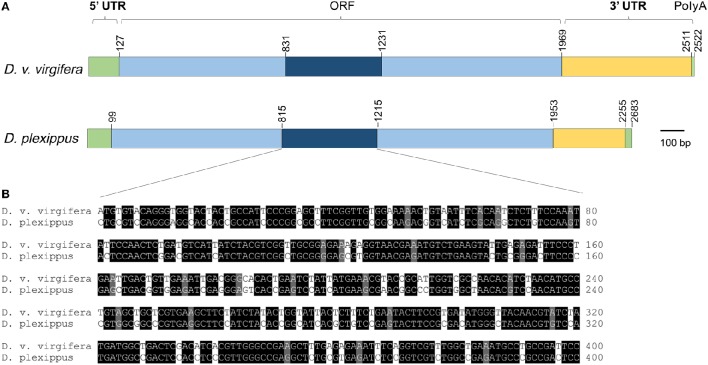
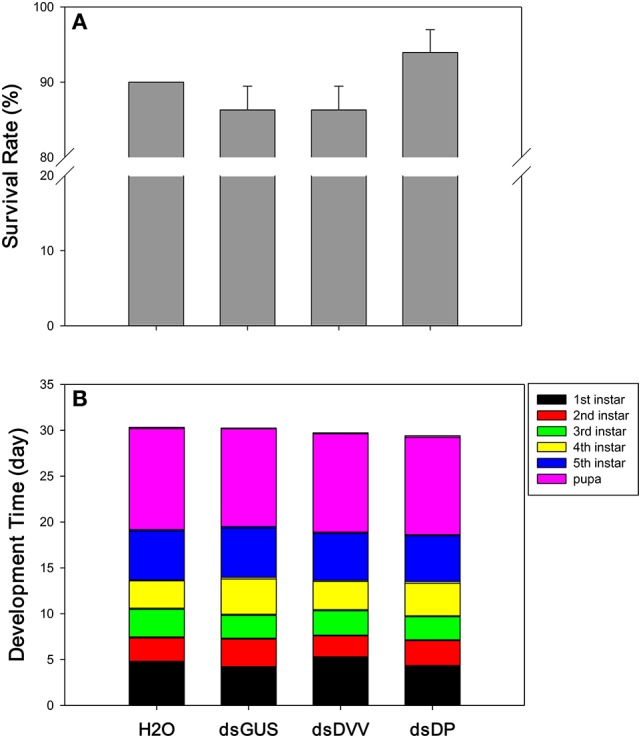
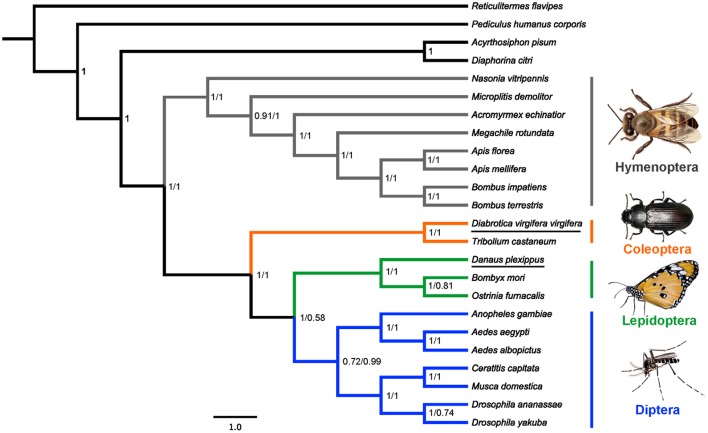
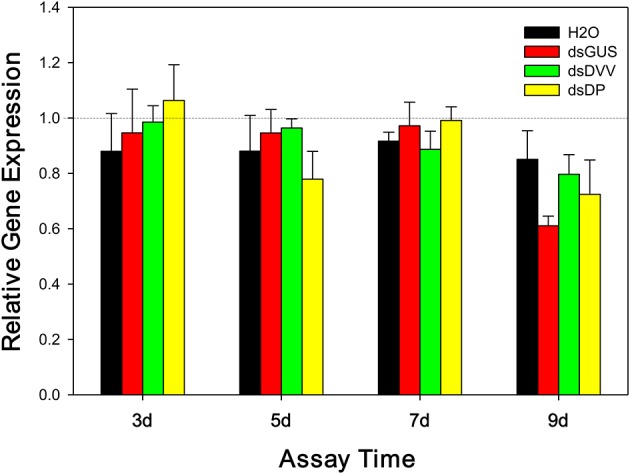
By suppressing the expression of genes with essential biological functions, RNAi can negatively affect the development and survival of target pests. As a part of a concerted effort to assess the risks of RNAi transgenic crops on non-target organisms, we developed an toxicity assay to examine the impacts of ingested dsRNAs incurred to the monarch butterfly, (L.), an iconic eco-indicator in North America. To create the worst case scenario, the full-length cDNAs from the target pest, western corn rootworm, , and the non-target were respectively cloned. A 400 bp fragment with the highest sequence similarity between the two species was used as the template to synthesize dsRNAs for the subsequent dietary RNAi toxicity assay. Specifically, newly hatched neonates were provisioned with leaf disks surface-coated with dsRNAs synthesized from and , respectively, a control dsRNA, β, from plants, and HO. The endpoint measurements included gene expressions and life history traits. The 2283 bp cDNA contains a 99 bp 5'-untranslated region, a 330 bp 3'-untranslated region, and an 1851 bp ORF encoding 617 amino acids. The temporal RNAi study did not detect any impact to expression by the assay days and treatments. This was reflected in the phenotypic impacts of dietary RNAi, in which both survival rate and development time were not affected by the uptake of ingested dsRNAs. These combined results suggest that larvae are not susceptible to dietary RNAi, therefore, the impact of transgenic RNAi plants on this non-target organism is, likely, negligible.
通过抑制具有重要生物学功能的基因表达,RNA干扰会对目标害虫的发育和生存产生负面影响。作为评估RNA干扰转基因作物对非目标生物风险的协同努力的一部分,我们开发了一种毒性测定方法,以研究摄入的双链RNA对北美标志性生态指示物种黑脉金斑蝶(Danaus plexippus L.)的影响。为了创造最坏的情况,分别克隆了目标害虫西部玉米根虫(Diabrotica virgifera virgifera)和非目标物种的全长cDNA。使用两个物种之间序列相似性最高的400 bp片段作为模板来合成双链RNA,用于后续的饮食RNA干扰毒性测定。具体而言,给新孵化的幼虫分别提供表面涂有从西部玉米根虫和黑脉金斑蝶合成的双链RNA、来自植物的对照双链RNAβ-葡糖醛酸酶(β-glucuronidase, β-GUS)以及水(HO)的叶盘。终点测量包括基因表达和生活史特征。2283 bp的黑脉金斑蝶cDNA包含一个99 bp的5'非翻译区、一个330 bp的3'非翻译区以及一个编码617个氨基酸的1851 bp开放阅读框。时间性RNA干扰研究在测定天数和处理中未检测到对黑脉金斑蝶基因表达的任何影响。这反映在饮食RNA干扰的表型影响中,即存活率和发育时间均未受到摄入双链RNA的影响。这些综合结果表明,黑脉金斑蝶幼虫对饮食RNA干扰不敏感,因此,转基因RNA干扰植物对这种非目标生物的影响可能微不足道。