Keiner Silke, Niv Fanny, Neumann Susanne, Steinbach Tanja, Schmeer Christian, Hornung Katrin, Schlenker Yvonne, Förster Martin, Witte Otto W, Redecker Christoph
Hans Berger Department of Neurology, Jena University Hospital, Am Klinikum 1, 07747, Jena, Germany.
Department of Cardiothoracic Surgery, Jena University Hospital, Am Klinikum 1, 07747, Jena, Germany.
BMC Neurosci. 2017 Mar 9;18(1):31. doi: 10.1186/s12868-017-0347-2.
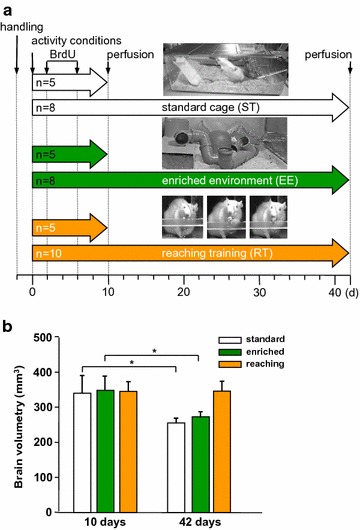
Increased motor activity or social interactions through enriched environment are strong stimulators of grey and white matter plasticity in the adult rodent brain. In the present study we evaluated whether specific reaching training of the dominant forelimb (RT) and stimulation of unspecific motor activity through enriched environment (EE) influence the generation of distinct oligodendrocyte subpopulations in the sensorimotor cortex and corpus callosum of the adult rat brain. Animals were placed in three different housing conditions: one group was transferred to an EE, a second group received daily RT, whereas a third group remained in the standard cage. Bromodeoxyuridine (BrdU) was applied at days 2-6 after start of experiments and animals were allowed to survive for 10 and 42 days.
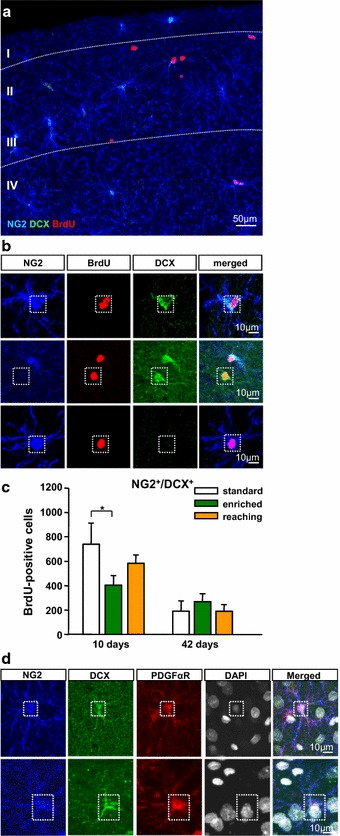
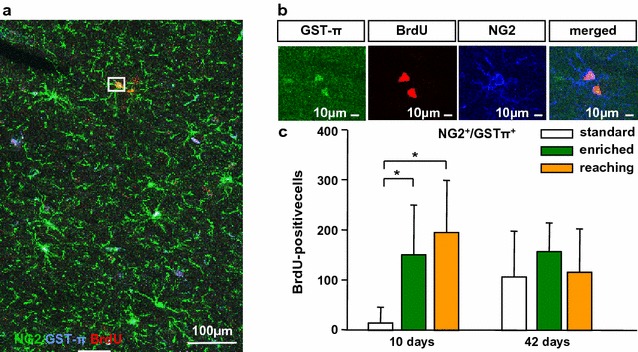
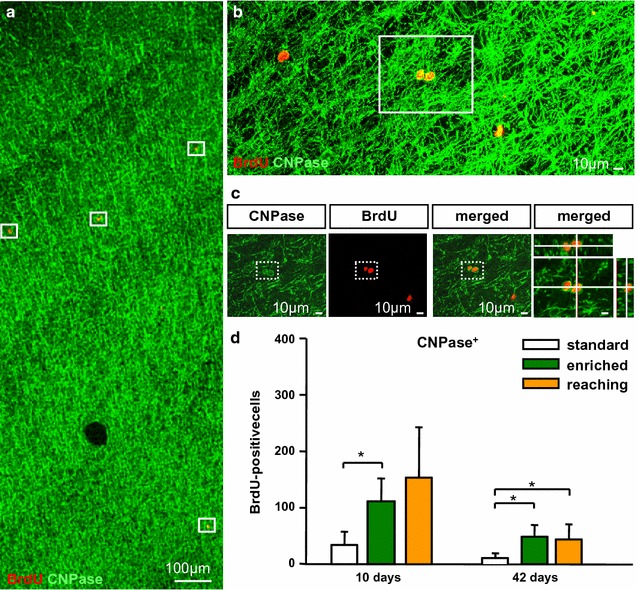
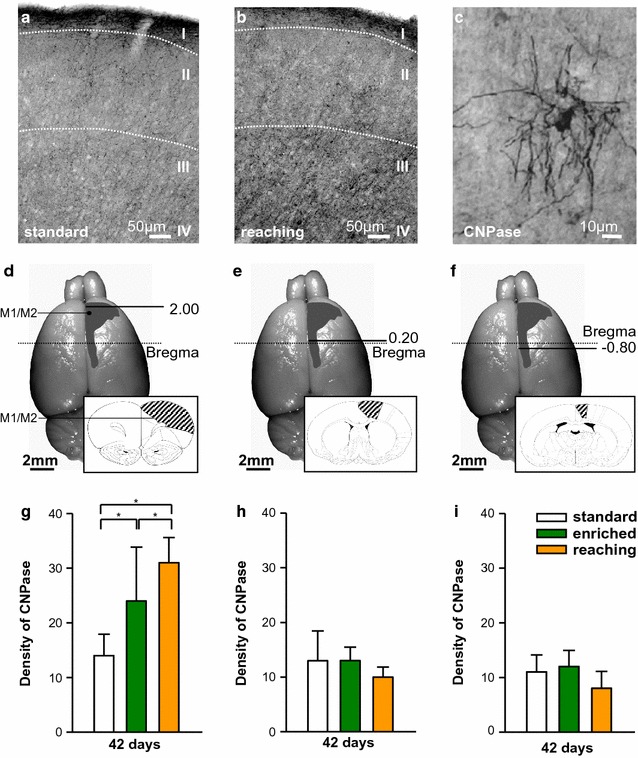
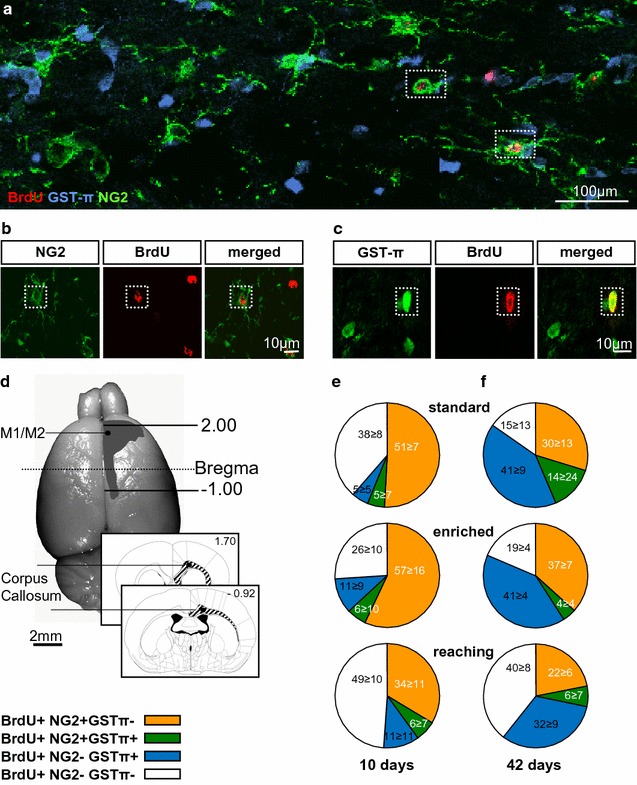
Enriched environment and daily reaching training of the dominant forelimb significantly increased the number of newly differentiated GSTπ oligodendrocytes at day 10 and newly differentiated CNPase oligodendrocytes in the sensorimotor cortex at day 42. The myelin level as measured by CNPase expression was increased in the frontal cortex at day 42. Distribution of newly differentiated NG2 subpopulations changed between 10 and 42 days with an increase of GSTπ subtypes and a decrease of NG2 cells in the sensorimotor cortex and corpus callosum. Analysis of neuronal marker doublecortin (DCX) showed that more than half of NG2 cells express DCX in the cortex. The number of new DCXNG2 cells was reduced by EE at day 10.
Our results indicate for the first time that specific and unspecific motor training conditions differentially alter the process of differentiation from oligodendrocyte subpopulations, in particular NG2DCX cells, in the sensorimotor cortex and corpus callosum.
通过丰富环境增加运动活动或社交互动是成年啮齿动物大脑灰质和白质可塑性的强大刺激因素。在本研究中,我们评估了优势前肢的特定伸展训练(RT)以及通过丰富环境(EE)刺激非特定运动活动是否会影响成年大鼠大脑感觉运动皮层和胼胝体中不同少突胶质细胞亚群的生成。将动物置于三种不同的饲养条件下:一组转移到丰富环境中,第二组每天接受伸展训练,而第三组留在标准笼中。在实验开始后的第2 - 6天应用溴脱氧尿苷(BrdU),并让动物存活10天和42天。
丰富环境和优势前肢的每日伸展训练在第10天显著增加了新分化的谷胱甘肽S转移酶π(GSTπ)少突胶质细胞的数量,在第42天显著增加了感觉运动皮层中新分化的2',3'-环核苷酸3'-磷酸二酯酶(CNPase)少突胶质细胞的数量。在第42天,通过CNPase表达测量的髓鞘水平在额叶皮层中增加。新分化的神经胶质细胞2(NG2)亚群的分布在10天至42天之间发生变化,感觉运动皮层和胼胝体中GSTπ亚型增加,NG2细胞减少。对神经元标志物双皮质素(DCX)的分析表明,超过一半的NG2细胞在皮层中表达DCX。在第10天,丰富环境减少了新的双皮质素阳性神经胶质细胞2(DCX⁺NG2)细胞的数量。
我们的结果首次表明,特定和非特定的运动训练条件会以不同方式改变感觉运动皮层和胼胝体中少突胶质细胞亚群,特别是双皮质素阳性神经胶质细胞2(DCX⁺NG2)细胞的分化过程。